
Évènements passés
Archives du calendrier
-

Dans le cadre de ses midis de l’éthique, le CRÉ reçoit la stagiaire postdoctorale Juliette Roussin, qui offrira une présentation intitulée Juger la démocratie à ses résultats ?
Résumé
En vue d’établir la légitimité de la démocratie par rapport à d’autres régimes, notamment le gouvernement d’un petit nombre de sages ou d’experts, certaines théories politiques normatives avancent des arguments « épistémiques », qui mettent l’accent sur la relation de connaissance particulière que le régime démocratique entretiendrait aux principes d’un bon gouvernement. Mais une justification épistémique de la démocratie peut en réalité s’appuyer sur deux types arguments très différents. Selon le premier argument, positif, les procédures de décision collective propres à la démocratie (vote au suffrage universel égal à la majorité, élections régulières, mécanismes représentatifs et de contrôle, débat public, etc.) favorisent la production de bons résultats politiques avec une probabilité supérieure à celle d’autres méthodes, non démocratiques, de décision. Selon le second, négatif, l’impossibilité de prouver la supériorité morale ou intellectuelle de quiconque en matière politique conduit à conclure à l’égalité épistémique des citoyens dans ce domaine et, par suite, à la légitimité exclusive de méthodes démocratiques (c’est-à-dire inclusives, participatives et égalitaires) de décision commune. L’objet de cette présentation est d’examiner la validité respective de ces deux arguments, et de s’interroger sur leurs implications respectives pour le concept de légitimité démocratique.
-
Silke Schicktanz (University Medical Center Goettingen) @ ESPUM 3rd floor Room 3014-7
14 h 00 – 15 h 30

Dans le cadre des ateliers de la bioéthique de l’axe Éthique et santé du CRÉ, Silke Schicktanz (University Medical Center Goettingen) offrira une présentation intitulée « Normative and epistemic challenges of collective patient representation ».
Abstract : The WHO Declaration on the Promotion of Patients’ Rights in Europe (1994) has pointed to the collective right of patients being presented on all level of health care decision makings. A general argument for more explicit presentation can be found in procedural considerations of justice in health care and political decision-making. Therefore, the representation and influence of patients on a collective level of health care policy and biopolitical deliberation is an important issue for bioethics and public health ethics.
The important practical moral question is therefore, why and if, how patient organisations should be considered and take part in public/political health decisions. This is also important for political bodies of bioethics, such as IRBs, ethics committees of health care institutions, or national ethics councils. The emergence of POs as relatively new social agents in this public sphere raises questions about the nature of their moral authority and also, their collective responsibility. Does the claim of POs that they « speak for » patients endow them with moral authority/agency?
This presentation analyses aims, modes of representation, and examples of collective interest formation of patient organizations (abbr. PO) which refer to patients who are commonly seen as unable to speak on behalf of themselves. This theoretical analysis is informed by an empirical interview study we conducted in 2016-17 with members, service recipients and representatives of dementia and autism POs in Germany and Israel.
The analysis highlights how new developments and splits into new POs are embedded in the discursive context of the stigmatisation of dementia and revised disease conception. I will also discuss how this might be relevant for patient respresentation in other areas of diseases.
BIO:
Since April 2010, Silke Schicktanz is full-professor at the Department of Medical Ethics and History of Medicine at the University Medical Center Goettingen. She has studied biology and philosophy at the University of Tübingen from 1991-1997. After finalising her PhD thesis on the ethics of xenotransplantation (2002) she held various research positions at the Deutsches Hygiene-Museum in Dresden (2001-2002), at the Max-Delbrück-Center for Molecular Medicine/Forschungszentrum Jülich (2002-2003) and at the Department for Ethics, History and Theory of Medicine at the University of Muenster (2004-2005). In 2011 she hold an Adjunct professorship for Philosophy at the San Francisco State University and was visiting research scholar at the University of California, Berkeley by a grant of the Alexander-von-Humboldt-Foundation (2011-12). Furthermore, she was visiting scholar at the University of Delhi, Tel Aviv University, and at CESAGEN, Lancaster. Currently, she is visiting research scholar at the University of Montreal, collaborating with Prof. Annette Leibing. She was reviewer for the ERC Advanced Review Panel SH4 (2009-2013; 2015-2017). Her current research combines the following interests in:
- cultural differences in bioethics (esp. organ donation, genetic testing, ageing and dying, personalized medicine)
- Lay people and patients’ involvement in bioethics and health politics
- Normative conceptions of responsibility, autonomy, and collectivity
-
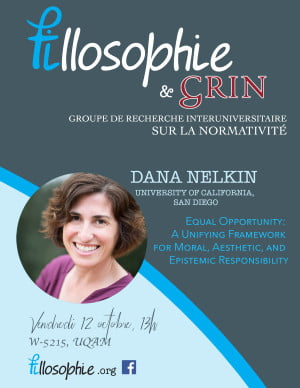
Dana Nelkin (University of California, San Diego) @ Salle :W-5215 – Pavillon Thérèse-Casgrain – UQÀM
13 h 00 – 15 h 00

Dans le cadre de ses ateliers mensuels, le GRIN en collaboration avec Fillosophie recevront Dana Nelkin (University of California, San Diego), qui offrira une présentation intitulée “Equal Opportunity: A Unifying Framework for Moral, Aesthetic, and Epistemic Responsibility”.
Abstract :
We naturally speak about moral obligations (e.g., “you ought to have kept your promise”) and we speak about epistemic ones and even sometimes what look like aesthetic ones, too (e.g., “you ought to have known that the polls were within the margin of error” and “you should have done better with that painting”). Similarly, we blame and praise people for epistemic and aesthetic transgressions and achievements, as well as moral ones. For these reasons, it is natural to conclude that our moral, aesthetic and epistemic practices should be treated in highly parallel ways, at least when it comes to the realm of holding responsible, praiseworthy, and blameworthy. At the same time, there are clear asymmetries between the moral and epistemic case, and also between the moral and the aesthetic, which might seem to doom any hope for a genuinely parallel treatment. For example, as many have pointed out, unlike actions or omissions, which are central objects of moral obligations, praise and blame, belief does not seem to be the kind of thing one has control over. When it comes to the aesthetic case, many have doubted that we have obligations in the way that we do in the other cases. Further, moral blame has seemed to many to be governed by a number of interpersonal norms that don’t seem to have parallels in either the pure epistemic or pure aesthetic case. Despite these challenges, I argue that the prospects are promising for a unifying framework that applies in all three cases while at the same time leaving room for divergence on some important dimensions. In particular, in this paper, I pursue the idea that one’s degree of blameworthiness or praiseworthiness depends on the quality of one’s opportunity in a given case.
-
Démocratie et débat public : au-delà des logiques partisanes ? @ Librairie Le port de tête
17 h 00 – 19 h 00

À la suite des élections, il est nécessaire de s’interroger sur la validité du processus. Non pas sur les modalités du scrutin, qui est un débat en soi, mais qui porte sur une partie seulement du processus électoral, mais plutôt les modalités des débats et des discussions politiques au sein de la population. On peut insister sur le rôle important donné aux partis politiques, il reste que les conditions actuelles du débat politique permettent difficilement un débat satisfaisant et instructif, où les électeurs et électrices sont à même de jouer le rôle qui est en principe le leur en démocratie représentative. On peut alors se demander qu’est-ce qui serait utile et nécessaire pour qu’une campagne électorale soit autre chose qu’une simple compétition entre partis politiques.
Cette discussion publique réunira Dominique Leydet, professeure de philosophie politique à l’UQAM, Laurence Bherer et Françoise Montambeault, toutes deux professeures de sciences politiques à l’Université de Montréal. Elle sera animée par Christian Nadeau, professeur de philosophie politique à l’Université de Montréal.
Cet événement est organisé par le Groupe de recherche interuniversitaire en philosophie politique (GRIPP) et le Centre de recherche en éthique (CRE).
-
Nils Holtug (U of Copenhagen) @ Salle 160 (Arts Council Room), Arts Building, McGill University
14 h 30 – 16 h 00

Nils Holtug (U of Copenhagen) présente une conférence intitulée « Cosmopolitanism and Open Borders ».
Conférence organisée par le GRIPP.
-

Dans le cadre de ses midis de l’éthique, le CRÉ reçoit Karin Jongsma (University Medical Center Utrecht), qui offrira une présentation intitulée « One for all, all for one? – On the aggregation of individual interests into collective claims within patient organization of dementia and autism. »
Résumé
The inclusion of patients’ perspectives in health care policy-making, agenda setting and research practices is increasingly practiced by patient organizations (POs). The underlying presumption is that POs aggregate their members’ perspectives and represent the interests of a collective. Claims for representation are however not self-validating, and need normative justification. Organizational structures of POs are of particular interest in this respect, given the fact that they influence which voices are included, how is mediated between subgroups and how collective standpoints are finally formulated. These methods of interest aggregation carry normative weight, as it is an implicit or explicit decision about whose interests are recognized.
In this presentation I will analyze methods of interest aggregation within POs by drawing on empirical material collected in my post-doc project in Germany. The cases of autism and dementia are illustrative, because the diversity of members (affected/non-affected members), range of affectedness (‘high function’/’low functioning’) and the particularities of the conditions (difficulties expressing oneself/following democratic methods) pose challenges for traditional democratic ideas of interest aggregation and collectivity.
-
Dans le cadre de ses ateliers, le GRIN reçoit Pamela Hieronymi (UCLA), qui nous offrira par vidéoconférence une présentation intitulée “Freedom, Resentment, and the Metaphysics of Morals”.
Résumé
Fifty-five years after its publication, P. F. Strawson’s “Freedom and Resentment” continues to inspire important work. Its main legacy has been the notion of “reactive attitudes.” Surprisingly, Strawson’s cent
ral argument—an argument to the conclusion that no general thesis (such as the thesis of determinism) could provide us reason to abandon these attitudes—has received little attention. In a short manuscript, I am arguing that neither of the standard interpretations are correct. Strawson’s argument relies on an underlying picture of the nature of moral demands and moral relationships—a picture that has gone largely unnoticed, that is naturalistic without being reductionistic, and that is, I think, worthy of serious consideration. After very briefly presenting the main outlines of my interpretation, I will, in this presentation, focus on objections to Strawson’s underlying, naturalistic picture. Though the objections are serious, I believe robust replies can be provided on Strawson’s behalf. -

Dans le cadre des midis de l’éthique du CRÉ, Constantine Sandis nous offrira une présentation. Il s’exprimera en anglais, mais la période de discussion sera bilingue.
Résumé:
Selon la distinction reçue entre faire et laisser faire, il y a une différence morale entre faire quelque chose et laisser cette chose se produire. Ses défenseurs comme ses critiques supposent qu’il existe une différence ontologique sur laquelle la différence morale est dite survenir. Cette différence – entre les soi-disant actes « positifs » de faire et les actes « négatifs » de ne pas faire – fut comme on sait introduite par Gilbert Ryle, qui soutint que les derniers (incluant les cas de négligence) ne sont pas véritablement des actions. Sa position est contestée par les Davidsoniens qui défendent l’idée que les actes négatifs particuliers, au contraire, ne sont que des actes positifs caractérisés par des traits négatifs. Dans cet article, je soutiens que les débats moraux et métaphysiques reposent tous deux sur la croyance erronée que les actions et/ou leurs caractérisations peuvent être divisées nettement entre celles qui sont positives et celles qui sont négatives. J’utilise un large éventail d’exemples pour montrer comment toute action contient de l’inaction et réciproquement. En outre, les perceptions ontologiques de ce qui est positif et de ce qui est négatif ne peuvent être nettement séparées des perceptions évaluatives. Rien de tout cela n’implique qu’il ne peut jamais y avoir de différence entre faire x et laisser xse produire. Mais cette différence n’est pas telle que l’on puisse la saisir en un principe ; et la raison en est principalement que toute instance de l’action de « faire x » inclura une non-action, celle de ne pas faire une autre chose (a, b ou c…), et que tout cas où un agent laisse x se produire sera inséparable de l’action de faire quelque chose d’autre, de telle sorte que l’action de faire a qui est inclus dans le fait de laisser x se produire peut être moralement pire que l’action de laisser a se produire quand on fait x.
Abstract:
According to the Doctrine of Doing and Allowing, there is a moral difference between doing something and allowing it to occur. Its defenders and critics both assume the existence of an ontological difference that the purported moral difference is said to supervene upon. This difference – between so-called ‘positive’ acts of doing and ‘negative’ acts of not-doing – was famously introduced by Gilbert Ryle, who argued that the latter (which include neglect) were not really actions at all. He is opposed by Davidsonians who, by contrast, maintain that negative act tokens are just positive acts under negative characterisations. In this paper I argue that both the moral and the metaphysical debates rest on the mistaken belief that actions and/or their characterisations can be neatly divided into those that are positive and those that are negative. I use a wide range of examples to demonstrate how all action contains inaction, and vice versa. Moreover, ontological perceptions of what is positive and what is negative cannot be neatly separated from evaluative ones. None of this entails that there can never be any moral difference between doing x and allowing x to happen. But it is not one that can be captured by any principle, not least because any given instance of doing x will involve the not-doing of some other thing (a, b, or c…), and any case of of allowing x to happen will be inseparable from doing some such other thing, where the doing of a involved in allowing x may be morally worse than the allowing of a which occurs in doing x.
-
« Ethics and Attention » @ Salle 309
12 h 00 – 13 h 30

Les membres du CRÉ accueillent Paloma Fernandez-Mc Auley, stagiaire en éthique de l’intelligence artificielle, qui nous offrira une présentation portant sur la nature de l’attention et les manières selon lesquelles elle est utilisée par la technologie.
La présentation sera faite en anglais.
-

À l’occasion des midis de l’éthique du CRÉ, Martin Gibert nous offrira une présentation intitulée « AI and moral considerability ».
Résumé
In this paper with Dominic Martin, we are looking for some arguments in favour of moral duties toward AI. We take inspiration in non anthropocentric fields of applied ethics, namely environmental and animal ethics. We will argue that 1) we may have indirect duties toward AI, 2) we don’t have (direct) duties because they are intelligent, 3) we may have (micro) duties toward alive AI, at least if we admit duties toward plants, 4) we will have duties toward sentient AI (if such things are possible).
-

École d’été 2018 du CÉRIUM, tenue à Paris, en partenariat avec la DAI de l’UdeM, la FAS et le CRÉ, ainsi qu’avec la Maison SUger-FMSH et EHESS.
Organisation: Marc-Antoine Dilhac. Co-responsables: David Décary-Hétu (Université de Montréal)
Luc Foisneau (CNRS, CESPRA) et Pierre-Yves Néron (Université Catholique de Lille)Le séminaire doctoral a pour objet d’étude la demande de transparence en démocratie. La démocratie contemporaine s’est cristallisée autour de la notion de transparence avec l’émergence de l’espace public au 18e siècle. La publicité de l’espace de parole politique est devenue une condition de la légitimité dans les régimes pré-démocratiques et a été érigée comme pierre de touche de l’édifice démocratique. Une caractéristique essentielle de la publicité est la transparence des informations qui permettent de juger les affaires publiques et de lutter à la fois contre la corruption et contre l’usage abusif de la raison d’État. La demande de transparence est ainsi consubstantielle à l’exigence démocratique de publicité.
Nous examinerons la demande de transparence en nous interrogeant sur les domaines pour lesquels cette demande est pertinente et peut-être nécessaire, comme celui des transactions financières et des marchés publics, mais aussi ceux de l’accès aux données numériques et des algorithmes de décision. Si la transparence est une condition épistémique de l’exercice des droits de la citoyenneté démocratique, elle donne aussi une direction pour penser la légitimité des décisions politiques : parce que les décisions politiques doivent elles-mêmes être transparentes, c’est le modèle de la participation citoyenne qui tend à s’imposer depuis une vingtaine d’années. Mais la revendication non éclairée de la transparence peut également engendrer une violation de certains droits fondamentaux comme celui d’avoir une vie privée. On pourrait ainsi se demander quelle place il faut encore accorder à l’intimité et au secret dans une société de la transparence.
Le programme de conférences et d’ateliers propose une formation de haut niveau à la recherche en philosophie politique, science politique, sociologie et en criminologie. Le thème de la transparence sera abordé sous l’angle de la réflexion philosophique sur la corruption, de l’élaboration de politiques de lutte anti-corruption, de l’étude politique et sociologique des sociétés qui se présentent comme des modèles de transparence (essentiellement dans les pays scandinaves), et enfin de la transparence numérique avec la lutte contre la cyber-criminalité financière et la régulation des crypto-monnaies, mais aussi avec la protection des libertés publiques menacées par l’avènement d’application utilisant l’intelligence artificielle à des fins de propagande.
Nous aurons le privilège de discuter de ces questions avec des spécialistes universitaires (Paris-Sorbonne, EHESS, UdeM) et des acteurs clés de la société civile (Transparency International, CNNum et CNIL) :Horaire de la semaine :
2 juillet : Céline Spector (Paris-Sorbonne)
3 juillet : Alban Bensa (EHESS)
4 juillet : David Décary-Hétu (Université de Montréal) et Laurène Bounaud (Transparency International, France)
5 juillet : Yohann Aucante (EHESS)
6 juillet : Valérie Peugeot (CNIL-Commission Nationale Informatique et Liberté ; Conseil National du Numérique ; Présidente de Vecam-Citoyenneté dans la société numérique).
-

Dans le cadre du cycle de conférence Reconsidérer le centre: à propos de la « décolonisation », la Chaire de recherche du Canada Polethics vous propose:
Vous êtes convié.e.s à une présentation de Soumaya Mestiri (Université de Tunis) intitulée « Du féminisme musulman au féminisme islamique décolonial, quelle évolution? ».
Ci-joint, le programme complet des conférences 2018 de la Chaire.
L’entrée est gratuite mais les réservations sont obligatoires sur Eventbrite.
Organisation : Delphine Abadie (Université de Montréal), avec Ryoa Chung (Université de Montréal) et Marc-Antoine Dilhac (titulaire de la Chaire).
*La conférence sera filmée.
-
« From each according to their abilities, to each according to their needs » @ Salle 422
7 Juin – 8 Juin Jour entier

Organisateurs: Pablo Gilabert (Concordia) et Peter Dietsch (UdeM).
Programme
Thursday, 7 June
9h30 Welcome
9h45-11h05 Lucas Stanczyk (Harvard University), « The Political Morality of Social Reproduction »
Commentator: Arash Abizadeh (McGill University)11h05 – 11h15 Coffee
11h15 – 12h35 Julie Rose (Dartmouth College), “The Ideal of the Stationary State: Two Alternatives”
Commentator: François Claveau (Université de Sherbrooke)12h35 – 14h15 Lunch
14h15 – 15h35 Carol Gould (City University of New York), “Socializing the Means of Free Development”
Commentator: Christine Straehle (University of Ottawa)15h35 – 15h50 Coffee
15h50 – 17h10 Peter Dietsch (Université de Montréal), “On the Very Idea of an Efficient Wage”
Commentator: Katharina Nieswandt (Concordia University)19h00 Workshop dinner
Friday, 8 June
9h30 – 10h50 AJ Julius (University of California at Los Angeles), “From each because to each”
Commentator: Colin Macleod (University of Victoria)10h50 – 11h00 Coffee
11h00 – 12h20 Pablo Gilabert (Concordia University), “Exloitation, Solidarity, and Dignity”
Commentator: Vida Panitch (Carleton University)12h20 Workshop ends
Abstracts
Peter Dietsch, “On the Very Idea of an Efficient Wage”
This paper argues that the standard characterisation of the equity-efficiency trade-off overstates the tension between these two values. The reason lies in the fact that economists tend to take individual labour supply preferences as given, which leads to a superficial analysis of the concepts of reservation wage and economic rent.
The paper distinguishes two kinds of reservation wages, one that refers to skills- and market-structure-induced scarcity, and one that refers to social norms governing remuneration. The former is relevant from an efficiency standpoint, whereas the latter operates on real world labour markets. The difference between them gives rise to an economic rent received by high-earning individuals that is obscured from view by the assumptions of standard economic analysis. Reducing this economic rent is a demand not only of justice, but also of efficiency.
The last section of the paper strengthens this conclusion further by drawing a parallel between expensive tastes in consumption and a certain class of high reservation wages. To the extent that the latter are underpinned by social norms rather than efficiency considerations, not paying them is both just and efficient.
Pablo Gilabert, “Exloitation, Solidarity, and Dignity”
This paper offers a new understanding of what exploitation is and of what is wrong with it. The focus will be on the critical assessment of the exploitation of workers in capitalist societies. Such exploitation is wrongful when it involves a contra-solidaristic use (and perhaps even allocation) of power to benefit oneself at the expense of others. Wrongful exploitation consists in using your greater power, and sometimes even in making other less powerful than you, in order to get them to benefit you more than they ought to. This account of exploitation is superior to others because it simultaneously captures three morally significant dimensions of exploitation-its material and social background, the relational (interpersonal and systemic) attitudes it enacts, and the final distributive outcomes it generates. Exploitation is indeed a multidimensional social process. The flipside of the proposed critical characterization of this process is a positive, solidaristic ideal of solidaristic empowerment in the allocation and use of economic power, which the paper articulates in terms of the socialist Abilities/Needs Principle (« from each according to ability, to each according to needs »). The Abilities/Needs Principle is grounded in human dignity.
Carol Gould, “Socializing the Means of Free Development”
Marx’s Abilities/Needs Principle, advanced for a high stage of the development of socialism, raises interesting philosophical and practical puzzles, e.g., regarding the meaning and limitation of needs, the problem of ‘material incentives’ for eliciting people’s contributions, the practicability and desirability of the abundance it presupposes, the sort of institutions and regulation it might require, whether central, local, or transnational, etc. I will argue that to properly interpret the principle and to determine the guidance it provides for social transformation, this principle needs to be taken in conjunction with another of Marx’s principles, namely, “The free development of each is a condition for the free development of all.” (Marx & Engels, The Communist Manifesto). I will argue that this reading provides some theoretical and practical guidelines for democratic socialism, centered on a principle of equal access to the conditions of free self-developing activity (both individual and collective). In previous work, I have elaborated this as a principle of equal positive freedom. Needs on this view can be usefully (and practically) shown to involve the fulfillment of economic and social human rights, as well as traditional civil and political ones, although this need not be taken reductively in a merely ‘sufficientarian’ way, but to point to an egalitarian principle, including also needs for recognition and for relationships. Central to the realization of the abilities/needs principle on this ‘equal positive freedom’ interpretation will be a system of worker self-managed firms that eschews a market in labor but still makes use of a market in goods and services. The focus on conditions for free development also helps us to understand how to deal with increasing automation and the replacement of traditional forms of work, and it can incorporate some new forms of socializing care work. But the problem of abundance and its impact on nature remains. I will conclude with some suggestions as to how the conjunction of the two principles even suggests a way of reinterpreting the meaning of abundance so that it can respect the integrity of the modes of functioning of nature and the environment.
AJ Julius, “From each because to each”
I develop a possible basis for the « From each… » standard. Cooperative production organized by this standard affords each producer the possibility of doing production as her own action. I contrast this possibility with the self-estrangement of commodity-producing labor. And I contrast this basis for the standard with an understanding on which it formulates a demand of distributive justice.
Julie Rose, “The Ideal of the Stationary State: Two Alternatives”
Skepticism about the value of economic growth is increasingly prominent today, with a growing political and social movement opposed to the “growth paradigm.” Some of these critics argue that a just society ought at some point to cease to pursue economic growth, and instead maintain a “steady-state” or “stationary state” economy. This paper analyzes the argument for the stationary state, examining two related normative and conceptual questions: On what grounds should a society cease to aim for economic growth? And what would it mean for a society to do so? I argue that there are two importantly distinct answers to these questions, a distinction that has been unappreciated yet is fundamental to assessing the justifiability of perpetually pursuing economic and social progress.
The first position holds that, beyond some point, a society should cease to aim for further economic growth because it is in conflict with the realization of further societal progress. This first position yields a progressive stationary state, in which a society ceases to aim for economic growth, while continuing to pursue progress on other dimensions. The second argument holds, instead, that, beyond some point, a society should cease to aim for further economic growth because its continued pursuit would be in conflict with the achievement of the good life or the just society, understood as an end which is complete in itself. This second view justifies a complete stationary state, in which a society ceases to aim not only for further economic growth but for perpetual progress on any dimension. Distinguishing these two ideals of the stationary state illuminates a central divide within current debates about economic growth, and contributes to our assessment of the question of how a society ought to weigh the value of the benefits brought by economic development against the burdens imposed by its pursuit.
Lucas Stanczyk, « The Political Morality of Social Reproduction »
Robert Nozick once described the attitude of left-leaning political philosophy toward the talents and abilities of productive people through the metaphor of “a horse in harness to a wagon, which horse doesn’t have to move ever, but if it does, it must draw the wagon along.” Nozick understood this description to be the basis of an indictment of left-leaning political philosophy, since in his view persons could not legitimately be made to work for the benefit of other persons, whatever one might legitimately do with horses. I do not share Nozick’s view, and thus I take the significance of his telling metaphor to lie elsewhere. Political philosophers of all stripes have overlooked important questions concerning the political morality of social reproduction.
In every society that persists over time and does not simply collapse or disband, there are processes in place whereby its continued existence is reproduced from one day to the next. These processes together are responsible for whatever benefits that life in the society brings, as well as for the social disadvantages that the persons living in the society are liable to experience. Among the most important ways that social reproduction in this sense can fall short of what morality demands is by exhibiting or depending on injustices of various kinds. This possibility gives rise to one of the more complex questions that can be asked about the content of political morality. How are we to conceive of justice in the ongoing production, or reproduction, of a whole society?
According to the view presented in this chapter, the answer to this question depends on considerably more than the demands of justice conceived as what is owed to each and every person. Equally important, how we are to conceive of justice in the labor-dependent process of a society’s continual reproduction depends on what can be reasonably expected from each person by way of individual productive contribution. The theory presented in this essay starts out from a recognition of the distinctness of these two perspectives.
While justice is often said to be essentially about what persons are owed, in the case of social justice this familiar description is misleading if not false. The maintenance of a society’s justice over time is not to be identified with the continuous proportional satisfaction of morally weighty claims. For besides rights, opportunities and other continuously recreated social goods, there are standing burdens of social life to be apportioned and individual duties to bear them as well. The proper burdens and duties of social life, moreover, do not lie in some pile like antibiotics or wealth, ready to be distributed according to a principle with this or that functional form. Our proper burdens and duties must instead be theorized in some satisfactory way, and for this purpose they cannot simply be deduced from a list of the important claims that people have. Wide reflective equilibrium among conceptions of basic rights and duties is called for, not simple deduction of one from the other. The task of this chapter is to sketch the main tools and concepts that I believe are necessary for this purpose.
-
« Décoloniser l’imaginaire colonial féminin. De la réussite relative de Fatima Mernissi » @ Salle 309
12 h 00 – 13 h 00

Dans le cadre de ses midis de l’éthique, le CRÉ reçoit Soumaya Mestiri (Université de Tunis), qui nous offrira une présentation intitulée « Décoloniser l’imaginaire colonial féminin. De la réussite relative de Fatima Mernissi ».
Résumé
L’une des caractéristiques majeures du travail de Fatima Mernissi est qu’elle n’a eu de cesse de lutter contre l’image coloniale de la femme arabe écervelée, dédiée au plaisir masculin, réussissant le paradoxe d’être à la fois soumise et nymphomane voire virago. Sa critique du « harem occidental », notamment à travers la figure de Shéhérazade, ce harem qui n’existe que dans les fantasmes orientalistes s’incarne dans une déconstruction systématique des topoï coloniaux.Mais la promesse d’une décolonisation du sous-érotisme de carte postale colonial n’est au final pas tenue, Mernissi se retrouvant elle-même happée par ce qu’elle dénonce, notamment dans sa volonté oeucuménique de gommer les frontières entre colon et colonisé, entre moi et l’autre. -
Congrès annuel de l’Association canadienne de philosophie 2018 @ Université du Québec à Montréal
4 Juin – 7 Juin Jour entier

Dans le cadre du Congrès annuel de l’Association canadienne de philosophie 2018 (ACP), les chercheurs.ses du CRÉ participent à plusieurs activités.
« The nature of moods », table ronde organisée par Christine Tappolet
« La loi 62: une discussion », table ronde organisée par Daniel Weinstock, à laquelle participe notamment Colin MacLeod
« Is the Internet epistemically safe? Personalization and the threat of epistemological skepticism », présentation de Charles Côté-Bouchard
« Responding to Group-Based Vulnerabilities – Intersectionality and Law », présentation de Frédérick Armstrong et Natalie Stoljar
« Normative Ethics 1 », table ronde présidée par Sarah Stroud
« Autonomy and (non-)domination: the case of non-human animals, table ronde co-organisée par Kristin Voigt et Valéry Giroux, à laquelle participent notamment Angie Pepper et Will Kymlicka
« Existence racisée, politiques de résurgence et philosophies de libération », table ronde organisée par Naïma Hamrouni
« Democracy in crisis? Historical and contemporary perspectives », table ronde co-organisée par Étienne Brown, à laquelle participent notamment Christian Nadeau et Robert Sparling
« Comments on Wright », commentaire sur la présentation de Jessica Wright, par Paul Boswell
« Éthique et intelligence artificielle » table ronde co-organisée par Martin Gibert et Dominic Martin, présidée par Christine Tappolet
« Exploitation, Solidarity, and Dignity », présentation de Pablo Gilabert
« Beyond Frontier Town: Domination and Theories of Private Property », présentation de Katharina Nieswandt
« Feminist Philosophy: Ethics and health care », table ronde à l’occasion de laquelle Ryoa Chung commentera la présentation de Holly Longair
« Meta-Ethics 1 », table ronde à l’occasion de laquelle Ulf Hlobil commentera la présentation de Griffin Klemick et Félix Aubé-Beaudoin commentera celle de Nicole Dular
« Two reasons to step into the matrix », présentation de Willem van der Deijl
« Quel est le rôle de la coopérative dans une société juste? », présentation de Dominic Martin
« La philosophie dans et pour la société: développer des pratiques exemplaires d’engagement », table ronde co-organisée par François Claveau
« The roles and responsibilities of scholars in crating public debate: Challenging intuitive ethical considerations », présentation de Françoise Baylis
« L’engagement antispéciste des chercheurs.ses en éthique animale », présentation de Valéry Giroux
« Agency, Inequality and Self-Respect », présentation d’Éliot Litalien
« Regarding Oneself as an Equal », présentation de Natalie Stoljar et Kristin Voigt
« Regad for Reason in the Moral Mind », table ronde à l’occasion de laquelle Christine Tappolet offrira un commentaire
« Normative Ethics 3 », table ronde à l’occasion de laquelle Katharina Nieswandt commentera la présentation de Frank Hindriks
« Applied Ethics: terrorism, business and climate », table ronde à l’occasion de laquelle Dominic Marin commentera la présentation de Hsko von Kriegstein
« Identity & Recognition: Québec’s Identity Debate as a Contribution to Canadian Political Philosophy », présentation de Sébastien Lacroix
« La philosophie dans l’éducation », table ronde à l’occasion de laquelle Marc-Antoine Dilhac offrira une présentation
« Truth and Reconciliation in Academia: What role of non-Indigenous Researchers? », table ronde à laquelle Aude Bandini et Daniel Weinstock participeront
Lunchtime workshop on SSHRC Insight Grant Applications, avec la participation de Peter Dietsch
« Paul Bloom’s Against Empathy« , table ronde à l’occasion de laquelle Joe Heath offrira un commentaire
« Social and Political Philosophy 3 », table ronde à l’occasion de laquelle Martin Gibert commentera la présentation d’Arjun Sawhney
« Conceptual Issues on Vulnerability », table ronde à laquelle participeront Frédérick Armstrong, Christine Straehle, Ryoa Chung et Naïma Hamrouni
« Racial Justice », table ronde co-organisée par Naïma Hamrouni et Ryoa Chung
« Can Metabolic Interaction Patterns Evolve? », présentation d’Antoine C. Dussault
« Social and Political Philosophy 4 », table ronde à l’occasion de laquelle Frédérick Armstrong commentera la présentation de Jeremy Butler, et Éliot Litalien commentera la présentation de Barbara Fultner
« Unpresumptous Paternalistic Constraint », présentation de Chrisoula Andreou
« Johannsen’s A Conceptual Investication of Justice », table ronde à l’occasion de laquelle Louis-Philippe Hodgson, Colin Macleod et Kristin Voigt offriront des commentaires
« Inquiry and Doxastic Attitudes », présentation de Michele Palmira
« The Cut-Free Approach and the Admissibility-Curry », présentation de Ulf Hlobil
« Return of the Living Dead? Genetic Resurrection of Zombie Species », présentation de Jennifer Welchman
« Methodological and Hermeneutical Issues in Cross-cultural Philosophy », table ronde organisée par Antoine Panaïoti
« The Holobiont Concept and the Ontology of Multispecies Biological Entities II », table ronde co-organisée par Antoine C. Dussault
« Epistemic Injustice and Cognitive Disability », présentation d’Amandine Catala
« A Functionalist Account of Group Self-Deception », présentation de Martina Orlandi et d’Éliot Litalien
-

Dans le cadre de ses midis de l’éthique, le CRÉ reçoit Anne-Marie Reynaud qui présentera un article co-écrit avec Cyntia Milton.
-
Le Groupe de recherche en philosophie politique de Montréal (GRIPP) est content de vous informer de la tenue d’un atelier d’une journée complète dédié au manuscrit « Not In Their Name» par Holly Lawford-Smith, lauréate du prix 2018 de l’atelier de philosophie politique de Montréal.
Format
Pour maximiser la qualité des discussions, on demande aux participants de lire le manuscrit au préalable. L’atelier comprendra quatre séances de discussions critiques sur le manuscrit ; chacune d’entre elles commencera sera lancée par des commentaires critiques d’une des sections du manuscrit, suivi d’une courte réponse de l’auteur et d’une discussion générale.
Inscription
L’atelier est ouvert à tous, mais l’inscription préalable est requise étant donné le nombre limité de places. RSVP la coordinatrice de l’atelier Nina Ahrendt: lincentre@mcgill.ca
Manuscrit
Cliquez ici pour l’accès au manuscrit. Vous aurez besoin d’un mot de passe, que vous aurez recevoir quand vous vous inscrivez.
Programme
9:30 Accueil
9:45 – 11:30 Présidente: Dominique Leydet (philosophie, UQAM)
Ch. 2: What is The State? Amandine Catala (philosophie, UQAM)
Ch. 3: Is the Citizen-Inclusive State an Agent? Pablo Gilabert (philosophy, Concordia)
11:30 – 13:00 Dîner
13:00 – 14:45 Chair: Hasana Sharp (philosophy, McGill)
Ch. 4: Is the Citizen-Exclusive State an Agent? Victor Muniz-Fraticelli (politics & law, McGill)
Ch. 5: Are Citizens Responsible Nonetheless for What the State Does? Catherine Lu (politics, McGill)
14:45 – 15:00 Pause café
15:00 – 16:45 Chair: Kristin Voigt (philosophy, McGill)
Ch. 6: Culpability in Hierarchical Groups: Daniel Weinstock (law, McGill)
Ch. 7: Cooperation Between States: Peter Dietsch (philosophie, Montréal)
19:00 Souper -

Nous avons le plaisir d’accueillir la doctorante Laura Silva. Sa présentation est intitulée « Agency and Outlaw Emotions »
Résumé
‘Outlaw’ emotions (Jagger, 1989), experiencing anger at a sexist slight that conflicts with a judgement that this treatment is unproblematic, for example, are incredibly important to resisting oppression. Outlaw emotions must be able to act as reasons for belief and action less we risk denying agency of those in their possession. Situations of outlaw emotions are often seen as cases of inverse akrasia, where we act for reasons despite acting against our overall judgment of what we ought to do. Many perceptual theories defend inverse akrasia based on emotion by taking emotions to justify evaluative beliefs much the same way perceptual states justify perceptual beliefs; immediately and non-inferentially, as long as there is no reason to distrust one’s emotional experience (Tappolet, 2016; Jones, 2003). The problem explored in this talk is whether such dominant views of how emotions play justificatory roles can really account for cases of outlaw emotions.
-
« Le concept de santé s’applique-t-il aux écosystèmes? » @ Salle 309
15 h 30 – 16 h 30

Vous êtes tou.te.s cordialement invité.e.s à écouter Antoine C.-Dussault parler de la santé des écosystèmes. Cette présentation lui permettra de s’exercer en vue d’un entretien d’embauche. Antoine espère ainsi profiter de vos commentaires critiques et constructifs. Venez en grand nombre!
-
« La valeur des arguments épistémiques dans l’argumentation pour la tolérance religieuse » @ Salle 309
12 h 00 – 13 h 00

Nous avons le plaisir d’accueillir Gilles Beauchamp, qui nous offrira une présentation intitulée « La valeur des arguments épistémiques dans l’argumentation pour la tolérance religieuse ».
Résumé
Pour faire suite à sa présentation au séminaire des boursier.e.s d’études supérieures, Gilles nous présentera une discussion critique des quatre types arguments épistémiques pour la tolérance qu’il a présentés au mois de février : le faillibilisme, le processus de formation des croyances, la parité épistémique et l’accès différencié à la connaissance divine. La discussion critique sera centrée sur trois points: la robustesse de l’argument, l’acceptabilité de l’argument du point de vue d’un croyant et la forme de tolérance soutenue par l’argument.