Évènements passés
Archives du calendrier
-

Peter Dietsch et Régis Coursin représenteront le CÉRIUM et le CRE au Sommet Idées7 avec une proposition de réforme pour limiter la concurrence fiscale. Idées7, c’est un sommet d’une trentaine d’experts issus des pays membres du G7 qui se réuniront du 21 au 23 mai à l’initiative des Hautes Études Internationales (HEI) à l’Université Laval. Ils réfléchiront aux défis de la complexité et de l’inclusion dans la gouvernance mondiale.
Le Sommet Idées7 (I7) donnera lieu à une déclaration qui sera remise aux représentants officiels des pays du G7 : la Déclaration Idées7.
Les institutions représentées au Sommet I7 sont des universités et des laboratoires d’idées (think tanks) d’Allemagne, du Canada, des États-Unis, de France, d’Italie, du Japon, du Royaume-Uni et de l’Union européenne. Ont aussi été invités des experts d’Afrique du Sud, de Chine et d’Inde.
-
Lewis Ricardo Gordon (University of Connecticut) @ Salle C-3061, Carrefour des arts et des sciences, UdeM
14 h 00 – 16 h 00

Dans le cadre du cycle de conférence Reconsidérer le centre: à propos de la « décolonisation », la Chaire de recherche du Canada Polethics vous propose:
Une conférence de Lewis Ricardo Gordon (University of Connecticut) intitulée »Philosophie et décolonialité dans la philosophie africaine de la diaspora / Philosophy and Decoloniality in Africana Philosophy « . Discutant.e.s : Daniel Weinstock (McGill University) et Bettina Bergo (Université de Montréal).
La conférence aura lieu principalement en anglais, mais les questions et réponses pourront également être en français.
Ci-joint, le programme complet des conférences 2018 de la Chaire.
Organisation : Delphine Abadie (Université de Montréal), avec Ryoa Chung (Université de Montréal) et Marc-Antoine Dilhac (titulaire de la Chaire)
-
Consentement, promesse et ordre : les pouvoirs normatifs en matière de moralité, de politique et de droit @ UdeM et McGill
14 Mai – 17 Mai Jour entier

Consentement, promesse et ordre : les pouvoirs normatifs en matière de moralité, de politique et de droit
Consenting, Promising, and Ordering: Normative Powers in Morality, Politics, and Law(English will follow)
Nous sommes heureux.ses annoncer d’un colloque international intitulé Consentement, promesse et ordre : les pouvoirs normatifs en matière de moralité, de politique et de droit, qui se tiendra à Montréal en mai 2018.
Les pouvoirs normatifs – tels que le pouvoir de promettre, de donner son consentement, de conclure des contrats, de vendre des biens et de donner des ordres – sont au cœur de nos relations interpersonnelles et de nos vies sociales. Nous promettons à nos proches de les aider ou de donner suite à leurs volontés; nous signons des contrats de travail et préparons des testaments; nous donnons notre consentement à des relations sexuelles, à des interventions médicales et (peut-être) à subir l’autorité de l’État; et ceux qui ont une autorité pratique (tels que les responsables militaires et peut-être les parents) imposent des obligations à ceux qui sont sous leur autorité (comme attaquer les combattants ennemis ou rentrer à la maison avant minuit). La grande variété des pouvoirs normatifs et leurs utilisations variées donnent génèrent de nombreuses questions philosophiques sur les pouvoirs normatifs généraux, ainsi que sur des pouvoirs normatifs spécifiques. L’objectif central de ce colloque est de faire progresser nos connaissances quant aux pouvoirs normatifs et leur importance dans les domaines moral, politique et juridique.
Organisateurs.trice du colloque: Richard Healey, Sarah Stroud et Daniel Weinstock.
*************************************
We are happy an international conference entitled, Consenting, Promising, and Ordering: Normative Powers in Morality, Politics, and Law, to be held in Montreal in May 2018.
Normative powers – such as the power to promise, to give consent, to make contracts, to sell property, and to give orders – are central to our interpersonal relationships and our social lives. We promise our loved ones to help out, or to carry out their wishes; we sign employment contracts and make wills; we give consent to sexual relationships, medical interventions, and (perhaps) to the authority of the state; and those with practical authority (such as military officials, and perhaps parents) impose obligations on those under their authority (e.g. to attack, or to be home by midnight). The great variety of normative powers, and their varied uses, give rise to an expansive set of philosophical questions about normative powers in general as well as about specific normative powers. The central objective of this conference is to make progress in our knowledge of normative powers and their significance across the moral, political, and legal domains.
For enquiries please contact Richard Healey at: richard.healey[at]mail.mcgill.ca
Conference Organizers: Richard Healey, Sarah Stroud, and Daniel Weinstock.
PROGRAMME
Tuesday/mardi May 15 mai 2018 – Pavillon Lionel-Groulx (3150 rue Jean-Brillant), room /local C-3061, Université de Montréal
12.00-13.00 lunch / dîner
13.00-14.20 Erin Taylor (Washington and Lee University), “The Normative Power of Social Conventions”
14.30-15.50 Katharina Nieswandt (Concordia University), “What Is Conventionalism about Moral Rights and Duties?”
15.50-16.25 coffee and snacks / café et collations
16.25-17.45 Richard Healey (Centre de recherche en éthique), “Immoral Promises”
18.00-19.30 table ronde publique (en français) : Promesses électorales et politiques
Marc-Antoine Dilhac (Université de Montréal), Sarah Stroud (McGill), et Daniel Weinstock (McGill); animateur : Étienne Brown (Centre de recherche en éthique)
20.00 dinner / souper – Restaurant Barbounya, 234 avenue Laurier West / ouestWednesday/mercredi May 16 mai 2018 – Arts W-120, McGill University
9.30-10.00 breakfast and coffee / déjeuner et café
10.00-11.20 Andrea Westlund (University of Wisconsin, Milwaukee), “Normative Powers and the Economy of Authority”
11.30-12.50 Daniel Viehoff (New York University), “Political Authority as a Normative Power”
12.50-14.00 lunch / dîner
14.00-15.20 Stephen Perry (University of Pennsylvania), “Legitimate Political Authority, Jurisprudence, and Moral Power”
15.20-15.55 coffee / café
15.55-17.15 Victor Tadros (University of Warwick), “Following Orders”
19.00 dinner / souper – Le beaux arts restaurant, Musée des beaux-arts de Montréal, 1380 rue Sherbrooke West / ouestThursday/jeudi May 17 mai 2018 – Arts W-120, McGill University
10.00-11.20 Tom Dougherty (Cambridge University), “Degrees of Consent”
11.30-12.50 Hallie Liberto (University of Connecticut), “Pursuant versus Compliant Consent”
13.00-15.00 lunch and graduate student poster session / dîner & affiches des étudiant.e.s
15.00-16.20 David Enoch (Hebrew University of Jerusalem), “Consent, Autonomy, and Adaptive Preferences; or: False Consciousness for Liberals, Part I” -
Jonathan Way (University of Southampton) @ S-M- 205, Concordia University
15 h 00 – 16 h 30

Le GRIN et le CRÉ sont heureux d’accueillir Jonathan Way, qui nous offrira une présentation intitulée « The Distinctiveness of Fittingness » (préparée avec Conor McHugh).
RésuméAccording to fitting-attitudes accounts of value, evaluative properties are to be analysed in terms of what’s fitting to value – e.g. the admirable is what’s fitting to admire, the delightful is what’s fitting to delight in, the loathsome is what’s fitting to loathe. Such accounts raise the question of what it is to be fitting to value something. While some proponents of fitting-attitudes accounts analyse fittingness in terms of reasons, obligations, or permissibility, others have suggested that fittingness is a distinctive and unanalysable normative property. This paper defends this latter view. We proceed by noting three marks of fittingness: that incentives for attitudes do not bear on their fittingness, that fitting is stronger than permissibility but weaker than obligation, and that absences of attitudes cannot be fitting. We argue that these marks allow us to distinguish fittingness from other normative properties and cast doubt on the prospects of analysing fittingness in other normative terms. The upshot is support not only for fitting-attitude accounts of value but for fitting-attitude accounts of other normative properties too.
-
Political Theory in / and / as Political Science @ Leacock 232, McGill University
10 Mai – 12 Mai Jour entier
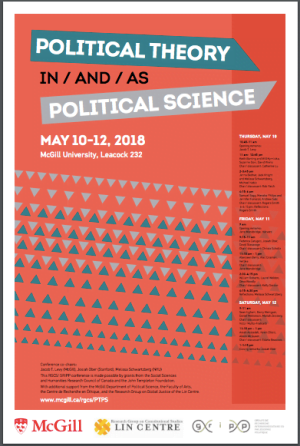
Conférence co-présidée:
Jacob T. Levy (McGill), Josiah Ober (Stanford), Melissa Schwartzberg (NYU)
Voir www.mcgill.ca/rgcs/PTPS.
Thursday May 10
10:45-11 am
Opening remarks: Jacob T. Levy, McGill
11 am- 12:45 pm
Keith Banting and Will Kymlicka, Queen’s: Theories of Justice, the Strains of Commitment, and Realistic Utopias
Suzanne Dovi, Arizona: The Four Janus-Faces Of Misogyny: Or How To Measure Bad Behavior?
David Wiens, UCSD: Ideal Theories in Political Science: Lessons from Game Theory and Statistics
Chair/ discussant: Catherine Lu, McGill
2-3:45 pm
Jenna Bednar, Michigan: Federalism as a Mechanism of Collective Problem Solving
Michael Neblo, Ohio State: Building a Directly Representative Democracy
Jack Knight, Duke and Melissa Schwartzberg, NYU: The Moral Limits of Bargaining
Chair/ discussant: Rob Reich, Stanford
4:15-6 pm
Samuel Bagg, McGill: Democratic Theory As Political Action
Menaka Philips, Tulane, and Jennifer Forestal, Stockton: « Democracy Dies in Darkness »: Anonymity, Accountability, and Information as a Public Good
Andrew Sabl, Yale/Toronto: The Strange Career of Aggregative Democracy
Chair/ discussant: Rogers Smith, University of Pennsylvania
6-6:15 pm
Reflections: Rogers Smith, University of Pennsylvania, and President-Elect, American Political Science Association
6:15-7:15 pm
Reception in celebration of the awarding of the 2018 Johan Skytte Prize in Political Science to Jane Mansbridge
Sponsored by the Faculty of Arts and the Department of Political Science, McGill University
—————
Friday May 11
9 am
Opening remarks: Jane Mansbridge, Harvard
9:15-11 am
Federica Carugati, Indiana: Tradeoffs of Inclusion: Development Before Liberalism
David Stasavage, NYU: Origins of Early Democracy
Josiah Ober, Stanford: Rationality and the origins of social cooperation in Greek thought
Chair/ discussant: Christa Scholtz, McGill
11:15 am – 1 pm: Graduate student panel
Aberdeen Berry, McGill: Arendtian Judgment and Pluralism
Alec Crisman, McGill: Instrumentalism and the Space of Non-Democracy
Vertika: Seeking Agency in the Interstices of Power
Chair/ discussant: Jane Mansbridge, Harvard
2:30-4:15 pm
William Roberts, McGill: Ideologies of domination and democratic theory
Deva Woodly, New School: From Idea To Ideology
Laurel Weldon, Purdue: Active Solidarity: Strategies For Transnational Political Cooperation In Contexts Of Difference, Domination And Distrust
Chair/ discussant: Kelly Gordon, McGill
4:15-4:30 pm
Reflections: Melissa Schwartzberg, NYU
—————
Saturday May 12
9-11 am
Sean Ingham, UCSD: Rule by Multiple Majorities: A New Theory of Popular Control
Mariah Zeisberg, Michigan: A New Political Jurisprudence
Daniel Weinstock, McGill: The Political Theory of Really Existing Democracies: The Case of Electoral Reform
Barry Weingast, Stanford: Should Majoritarians Embrace Countermajoritarian Constitutional Provisions?
Chair/ discussant: Victor Muñiz-Fraticelli, McGill
11:15 am – 1 pm
Kevin Elliott, Columbia: The Uses and Abuses of Public Opinion in Political Theory
Alison McQueen, Lisa Blaydes and Justin Grimmer, Stanford: Mirrors for Princes and Sultans
Arash Abizadeh, McGill: Representation, Bicameralism, and Sortition
Chair/ discussant: Edana Beauvais, McGill
1-1:15 pm
Closing remarks: Josiah Ober, Stanford
Conference co-chairs: Jacob T. Levy (McGill), Josiah Ober (Stanford), Melissa Schwartzberg (NYU)
A conference of the Research Group on Constitutional Studies, a unit of the Yan P. Lin Centre for the Study of Freedom and Global Orders in the Ancient and Modern Worlds at McGill University, and the Groupe de Recherche Interuniversitaire en Philosophie Politique.
This conference is made possible by grants from the Social Sciences and Humanities Research Council of Canada and the John Templeton Foundation.
With additional support from the McGill Department of Political Science, the Centre de Recherche en Éthique, and the Research Group on Global Justice of the Lin Centre.
To register, please e-mail rgcs.mcgill@gmail.com with your name and institutional affiliation.
-
Ariel Cascio (Neuroethics Research Unit, Institut de recherches cliniques de Montréal) @ ESPUM, 3e étage, salle 3019
12 h 00 – 13 h 00
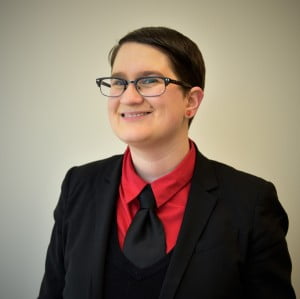
Dans le cadre des Ateliers de la bioéthique, Ariel Cascio, Ph.D. et stagiaire postdoctorale à la Neuroethics Research Unit de l’Institut de recherches cliniques de Montréal, nous offrira une présentation intitulée « Ethical and social issues in autism research: Engaging with literature and stakeholders to build best practices ».
Résumé
Autism is a spectrum condition currently classified as a neurodevelopmental disorder, characterized by differences in social interaction, social communication, and repetitive behaviors. Autism diagnoses have increased in recent decades, accompanied by greater research attention in basic, clinical, and social sciences. This talk addresses ethical and social issues in autism research, focusing particularly on the relational and experiential aspects of research participation. Including autistic people in research can be considered an important form of social inclusion, respecting the disability rights call “nothing about us without us.” However, common characteristics and experiences of people with autism may raise challenges for ethical and meaningful research inclusion. We are therefore working with stakeholders from autism communities – including self-advocates, parents, advocacy organizations, professionals, and researchers – to develop best practices through a process of deliberation and reflection on findings from a literature review. This process is guided by the five guideposts of our model of person-oriented research ethics. This talk will present background on the social context of research involving participants with autism, describe the model of person-oriented research ethics, reflect on the results of the literature review, and discuss the status and next steps of the deliberation process.
Biographie
Ariel Cascio, Ph.D. is a postdoctoral fellow at the Neuroethics Research Unit of the Institut de recherches cliniques de Montréal (Québec, Canada). Dr. Cascio received a doctorate in anthropology from Case Western Reserve University (Cleveland, OH, USA) after completing 11 months of ethnographic research on the experiences of adolescents and youth accessing autism-focused services in Italy. Several ongoing projects, primarily related to autism spectrum conditions, use lenses from anthropology and disability studies and focus on social and ethical issues, including in the context of research and health and human services. Dr. Cascio’s has been funded by the US-Italy Fulbright Commission.
-
« La métaéthique et ses implications normatives » @ C-2059, Carrefour des arts et des sciences, Pavillon Lionel-Groulx (UdeM)
1 Mai – 4 Mai Jour entier

« La métaéthique et ses implications normatives »
6èmes Journées de Métaéthique
En hommage à Ruwen Ogien (circa 1949-2017)
Université de Montréal
2-4 mai 2018Organisation : Marc-Kevin Daoust (Montréal), Stéphane Lemaire (Rennes), Christine Tappolet (Montréal), et Patrick Turmel (Laval)
Le Département de philosophie de l’Université de Montréal accueille les 6èmes Journées de métaéthique, qui se tiendront à Montréal les 2, 3 et 4 mai 2018.
Ces journées seront tenues en hommage à Ruwen Ogien, qui a organisé les premières Journées de méta-éthique, à Paris, en mars 2011.
Le thème central des 6èmes Journées sera « La métaéthique et ses implications normatives ».
La méta-éthique a longtemps été considérée comme une discipline se pratiquant en vase clos et n’ayant aucune incidence sur la vie ordinaire, que ce soit au niveau des théories normatives ou de la philosophie politique. Plus récemment, cette façon de voir a été remise en question. Ainsi, certains arguments métaéthiques prennent comme prémisses des thèses normatives, alors que la psychologie morale regarde de plus en plus du côté de la psychologie sociale. Ces journées seront l’occasion d’examiner les allers-retours entre les questions plus abstraites de la métaéthique et les questions normatives d’éthique et de philosophie politique.
Programme :
Mercredi 2 mai
16h15-16h45 Inscription
16h45-7h30 Aude Bandini (Montréal), « Le dolorisme épistémique »
18h00-20h00 Table ronde grand public sur le thème « penser et agir », à la Librairie Olivieri, avec Christian Nadeau (Montréal), Valéry Giroux (Montréal) et Daniel Weinstock (McGill)
Jeudi 3 mai
9h45-10h30 Antoine C.-Dussault (CIRST/LionelGroulx), « La relativité au sujet du bienêtre et la considérabilité morale des entités nonsentientes »
11h00-11h45 Victor Mardellat (EHESS), « Les conditions métaéthiques de l’opposition scanlonienne à l’agrégation des utilités individuelles »
11h45-12h30 François Côté Vaillancourt (Sudbury), « La convergence rationnelle en métaéthique. Vers un renversement de nos attentes quant au succès de la pratique morale »
14h00-17h00 Table ronde « métaéthique et philosophie politique », avec Ophélie Desmons (ESPE, Paris), Marc-Antoine Dilhac (Montréal), Jocelyn Maclure (Laval) et Véronique MunozDardé (UCL/UC Berkeley)
17h30-19h00 Conférence plénière : Ronald de Sousa (Toronto), « Pour un amoralisme »
19h30 Banquet
Vendredi 4 mai
9h45-10h30 Simon-Pierre Chevarie- Cossette (Oxford), « Réalisme et dogmatisme »
11h00-11h45 Samuel Dishaw (Harvard), « Le réalisme moral : meilleur sans modération? »
11h45-12h30 David Rocheleau Houle (York), « Nonnaturalisme et vérités normatives contingentes »
14h00-17h00 Table ronde « métaéthique et psychologie morale », avec Félix Aubé Beaudoin (Laval), Martin Gibert (Montréal), Charles Larmore (Brown) et Sarah Stroud (McGill)
La langue de communication de ces journées sera le français.
Organisation : Marc-Kevin Daoust (Université de Montréal), Stéphane Lemaire (Université de Rennes), Christine Tappolet (Université de Montréal), et Patrick Turmel (Université Laval)
Avec l’appui du CRÉ (Centre de Recherche en Éthique), du GRIN (Groupe de Recherche Interuniversitaire sur la Normativité), de Philosophiques et de la SoPhA (Société de Philosophie Analytique).
-
Valère Moutarlier (Commission européenne) @ Salle C-2059, Carrefour des Arts et des Sciences, UdeM
16 h 00 – 18 h 00

La seconde conférences « En route vers le Sommet du G7 dans Charlevoix: conférences pour une croissance économique qui profite à tout le monde », organisée par le CÉRIUM, par le CRÉ et par l’Équipe de recherche « New Empirical Approaches to International Political Economy » (financée par le FRQ-SC) sera offerte par Valère Moutarlier. Le titre de sa présentation sera « Évasion fiscale, fiscalité du numérique : l’ambition européenne ».
Commentaires
Allison Christians (Faculté de droit, McGill)
Lyne Latulippe (École de gestion, Université de Sherbrooke)Cette conférence fait suite à celle de Jonathan Ostry (Deputy Director of the Research Department at the International Monetary Fund), qui avait lieu le 14 février 2018. Dans le cadre de cette même série, il ne faut pas manquer la conférence de Valère Moutarlier, le 25 avril 2018, également à 16h00.
-
“Exit versus voice – options for socially responsible investment in a liberal state” @ Salle 309
12 h 00 – 13 h 15

Le CRÉ reçoit Peter Dietsch, qui offrira une présentation intitulée “Exit versus voice – options for socially responsible investment in a liberal state”
Résumé:
Quelles obligations un État libéral a-t-il envers ces citoyens en matière d’investissement responsable? Plus spécifiquement, quelles sont les exigences de justice par rapport aux régimes de retraite publics? Le texte distingue deux attitudes qu’un investisseur éthique pourrait adopter dans le contexte d’un tel régime: une attitude de faire du bien dans le monde et une attitude de vouloir avoir des mains propres en termes d’investissement. Je défends les deux attitudes contre certaines critiques qui ont été présentées à leur égards. Le texte conclut que l’État libéral doit à ces citoyens un choix d’investissement responsable dans les régimes de retraites publiques.
*La présentation sera donnée ou bien en anglais, ou bien en français, en fonction des préférences des gens qui y assisteront.
-
Carl Knight (Glasgow University) @ Salle 309
12 h 00 – 13 h 15
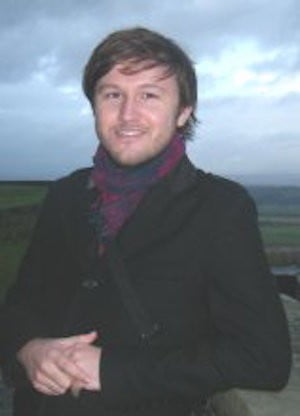
Les membres du CRÉ sont heureux.ses d’accueillir Carl Knight (Glasgow University) qui nous offrira une présentation intitulée « Leaving Nothing to Chance ».
Résumé
The most prominent theory of distributive justice to have emerged since John Rawls’ justice as fairness is luck egalitarianism, which aims to accommodate considerations of individual choice and responsibility within a theory of equality. The standard luck egalitarian view, ‘brute-luck egalitarianism’, allows the distributive effects of option luck (the results of deliberate gambles) to stand while neutralizing the effects of brute luck (the results of unchosen risk). This paper argues for a radical ‘all-luck egalitarianism’, which unlike brute-luck egalitarianism neutralizes the effects of option luck as well as brute luck.
-

Dans le cadre des Ateliers de la bioéthique de l’axe Éthique et santé, le CRÉ reçoit Chantal Bouffard (Université de Sherbrooke), qui nous offrira une présentation portant sur un des thèmes phares du centre, soit l’éthique de l’intelligence artificielle.
Titre :
« De la recherche à la pratique médicale, distinguer les artifices dans la réflexion éthique sur l’intelligence artificielle »Résumé :
L’intelligence artificielle fera bientôt partie des standards de la médecine. Nous disposons de très peu de temps pour discerner les dérives cliniques, éthiques et sociales qu’elle pourrait susciter. Et encore moins pour en assurer un usage éthique et bénéfique pour la santé des individus et des populations. Toutefois, pour y arriver, il faudra débusquer les artifices qui vont influencer nos perceptions de l’IA, ainsi que ses conditions de développement, d’implantation et d’appropriation par une médecine proactive. Il sera ensuite possible de l’appréhender comme un phénomène sociotechnique, dont les rationalités ne pourront être comprises sans les replacer dans les contextes sociaux et culturels d’où l’IA émerge et se déploie. -
Centre de recherche en éthique / Centre for Research on Ethics, University of Toronto @ University of Toronto
12 Avr 13 h 00 – 13 Avr 17 h 00

Rencontre annuelle entre les chercheurs.ses du Centre de recherche en éthique (CRÉ) et du Centre for Research on Ethics (C4E) de la University of Toronto.
Les représentant.e.s de l’équipe du CRÉ seront cette année:
Étienne Brown
Willem van der Deijl
Charles Dupras
Pablo Gilabert
Hazar Haidar
Christine Tappolet & Mauro RossiSeront aussi du voyage: Paul Boswell, Richard Healey et Angie Pepper.
Les représentant.e.s de l’équipe du C4E, pour leur part, seront:
Aaron Ansell
Hilary Cameron Evans
John-Stewart Gordon
Simon Lambek
Richard Moon
Stephanie SilvermanTitres et résumés des présentations
-
« Search Ranking to Neural Networking and The Obligation of Account-Giving » @ Salle 307
14 h 00 – 15 h 30

On reçoit Dominic Martin (UQÀM), qui est responsable de l’un des thèmes phares du CRÉ, soit l’éthique de l’intelligence artificielle. Dominic nous offrira une présentation intitulée « Search Ranking to Neural Networking and The Obligation of Account-Giving ».
Résumé
Algorithmic accountability — that is, holding to account the people or organizations that design, or use, algorithms — is not a new issue. People started questioning the legitimacy of Google’s search-ranking algorithms, or credit ranking scores, two or three decades ago. On a broad construal, even the last-century debates on socialist calculations raises issues of algorithmic accountability. If the allocation of the means of production is managed centrally rather than being left to market mechanisms, governments are compelled to engage in extensive calculations to decide where to distribute each good in the economy. One may wonder if these calculations are possible, or even fair.
But recent developments in information technologies, the increasing usage of quantitative data, the so-called Big Data paradigm and major breakthrough in artificial intelligence have pushed the issue of algorithmic accountability to a new level. Cathy O’Neil claims that the mathematical models powering the data economy are nothing less than “Weapons of Math Destruction,” a play on words suggesting the potential destructive power algorithms. According to Frank Pasquale, we now live in a “Black Box Society,” wherein secret algorithms control money and information.
The aim of this paper is to clarify the extent to which we have an obligation of account-giving regarding the usage of algorithms in society. More precisely, what are the people or organizations that design or use algorithms be accountable about, and who among these people should be accountable? Obligations of account-giving do not apply similarly to every situation, individual or group.
In the first part of the paper, I will clarify the notion of algorithmic accountability, to show, among other things, that it captures important insights about what people value in their social arrangements. Beyond that, however, the notion also suffers from a form of conceptual expansionism, where the scope and meaning of accountability has been extended in a number of directions. Furthermore, while more accountability always seems generally desirable, I will posit that there must be a point where our obligation of account-giving reaches a limit. In the second part of the paper, I will introduce three of these limits, namely: the epistemic limit, the efficiency limit and non-proportional harms.
In part three of the paper, I will claim that governments — and private organizations to a lesser extent — should be held to account for the validity of the models that support the algorithms they use for automating decision processes. They should be clear about the role of humans in automated decision processes. They should also be held to account for the potential discriminatory impacts of these algorithms, and they should be accountable, although to a lesser extent, for the effects of these algorithms on social equality. In the fourth and last part of the paper, I will show that new technologies in artificial intelligence, and especially neural networks, raise additional issues of accountability, given the complexity of the internal functioning of these systems. I will then suggest a series of measures or tools to help the people that design or use these systems be more accountable.
-
« Is the market a morality-free zone? » @ Salle 309
12 h 00 – 13 h 15

Pour se préparer à une présentation à donner dans le cadre d’une entrevue d’embauche, Willem van der Deijl nous offrira une courte présentation d’une vingtaine de minutes sur la question « Is the market a morality-free zone? »
-
Justice and Reconciliation in World Politics, de Catherine Lu @ McGill
Jour entier

À l’occasion de la parution du livre Justice and Reconciliation in World Politics de Catherine Lu, RGCS, CIPSS, CHRLP et ISID co-organisent une table ronde.
-

Discutant: Vertika.
-
Décolonisation épistémique @ Salle C-3061 Carrefour des arts et des sciences, UdeM
14 h 00 – 16 h 00
Dans le cadre du cycle de conférence Reconsidérer le centre: à propos de la « décolonisation », la Chaire de recherche du Canada Polethics vous propose:
Une conversation entre Souleymane Bachir Diagne (Columbia University) »Quand traduire est un acte de décolonisation » et Nadia Yala Kisukidi (Université Paris 8) »Du retour en Afrique » sur le thème de la décolonisation épistémique.
Ci-joint, le programme complet des conférences 2018 de la Chaire.
Organisation : Delphine Abadie (Université de Montréal), avec Ryoa Chung (Université de Montréal) et Marc-Antoine Dilhac (titulaire de la Chaire)
-
 Le GRÉEA est heureux de recevoir Alexia Renard, qui nous présentera son projet de mémoire de maîtrise en environnement et développement durable intitulé « Être végane aujourd’hui au Québec : de l’engagement quotidien au « militantisme ».Résumé :Être végane a longtemps été considéré comme un choix personnel. Aujourd’hui, ce « choix de vie » s’accompagne de plus en plus de revendications politiques : les véganes sont nombreux à souhaiter que la cause animale devienne l’objet d’un débat public. Dans ce projet de recherche, nous tenterons de comprendre quelles sont les racines de l’engagement politique en faveur des animaux, chez les véganes (au Québec). Nous utiliserons pour ce faire des méthodes qualitatives (entretiens semi-dirigés, observation participante, analyse de discours) et mobiliserons des concepts utilisés traditionnellement en sociologie des mouvements sociaux (trajectoire militante, identité collective, répertoire d’action, cycle de mobilisation).
-

Le CRÉ reçoit Mark Reiff, qui nous offrira une présentation intitulée « The Unbearable Resilience of Illiberalism ».
Résumé
The rise of Donald Trump and Trumpism, and the rise of illiberalism this entails, suggests that racism, sexism, xenophobia, religious hatred and paranoia, homophobia, tribalism, a rejection of the rule of law and reason, and an attraction to authoritarianism is endemic in the human psyche, and therefore in human culture. Apparently, these illiberal attitudes can lie dormant for decades and perhaps even generations but still be activated at any time, spread through a community, and from one community to another. The purpose of this essay is to explain how complacency and a misunderstanding of the precepts of liberalism has allowed its antithesis to raise once again. I shall discuss how the battle between liberalism and illiberalism might be joined, and most importantly, what counts as an argument in this battle and what does not. I shall point out the weaknesses in the appeal to reason, the argument from consequences, and the argument from coherence, and query whether there are indeed some fundamental values on which liberals and illiberals can still agree. I shall then offer some suggestions about how liberals can more effectively respond to the rise of illiberalism in their own communities and others, and explain how they can better organize and prioritize their efforts to keep the endemic attraction of illiberalism at bay.
-
Ulf Hlobil (Concordia University) @ Salle 223
10 h 00 – 12 h 00

Dans le cadre des ateliers du GRIN, Ulf Hlobil (Concordia University) offrira une présentation intitulée “On Weighing Reasons with Defeaters”.
Résumé
According to the Reasoning View about normative reasons, R is a normative reason to φ just in case R can figure as a premise in good reasoning that results in φ-ing. As is widely recognized among advocates of the Reasoning View (e.g. Setiya, Way, Asarnow), the most important challenge for the Reasoning View is to give an account of how reasons can be outweighed. It is also widely recognized that this is best done by appeal to the defeasibility of reasoning. After introducing the Reasoning View, I start by criticizing different accounts of weights in terms of defeasibility. I then offer my own account of the weights in terms of defeasibility. A crucial feature of the account is that it distinguishes premises of practical reasoning from background attitudes. Along the way, I introduce notions of enablers, obligations, and virtuous action. I end by suggesting that the “objective ought” and “objective reasons” are idealizations, and that the “subjective ought” and “subjective reasons” are primary.