Évènements passés
Archives du calendrier
-
Quand l’intelligence artificielle remplace l’humain @ Salle Z-240, Pavillon Claire-McNicoll
14 h 45 – 17 h 00

Quand l’intelligence artificielle remplace l’humain
Table ronde dans le cadre de Philopolis 2019
Organisée par Martin Gibert.
Programmation:
1. Introduction
par Martin Gibert2. La cybernetique et l’unicité de l’être humain
par Charles Selva Rivero3. Quand l’intelligence artificielle remplace l’humain dans la prise de décisions: l’enjeu éthique de “l’explicabilité”
par Sylvain Auclair4. Un outil pour identifier les enjeux éthiques liés à l’IA : le Protocole Canadien
par Carl Maria Morch6. Big brother is watching you: la surveillance à l’ère numérique selon David Lyon
par Rose Landry7. La robotique sexuelle : l’intelligence artificielle au service du désir dominant
par Pauline Noiseau8. Table de discussion
-
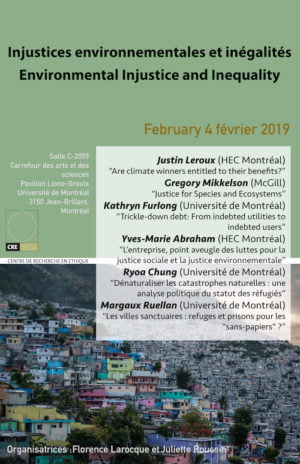
« Injustices environnementales et inégalités » / « Environmental Injustice and Inequality » @ Salle C-2059, Carrefour des arts et des sciences, Pavillon Lionel-Groulx, UdeM
13 h 30 – 17 h 00
Coorganisatrices/ Co-organizers :
Florence Larocque (fl2287@columbia.edu) et Juliette Roussin (juliette.roussin@umontreal.ca), stagiaires postdoctorales / postdoctoral fellows, Centre de recherche en Éthique
Description :
Quelle est la pertinence du concept d’injustice environnementale? Quels sont les enjeux de redistribution et de réparation dans le champ environnemental? En interrogeant l’intersection des formes d’inégalités (socio-économiques, politiques, spatiales, environnementales), cet atelier vise à réfléchir à la relation entre les injustices environnementales et l’exclusion ou la marginalisation. Il est aussi l’occasion de se demander si et comment le combat pour la protection de l’environnement peut s’inscrire dans une lutte sociale.
How relevant is the concept of environmental injustice? What redistributive and restorative issues do environmental problems raise? In questioning the intersection of geographical, socio-economic, political and environmental inequality, this workshop aims at exploring the relationship between environmental injustices on the one hand and exclusion and marginalization on the other. It also raises the question of whether, and under which conditions, environmental mobilization may be part of a social justice movement.
Programme (affiche) :
13h30 : What is environmental injustice?/ Qu’est-ce qu’une injustice environnementale?
Justin Leroux (Professeur, Institut d’Économie appliquée, HEC Montréal) – “Are Climate Winners Entitled to their Benefits?”
Gregory Mikkelson (Professor, Department of Philosophy/ School of Environment, McGill) – “Justice for Species and Ecosystems”14h30 : Pause / Break
14h40 : Environnement et justice sociale / Social justice and the environment
Kathryn Furlong (Professeure, Département de Géographie, Université de Montréal) – “Trickle-Down Debt: From Indebted Utilities to Indebted Users”
Yves-Marie Abraham (Professeur, Département de Management, HEC Montréal) – « L’entreprise, point aveugle des luttes pour la justice sociale et la justice environnementale »15h40 : Justice, climat et migrations / Justice, climate and migrations
Ryoa Chung (Professeure, Département de Philosophie, Université de Montréal) – « Dénaturaliser les catastrophes naturelles : une analyse politique du statut des réfugiés climatiques »
Margaux Ruellan (PhD en philosophie, Université de Montréal) – « Les villes sanctuaires : refuges et prisons pour les « sans-papiers » ? »16h45: Cocktail
Source de l’image.
-
« Varieties of epistemic constitutivism » @ Salle 223
10 h 00 – 12 h 00
Atelier GRIN/CRÉ intitulé « Varieties of epistemic constitutivism »
Charles Côté-Bouchard (GRIN, CRÉ, Université de Montréal)
Résumé
Epistemic constitutivism (EC) seeks to ground the epistemic domain in constitutive features relevant to agency. In this presentation, I examine the prospects of EC via two distinctions within the epistemic constitutivist family. The first is between what I call requirement-constitutivism (ERC) and normative-constitutivism (ENC). This distinction is about what epistemic constitutivism should try to ground. While ERC only seeks to ground the requirements (norms, standards, rules) of epistemology, proponents of ENC want to go further and ground the normative authority of those epistemic requirements.The second distinction, which draws from recent work by Kate Nolfi and Amy Flowerree, is between belief-constitutivism (EBC) and action-constitutivism (EAC). This second distinction is about what should do the grounding in epistemic constitutivism. While EBC grounds the epistemic in what is constitutive of belief, EAC invokes the constitution of action or agency more generally. My goal is to formulate and evaluate the four possible versions of EC that we get from these distinctions. I argue that all four versions of EC face serious problems. Constitutivism is therefore not a promising approach to grounding the epistemic domain.
-
Geneviève Rousselière (Duke University) @ Salle C-2059, Carrefour des arts et des sciences
9 h 00 – 11 h 00

Les membres du GRIPP sont heureux d’accueillir Geneviève Rousselière, qui offrira une présentation intitulée “Finding the Sources of Solidarity: Durkheim’s Social Republicanism”.
Commentateur: Gabriel MonetteTexte disponible sur demande, pour celles et ceux qui prendront part à l’atelier.Bio:
Geneviève Rousselière is Assistant Professor of Political Science at Duke University. Her research focuses on modern and contemporary political philosophy, social theory, republicanism and democratic thought. She is finishing a book entitled Sharing Freedom: Republican Democracy from Rousseau to Durkheim.

-

Dans le cadre de ses midis de l’éthique, le CRÉ accueille Maude Ouellette-Dubé, de l’Université de Fribourg, en séjour au centre. Maude offrira une présentation intitulée : « What is moral understanding ? »
Résumé
Moral epistemology, similar to epistemology in general, is characterized by a search for knowledge and questions such as “does moral knowledge exist and, if yes, how can we gain some?”, “what is good and how can we know?” or again “what is a morally right action?” are central to it. In trying to answer these questions the moral inquiry centers on how and whether we can gain moral knowledge, that is, how we can come to have a justified true moral belief. While it is uncontroversial that moral epistemology echoes a search for moral knowledge, some have questioned whether this needs to be so. Over and above moral knowledge, some defend the view that the primary goal of the moral inquiry should be to gain moral understanding (Hills 2009, 2011). There are many reasons to favor the pursuit of moral understanding over that of moral knowledge. For instance, moral understanding is considered central in an account of morally worthy action. Again when an agent has moral understanding she is more reliable because she has a systematic grasp of the subject at hand and, presumably, an ability to reliably make good judgements about new cases. The account of moral understanding favored in the literature is explanatory understanding or “understanding why”. In this case, the agent is said to understand when she grasps the reasons “why P”. In the case of moral understanding “P” has moral content: “understanding why lying is wrong”, “understanding why an action is right”. I argue that to reduce moral understanding to explanatory understanding is not satisfactory because it does not fully capture what it is to morally understand. I suggest that an account of moral understanding as explanatory understanding makes us fail to recognize another kind of understanding which I will call “experiential understanding” and which seems necessary to a full account of moral understanding. In presenting my account of experiential understanding I hope to motivate the idea that a full account of moral understanding is a type of “understanding how”, namely, understanding how to live well.
-
François Boucher (Paris 1 – Sorbonne, Institut des sciences juridiques et philosophiques) @ Salle 309
11 h 00 – 12 h 15

Présentation de François Boucher, ancien postdoc du CRÉ, intitulée « Against Social Credit Scores? Privacy, friendship and equality ».
Source de l’image.
-
« Race et racisme » et « Citoyenneté, piété et démocratie » @ Salle 422
16 h 00 – 18 h 00

Nous sommes ravi.e.s de vous convier à notre prochain 5 à 7 du CRÉ. Ce sera l’occasion d’entendre deux de vos collègues présenter leurs travaux à tour de rôle. Une discussion suivra chacune des présentations.
Au programme:
Luc Faucher: « Race et racisme à la lumière des sciences cognitives ».
Valérie Amiraux: « Citoyenneté, piété et démocratie. Réflexions sur l’occultation des corps croyants, l’intimité et le droit au secret ».
Bienvenu à tou.te.s!
-
Internet et éthique de la croyance : les dangers épistémiques de la personnalisation @ Salle 309
11 h 00 – 12 h 15

À l’occasion des midis de l’éthique du CRÉ, Charles Côté-Bouchard nous offrira une présentation intitulée « Internet et éthique de la croyance: les dangers épistémiques de la personnalisation ».
Résumé:
Bon nombre de nos croyances se forment aujourd’hui en ligne. Les plateformes Web comme Google, Facebook et YouTube sont bien souvent notre principale source d’information sur des sujets aussi importants que l’actualité, la santé et la science. Or, l’une des principales caractéristiques de ces plateformes est qu’elles sont personnalisées. Grâce à des algorithmes de plus en plus sophistiqués, ces sites offrent à chaque utilisateur un contenu différent, personnalisé en fonction de données comme son historique d’utilisation et son profil démographique. Dans cette présentation, je soutiens que malgré ses avantages, cette tendance récente s’accompagne d’importants problèmes épistémiques. En effet, le caractère de plus en plus personnalisé de ces plateformes nuit à l’acquisition d’importants biens épistémiques. La personnalisation tend non seulement à nous induire en erreur, elle prive également plusieurs de nos croyances vraies du statut de connaissance. Plus précisément, elle va à l’encontre de conditions souvent associées à la connaissance comme la fiabilité, la sensibilité et la sûreté. Ainsi, dans bien des cas, même si les sites comme Facebook, Google et YouTube nous fournissent la bonne réponse à une question, ils ne nous permettent pas de connaître véritablement cette réponse.
-

Dans le cadre des ateliers du GRIN, Stephanie Leary (McGill) offrira une présentation intitulée “What is Moorean Non-naturalism?” .
Abstract:Most metaethicists take the sort of non-naturalist view endorsed by Moore and his followers to amount to either a claim about identity or a claim about grounding. In this paper, however, I argue that specifying non-naturalism just in terms of identity is at best not illuminating, and specifying the view in terms of grounding either makes the naturalism vs. non-naturalism debate settled by general metaphysical considerations or fails to make room for Moore himself to count as a genuine non-naturalist. So, instead, I propose that we understand the view in terms of essence: specifically, as the claim that the essences of at least some normative properties cannot be ultimately specified in entirely non-normative terms and do not specify non-normative sufficient conditions for their instantiation. Characterizing the view in these terms most clearly captures the non-naturalist’s core pre-theoretical claims in a way that makes it a substantive, local view about normative properties and makes room for Moore.
-
Déclaration de Montréal IA responsable / Montreal Declaration responsible AI @ Société des arts technologiques
7 h 00 – 10 h 00

INVITATION AU LANCEMENT DE LA DÉCLARATION DE MONTRÉAL IA RESPONSABLE
L’Université de Montréal, en collaboration avec les Fonds de recherche du Québec et ses partenaires, vous convie au lancement officiel de la Déclaration de Montréal pour un développement responsable de l’intelligence artificielle.
Le 3 novembre 2017, lors du Forum IA responsable tenu au Palais des congrès de Montréal, était dévoilée la version préliminaire de la Déclaration. Ce texte visait à susciter un débat public et à proposer une orientation progressiste et inclusive du développement de l’IA. Un an plus tard, nous dévoilons la nouvelle version de la Déclaration de Montréal IA responsable, enrichie de l’expérience citoyenne et des perspectives d’experts de tout horizon.
Rémi Quirion, scientifique en chef du Québec, et Yoshua Bengio, directeur scientifique du Mila et de l’IVADO, et membre du comité d’orientation de la Déclaration, ouvriront officiellement cet événement tant attendu.
Marc-Antoine Dilhac, instigateur du projet et responsable du comité d’élaboration de la Déclaration, Christophe Abrassart, codirecteur scientifique de la coconstruction et Nathalie Voarino, coordonnatrice scientifique de l’équipe de la Déclaration, présenteront les principes et les recommandations au cœur de la Déclaration IA responsable. Jocelyn Maclure animera un panel portant sur la Déclaration, le processus suivi ayant mené à son terme de même que sur les recommandations.
S’ensuivra un panel de collaborateurs pour échanger sur la portée de la Déclaration dans les différents secteurs d’activité, au niveau national et international.
Nous vous accueillons dès 8 h !
Les places sont limitées.
***
INVITATION TO THE OFFICIAL LAUNCHING OF THE MONTREAL DECLARATION RESPONSIBLE AI
The Université de Montréal, in collaboration with the Fonds de recherche du Québec and his partners, is pleased to invite you to the official launching of the Montreal Declaration for a Responsible Development of Artificial Intelligence.
November 3, 2017 at the conclusion of the Forum Responsible AI, held at the Palais des congrès de Montréal, was announced the preliminary version of the Declaration, aiming to spark public debate and encourage a progressive and inclusive orientation to the development of AI. A year later, we are unveiling a new version of the Declaration Responsible AI, enriched by the citizen experience and the expert perspectives from all horizons.
Rémi Quirion, Chief Scientist of Québec, and Yoshua Bengio, Scientific Director of Mila and IVADO, and member of the Declaration Steering Committee, will officially open this greatly anticipated event.
Marc-Antoine Dilhac, Project Instigator and Leader of the Declaration Development Committee, Christophe Abrassart, Leader of the Citizen deliberation and Co-construction, and Nathalie Voarino, Scientific Coordinator of the Declaration team, will present the principles and recommendations that lie at the heart of the Declaration. Jocelyn Maclure will chair a panel discussion on the Declaration, the process that has been completed and the recommendations.
A panel of collaborators will follow, regarding the scope of the Declaration in different sectors of activity, on national and international level.
We look forward to seeing you from 8:00 AM onwards!
Places are limited.
-
Ariel Cascio, Pragmatic Health Ethics Research Unit of the Institut de recherches cliniques de Montréal @ Salle 3014-7
13 h 00 – 14 h 30
Title: Person-oriented research ethics guidelines for autism research: Collaboratively developed best practices
Abstract: Autism is a spectrum condition characterized by differences in social interaction and social communication, and by the presence of restricted, repetitive patterns of behavior and interest, including atypical sensory and perception experiences. Autism diagnoses and autism research have increased dramatically in recent decades, across clinical and social sciences as well as ethics and the humanities. This talk addresses ethical and social issues in autism research, drawing on the model of person-oriented research ethics which focuses particularly on the everyday relational and experiential aspects of research participation. Through a review of autism research ethics literature and collaboration with a task force of autism stakeholders (including autistic self-advocates, parents, advocates, professionals, and researchers), we have developed a list of best practices and actionable suggestions for researchers looking to include participants on the autism spectrum in their studies. This talk will present some of these guidelines and reflect on the process of collaboratively developing them, as well as steps for future implementation.
Bio: Ariel Cascio, Ph.D. is a postdoctoral fellow at the Pragmatic Health Ethics Research Unit of the Institut de recherches cliniques de Montréal (Québec, Canada). Dr. Cascio received a doctorate in anthropology from Case Western Reserve University (Cleveland, OH, USA) after completing 11 months of ethnographic research on the experiences of adolescents and youth accessing autism-focused services in Italy. Several ongoing projects, primarily related to autism spectrum conditions, use lenses from anthropology and disability studies and focus on social and ethical issues, including in the context of research and health and human services. Dr. Cascio’s has been funded by the US-Italy Fulbright Commission and the Social Sciences and Humanities Research Council of Canada’s Banting Fellowship Program.
-
Nicholas Dunn et Taher Saaz @ Salle C-2059, Carrefour des arts et des sciences
14 h 00 – 16 h 00
Fellows Research Workshop / Atelier de recherche des boursier.e.s
Nicholas Dunn: “From Kantian Pluralism to Arendtian Plurality: on Representative Thinking and World Citizenship”
Commentator: Aberdeen BerryTaher Saaz: “De l’interdiction de la burqa: Analyse des philosophies publiques d’intégration en Suisse et au Québec”
Commentator: Éliot LitalienLes participants doivent avoir lu les articles préalablement à la rencontre. Pour les obtenir, veuillez contacter Nina Ahrendt: nina.ahrendt@mcgill.ca.
-
« Que pensent les animaux de la zoothérapie? » @ Doggy Café, 2e étage
14 h 00 – 15 h 30
Au cours du mois de novembre dernier se tenait l’activité « Zooanimation », lors de laquelle les étudiant.e.s de l’UdeM était invité.e.s à « venir retrouver et câliner Ti-Gars, le chat, ainsi que ses compagnons canidés Winnie et Dalya », afin de « décompresser durant la session ».
Que faut-il penser des activités comme celle-là? Surtout, « Que pensent les animaux de la zoothérapie? ». C’est la question à laquelle Sophie Lecompte, consultante en comportement félin, répondra. Ce sera l’occasion de discuter avec elle des enjeux éthiques entourant cette utilisation d’animaux non humains pour des fins humaines.
Animation: Frédéric Côté-Boudreau et Valéry Giroux.
Vous êtes attendu.e.s – avec votre chien ou pas – au Doggy Café!

-
Rémi Beau (Paris 1 Panthéon/Sorbonne) @ Salle 309
12 h 00 – 13 h 15
Le GRÉEA est heureux d’accueillir Rémi Beau (Paris 1), qui nous offrira une présentation intitulée « L’éthique de la nature ordinaire comme variété du perfectionnisme moral ».
Résumé :
À partir d’une réflexion sur l’ordinaire, je reviendrai sur deux des grands débats qui ont animé le développement du courant des éthiques environnementales, articulés respectivement autour de la question de la wilderness, d’une part, et de la critique pragmatiste de l’inefficacité pratique des théories non anthropocentristes, d’autre part. Je chercherai à montrer comment aborder l’éthique environnementale sous l’angle du perfectionnisme émersonien, décrit par Stanley Cavell, permet de proposer des éléments de réponse aux critiques soulevées lors de ces deux débats.
-
François Hudon (Institute for Ethics, History, and The Humanities, University of Geneva) @ Charles Meredith Buiding
12 h 00 – 13 h 30
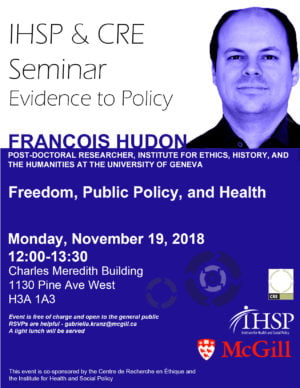
Joint conference IHSP & CRÉ
Seminar Evidence to Policy
« Freedom, Public Policty, and Health »
François Hudon (Post-doctoral Researcher, Institute for Ethics, History, and The Humanities at the University of Geneva).
-
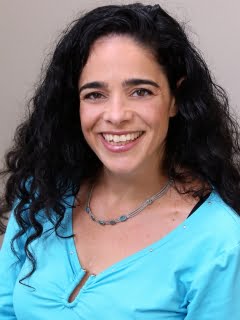
Dans le cadre de leur Ateliers de la bioéthique, les membres de l’axe Éthique et santé du CRÉ sont heureux.ses d’accueillir Sharon Bassan (Princeton University), qui offrira une présentation intitulée « Surrogacy – On Reproductive Labor and Labor Law ».
Abstract
This talk aims to explore whether labor law is an appropriate mechanism to regulate cross-border surrogacy. Work-related arguments concerning surrogacy usually support the view that commercial surrogacy deserves some sort of remuneration. In this talk, I do not oppose commercial surrogacy per se, but rather argue that not all forms of work are part of the labor market, and not all forms of earning in the market are necessarily work. I focus on the conceptualization of surrogacy as work, the surrogate as a worker, and on labor law, which should accordingly be assumed appropriate for regulating such markets. To do that, I analyze the purpose of labor law and the conceptual framework of work and worker, and examines their applicability to the conduct of surrogacy arrangements.
Short bio
Sharon Bassan is a second year Postdoctoral Research Associate with a joint appointment in the University Center for Human Values and the Woodrow Wilson School’s Office of Population Research in Princeton University. A bioethicist, with a PhD and JD in law, Sharon is interested in issues of health law/policy and bioethics, in particular in the areas of the ethics of reproductive technologies, health markets, global health governance and global justice. Her current project is a book about the regulation of cross-border surrogacy.
-
Lancement du livre: Do central banks serve the people? @ Librairie Paragraphe Bookstore
15 h 15 – 17 h 00

Lancement du livre Do central banks serve the people?, de Peter Dietsch, François Claveau et Clément Fontan.
Central banks have become the go-to institution of modern economies. In the wake of the 2007 financial crisis, they injected trillions of dollars of liquidity – through a process known as quantitative easing – first to prevent financial meltdown and later to stimulate the economy. The untold story behind these measures and behind the changing roles of central banks generally is that they have come at a considerable cost. Central banks argue we had no choice. This book offers a powerfully original examination of why this claim is false. Using examples from Europe and the US, the authors present and analyse three specific concerns about the way central banks in developed economies operate today. Firstly, they show how unconventional monetary policies have created significant unintended negative consequences in terms of inequalities in income and wealth. They go on to argue that central banks may have become independent of governments, but have instead become worryingly dependent on financial markets. They then proceed to analyse how central bankers, despite being the undisputed experts on monetary policy, can still err and suffer from multiple forms of bias.
Participeront au lancement: Peter Dietsch (Université de Montréal), François Claveau (Université de Sherbrooke) et Juliet Johnson (McGill).
-
Paul Boghossian (New York University) @ Room 201, S Annex, Sir George Williams Campus, Concordia University
15 h 00 – 17 h 00
Dans le cadre de ses ateliers mensuels, le GRIN recevra Paul Boghossian (New York University), qui offrira une présentation intitulée « The Boundaries of Inference ».
Boghossian will look at how we should decide the question what inference is and discuss some objections to his ‘intellectualist’ and ‘agential’ conception of inference.
Organisé par Ulf Hlobil et tenu à Concordia.
-
« Animal welfare organizations: responding to ethical challenges » @ SPCA de Montréal
21 Oct – 22 Oct Jour entier
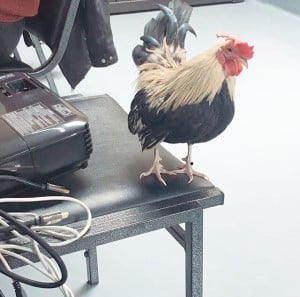
Le premier atelier de travail, en partenariat GRÉEA/CRÉ/SPCA, réunissait des chercheurs en philosophie morale et en philosophie politique, des employé.es de la SPCA et Tommy le coq.
Autres participant.es:
Frédéric Côté-Boudreau (Queen’s U.); Élise Deslaulniers (SPCA); Nicolas Delon (U. of Florida); Sue Donaldson (Queen’s U.); Hosanna Galea (McGill U.); Valéry Giroux (CRÉ); François Jaquet (Stockholm U.); Will Kymlicka (Queen’s U.); Angela Martin (Université de Fribourg); Angie Pepper (Birminham U.); Agnes Tam (Queen’s U.) Kristin Voigt (McGill U.).
Les discussions donneront lieu à une conférence tenue en mars 2019 et visant à présenter le travail des chercheurs.ses sur les enjeux éthiques soulevés par les employés de la SPCA de Montréal.


-
Relational Autonomy in Fiction @ Université McGill, salle de conférence 101 de la maison Charles Meredith (Institute for Health and Social Policy)
Jour entier

(English will follow)
Journée d’étude intitulée “Relational Autonomy in Fiction” à l’occasion de laquelle les conférencier.e.s suivant.e.s seront entendu.e.s:
David Collins (McGill University)Rebekah Johnston (Wilfrid Laurier University)Sam Shpall (The University of Sydney)Natalie Stoljar (McGill University)Andrea Westlund (Florida State University)Voici l’affiche de l’événement de même que le programme et les résumés des présentations.Pour ceux d’entre vous qui voudraient assister à la journée entière et partager le dîner avec les autres participants, l’inscription est obligatoire. S’il vous plaît, veuillez vous inscrire en m’écrivant (eliot.litalien@mail.mcgill.ca) d’ici au 12 octobre 2018. _____________________________
Full-day Workshop on Relational Autonomy in Fiction. Will present at the workshop:David Collins (McGill University)Rebekah Johnston (Wilfrid Laurier University)Sam Shpall (The University of Sydney)Natalie Stoljar (McGill University)Andrea Westlund (Florida State University)You will find attached a poster for the event and a provisional schedule and abstracts for the presentations.For those of you who would want to attend the full day and enjoy lunch along with the other participants, registration is required. Please register by emailing me (eliot.litalien@mail.mcgill.ca) before 12 October 2018.