Past events
Calendar archives
-
Briana Toole (Claremont McKenna College) @ Université du Québec à Montréal
15 h 00 – 17 h 00

Briana Toole (Claremont McKenna College) will give a presentation entitled “Standpoint Epistemology – Social or Applied?” at the Université du Québec à Montréal.
Registration is required. Information about the room and exact location of the presentation will provided after registering via the following link.
The event is co-organized by the Centre de Recherche en Éthique (CRÉ) and the Canada Research Chair on Epistemic Injustice and Agency.
Abstract
As a standpoint epistemologist, I have sometimes been called an “applied epistemologist”. But is this characterization of standpoint epistemology correct? On the surface, one might think the distinction is insignificant. But I argue that the interpretation of standpoint epistemology as an applied epistemology serves an important ideological purpose: it preserves an epistemological landscape wherein mainstream, or traditional epistemology, is the default theory of knowledge. This in turn diminishes some of the central insights of standpoint epistemology, most notably those that represent standpoint epistemology as an alternative to classical theory, or demand a revision of key components of traditional epistemology.
This paper aims to accomplish two tasks: first, to show that standpoint epistemology, though a social epistemology, is not an applied epistemology. I’ll then argue that classical epistemology is social in many of the same ways that standpoint epistemology is – it merely hides this fact. In epistemology, traditional epistemology holds pride of place. It maintains this grip on the field primarily through the devaluation of alternatives, like standpoint theory. By clarifying the relationship between the social and applied, as well as between traditional and standpoint, I hope to de-center traditional epistemology, and to reposition it as but one theory among many.
-
Hugues-Leblanc Conference 2024: Simon Caney on Climate Justice @ Université du Québec à Montréal
10 Oct 15 h 30 – 11 Oct 15 h 30
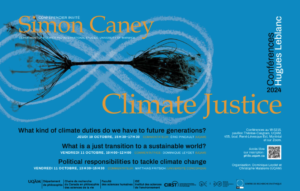
The Departement of philosophy at UQAM invites you to the 2024 Hugues-Leblanc lectures, October 10th-11th, room W-5215.
Guest speaker Prof. SIMON CANEY (Department of Politics and International Studies, University of Warwick) will deliver three lectures on the theme: CLIMATE JUSTICE
Schedule:
“What Kind of Climate Duties Do We Have to Future Generations?”
Thursday, October 10th, 15:30-17:30 (Eastern Standard Time)
Commentator: Éric Pineault (UQAM)
“What is a Just Transition to a Sustainable World?”
Frisday, October 11th, 10h00-12h00 (Eastern Standard Time)
Commentator: Dominique Leydet (UQAM)
“Political Responsibilities to Tackle Climate Change”
Vendredi 11 octobre, 13h30-15h30 (Eastern Standard Time)
Commentator: Matthias Fritsch (Concordia)
All activities will take place in person, room W-5215 (UQAM, Departement of philosophy, 455 Boulevard René-Lévesque Est, Montréal, Québec, Canada). Refreshments will follow the talks, as well as a light lunch on Friday noon.
Can’t make it in-person? The talks will be available online through Zoom.
In any case, please register (required) here.
For more information, check the following website.
Organization: Dominique Leydet (leydet.dominique@uqam.ca) and Christophe Malaterre (malaterre.christophe@uqam.ca)
This event is organized with the support of the Département de philosophie, the Chaire de recherche du Canada en philosophie des sciences de la vie, the Faculté des Sciences humaines, the Institut des sciences de l’environnement de l’UQAM, the Centre interuniversitaire de recherche sur la science et la technologie, the Groupe de recherche interuniversitaire en philosophie politique, and the Centre de recherche en éthique.
-
The Montreal Workshop on Emotions and Normativity @ W-3235, UQAM [Hybrid]
10 Oct – 11 Oct All day

The Montreal Workshop on Emotions and Normativity aims to discuss recent work on fundamental questions at the intersections of the philosophy of normativity, (meta-)ethics, and the philosophy of emotion.
Keynote speakers: Justin D’Arms (Ohio State University), Alexandra King (Simon Fraser University), Laura Silva (Université Laval), Christine Tappolet (Université de Montreal)
Additional speakers: Alex Carty (McGill University), Alejandro Macías Flores (Université de Montreal), Anne-Marie Gagné-Julien and Zoey Lavallee (McGill, CRÉ), Melissa Hernández Parra (Université de Montreal), Guillaume Soucy (Université du Québec à Montreal)
Registration required to attend in person via this link.
To attend online, register here.Day 1 – Thursday October 10th
9h15: Opening remarks from Ryoa Chung (coffee/snacks provided)
9h30: Morning keynote – Justin D’Arms (Ohio State University), Title TBD
10h45: Alexander Carty (McGill), “Blame and Blameworthiness are Agent-Relative”
12h00: Lunch break
13h00: Anne-Marie Gagne-Julien and Zoey Lavallee (McGill, CRE), “Affective Injustice in Psychiatry: Emotion Hegemonizing and Psychiatric Drugs”
14h15: Melissa Hernandez Parra (Université de Montréal), “The Relativist Challenge to Moral Attributions: Addressing Variation in Responsibility Practices”
15h30: Coffee Break
15h45: Afternoon keynote: Laura Silva (Université Laval), “Feeling Reasons and Believing Feelings”
18h00: Dinner at Bistro Tendresse (1259 Rue Ste Catherine East)Day 2 – Friday October 11th
10h00: Morning keynote: Christine Tappolet (Université de Montréal), Title TBD
11h15: Alejandro Macías Flores (Université de Montréal), “No Way José! A phenomenological analysis of incredulity”
12h30: Lunch Break
14h00: Guillaume Soucy (Université du Québec à Montréal), “Aesthetic constructivism: an attempt at a formal definition of the aesthetic standpoint”
15h15: Coffee break
15h45: Afternoon keynote: Alex King (Simon Fraser University), Title TBD
17h30: 5à7 at Ginkgo, UQAM, 308 Rue Ste Catherine EastFor any inquiries and further information, please contact: Alex Carty (alexander.carty@mail.mcgill.ca)
Organization: Alex Carty (McGill), Melissa Hernandez (UdeM) and Guillaume Soucy (UQÀM), with the support of the Centre de recherche en éthique (CRÉ), the Groupe de recherche interuniversitaire sur la normativité (GRIN) and the Canadian Journal of Philosophy.
-
Annabelle Lever (Science Po, Paris) @ Room 309, UdeM, hybrid
12 h 00 – 13 h 30

Annabelle Level (Science Po, Paris) will be presenting her recent work at the CRÉ: “The equal right to Stand as a Candidate and the Democratic Value of Election”. The lecture will be followed by a discussion chaired by Charles Blattberg (UdeM).
To participate via Zoom, click here.
If you plan to participate in the event and would like to receive a copy of the article that will be presented, please write to valery.giroux@umontreal.ca.
-
Conference Series “Exclusions et dissidences démocratiques” at Université Laval @ Université Laval
2 Oct 9 h 00 – 4 Oct 16 h 00
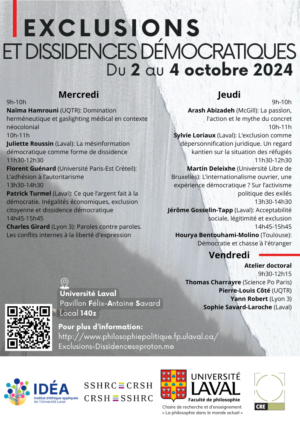
Schedule
Wednesday October 2nd:
- 9h00-10h00: Naïma Hamrouni (Université du Québec à Trois-Rivières): Domination herméneutique et gaslighting médical en contexte néocolonial
- 10h00-11h00: Juliette Roussin (Université Laval): La mésinformation démocratique comme forme de dissidence
- 11h30-12h30: Florent Guénard (Université Paris-Est Créteil): L’adhésion à l’autoritarisme
- 13h30-14h30: Patrick Turmel (Université Laval): Ce que l’argent fait à la démocratie. Inégalités économiques, exclusion citoyenne et dissidence démocratique
- 14h45-15h45: Charles Girard (Lyon 3): Paroles contre paroles. Les conflits internes à la liberté d’expression
Thursday October 3rd:
- 9h00-10h00: Arash Abizadeh (Université McGill): La passion, l’action et le mythe du concret
- 10h00-11h00: Sylvie Loriaux (Université Laval): L’exclusion comme dépersonnification juridique. Un regard kantien sur la situation des réfugiés
- 11h30-12h30: Martin Deleixhe (Université Lubre de Bruxelles): L’internationalisme ouvrier, une expérience démocratique? Sur l’activisme politique des exilés
- 13h30-14h30: Jérôme Gosselin-Tapp (Université Laval): Acceptabilité sociale, légitimité et exclusion
- 14h45-15h45: Hourya Bentouhami-Molino (Toulouse): Démocratie et chasse à l’étranger
Friday October 4th:
- 9h30-12h15: Doctoral workshop with Thomas Charrayre (Science Po Paris), Pierre-Louis Côté (Université du Québec à Trois-Rivières), Yann Robert (Lyon 3) and Sophie Savard-Laroche (Université Laval)
Registration
The event is co-sponsored by the Institut d’éthique appliqué de l’Université Laval (IDÉA), the Social Sciences and Humanities Research Council of Canada (SSHRC), the faculté de philosophie de l’Université Laval, and the Centre de recherche en éthique (CRÉ).
-
Philosophy of social movements @ Room 3038, Pavillon Marguerite D'Youville
9 h 00 – 16 h 00
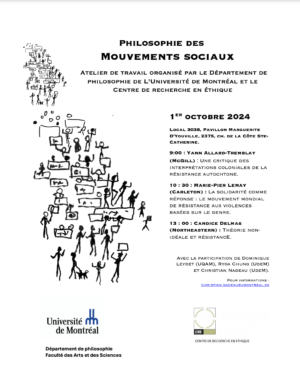
Workshop organized by Christian Nadeau for the Department of Philosophy at the University of Montreal and the Centre de recherche en éthique (CRÉ).
The event will be held in French.
9:00: Yann Allard-Tremblay (McGill): A Critique of Colonial Interpretations of Indigenous Resistance.
10:30: Marie-Pier Lemay (Carleton): Solidarity as a Response: The Global Movement of Resistance Against Gender-Based Violence.
13:00: Candice Delmas (Northeastern): Non-Ideal Theory and Resistance.
With the participation of Dominique Leydet (UQAM), Ryoa Chung (UdeM), and Christian Nadeau (UdeM).
For more information: Christian.nadeau@umontreal.ca
-
La désobéissance incivile. Discussion avec la philosophe Candice Delmas @ Le Port de tête bookstore
19 h 00 – 20 h 30

The CRÉ is delighted to invite you to an evening of discussion, in French, on the themes of resistance, activism, and civil and uncivil disobedience, featuring Candice Delmas, philosopher at Northeastern University in Boston, as she presents her book, The Duty to Resist, recently translated in French.
All are welcome!
Event organization, moderation, and inquiries: Christian Nadeau (christian.nadeau@umontreal.ca).
What are our responsibilities in the face of injustice? Philosophers often argue that citizens of a generally just state must obey the law, even when it is unjust, except in rare cases of civil disobedience to protest specific issues. Activists, on the other hand—whether fighting for civil rights, combating violence against women, or addressing the climate crisis—often believe that the primary obligation is to resist injustice.
Reexamining the concept of political obligation, Candice Delmas demonstrates that the duty to resist is grounded in the same principles as the duty to obey the law. Forms of uncivil disobedience, from offering clandestine aid to migrants and leaking unauthorized documents to ecosabotage and cyberattacks, can sometimes be justified, and even morally required, in democratic societies.
It is through such illicit and uncivil actions that the Freedom Riders challenged segregation in the United States, that #BlackLivesMatter exposed police violence, and that #MeToo revealed the widespread nature of harassment and femicide. Incivility disrupts, accuses, and makes indifference impossible, forcing people to take a stand.
So, what is legitimate to do in defense of a just cause in a rule-of-law state that turns a blind eye to critical issues?
-
Research Group on Global Justice (RGGJ) International Conference: Practical, Political, and Institutional Progress @ Thomson House
24 Sep 8 h 45 – 25 Sep 17 h 00
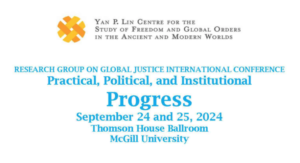
The Research Group on Global Justice (RGGJ) of the Yan P. Lin Centre is pleased to invite you to its 2024 Conference on “Practical, Political, and Institutional Progress”, taking place this September 24 and 25, in the Thomson House Ballroom at McGill University. The conference brings together senior and junior scholars working on progress and related topics that have practical, political and institutional import for understanding and theorizing global justice, broadly conceived.
The papers will be distributed in advance. To register and view the full program of the event, as well as receive the papers, click here.
An event organized by Catherine Lu (McGill University) and co-sponsored by the Princeton University Department of Politics, the Centre de Recherche en Éthique (CRÉ), the Groupe de Recherche Interuniversitaire en Philosophie Politique (GRIPP), and the Research Group on Constitutional Studies (RGCS) of the Yan P. Lin Centre.
-
In the memory of Charles W. Mills @ Salle C-3061, Carrefour des arts et des sciences, UdeM
16 h 00
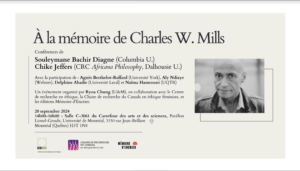
Lectures by Souleymane Bachir Diagne (Columbia U.) and Chike Jeffers (CRC in Africana Philosophy, Dalhousie U.).
With the participation of: Agnes Berthelot-Raffard (York U.), Aly Ndiaye (Webster), Delphine Abadie (Laval U.), and Naïma Hamrouni (UQTR).
An event organized by Ryoa Chung (UdeM), in collaboration with the Centre de recherche en éthique (CRÉ), the Canada Research Chair in Feminist Ethics, and Mémoire d’Encrier Publishing.
-
Online Workshop: Radical and Critical Approaches to Mental Health II @ Online
9 h 00 – 12 h 15

Online Workshop: “Radical and Critical Approaches to Mental Health II”
We are pleased to announce the second edition of the online workshop Radical and Critical Approaches to Mental Health.
Date: September 20th, 2024 (the workshop will take place online, via Zoom)
Time:
9:00 am – 12:15 pm EDT
1:00 pm – 4:15 pm GMT
3:00 pm – 6:15 pm CEST
Speakers:
- Sofia Jeppsson (Umeå University): ‘Different dissociations and philosophical distinctions.’
- Mikaela D. Gabriel (University of Toronto): ‘Kisapniaq: Exploring the evidence for ceremony and mental health care for Indigenous Peoples in Canada.’
- Alexandre Baril (University of Ottawa): ‘Radical and Critical Approach to Rethinking Suicidality: Reconceptualizing Suicide Prevention Through the Lens of Suicidism’
To register, and to see the program and abstracts for the event, click here.
We invite you to share the event flyer and information within your networks!
The event is co-sponsored by the Centre de Recherche en Éthique, Montréal (CRÉ), the Centre for Ethics, University of Toronto (C4E), and the Canada Research Chair on Epistemic Injustice and Agency (CRC-IAE).
Organizers: Anne-Marie Gagné-Julien, Zoey Lavallee, and Larisa Svirsky.
*Note that the event will take place entirely in English.
-
Lisa Herzog (UGroeningen) @ Online
11 h 00 – 12 h 00
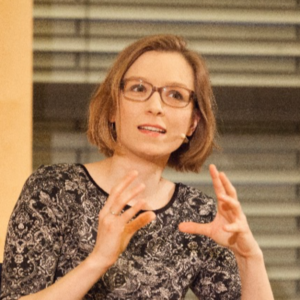
As part of the activities of the Philosophy of Work Network, Lisa Herzog (UGroeningen) will offer a presentation entitled: “Labor Markets without Market Wages”.
The activities of the Philosophy of Work Network are open to researchers and graduate students with research interests in this area. Please write to the organizers, Denise Celentano (denise.celentano@umontreal.ca) and Pablo Gilabert (pablo.gilabert@concordia.ca), to receive the zoom link.
Abstract
Should wages be determined by market forces? This paper argues against this view, based on consideration of the kind of good that labor is and what it means to “trade” it. Two arguments brought forward in favor of market wages, the desert argument and the information argument, are not only mutually incompatible but also both not convincing. The first founders on the problem of complementarities in value creation. The second fails not only because of endogeneity problems, but also because of systemic market failures in labor markets. But is it possible to give up labor markets without endangering freedom of occupation or risking problematic degrees of inefficiency? This can be achieved by understanding labor markets as matching markets, comparable to those for donor organs: what matters is creating good matches, but the price mechanism is not central for this. From this perspective, various existing institutions, such as minimum wages and collective bargaining, can be reinterpreted as “approximative institutions” that move labor markets in a more just direction.
-
8th Montreal Social Justice Theory Workshop @ Room LB-145, Concordia
27 Jun – 28 Jun All day
8th edition of the Social Justice Theory Workshop, organized by Pablo Gilabert and Peter Dietsch, for the Social Justice Centre, at Concordia, and University of Victoria.
The aim of the Social Justice Theory Workshop is to enable sustained exploration in the theory of social justice. It addresses topics such as the articulation of ideals and principles of economic, political, gender, race, environmental, and cultural justice; the critique of inequality, domination, exploitation, and alienation; and the illumination of political institutions, practices and processes of transformation that might foster progressive change.
Workshop papers will be pre-circulated, and participation implies a commitment to reading the papers in advance.
This workshop is organized by Pablo Gilabert and Peter Dietsch, in association with the Social Justice Centre (Concordia University), le Centre de Recherche en Éthique (Université de Montréal) and the Department of Philosophy at the University of Victoria.
The 8th edition of this intensive research workshop will take place on June 27-28, 2024.
The workshop will be in person. Places are limited. If you would like to participate, please send your name to Christiane Bailey (sjc@concordia.ca) by May 25, 2024.
The workshop will take place at the SHIFT Centre for Social Transformation.
Program
Pablo Gilabert (Concordia University): “Real Interests, Well-Being, and Ideology Critique.” Commentator: Denise Celentano (Universite de Montreal)
Andree-Anne Cormier (Ecole Nationale d’Administration Publique, Montreal): “Is Loneliness a Problems of Justice?” Commentator: Natalie Stoljar (McGill)
Peter Dietsch (University of Victoria): “Just incomes and climate change: Can economic justice pave the way for climate justice?” Commentator: Juliette Roussin (Laval)
Brookes Brown (University of Toronto): “The Acceptance Condition Reconsidered: Impartiality, Mutuality, and the Grounds of Fair Play. Commentator: Louis-Philippe Hodgson (University of York)
Aaron James (University of California, Irvine): “Republican Money” Commentator: Jacqueline Best (University of Ottawa)
Steven Klein (King’s College, London): “Towards a Democratic Theory of Labour Unions” Commentator: Éliot Litalien (Université de Montréal)
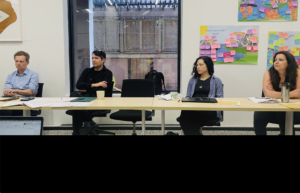
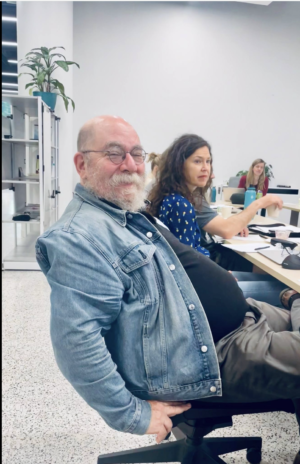
-
“Quel rôle pour les animaux dans les sciences, les pratiques et les imaginaires du réensauvagement ?” @ Room 309, UdeM, Hybrid mode
12 h 00 – 13 h 30

Virginie Maris (Centre d’Écologie Fonctionnelle et Évolutive, at Montpellier | CEFE) will give a lunch talk at CRÉ/GRÉEA.
To participate via Zoom, click here.
-
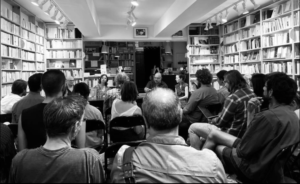
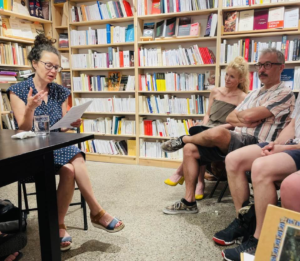
Luttes de justice sociale et environnementale: l’engagement des chercheur.ses @ Librairie Port de tête
18 h 30 – 20 h 00
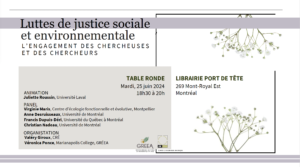
The GRÉEA and the CRÉ are pleased to invite you to a roundtable discussion on the theme of researchers’ engagement in social and environmental struggles.
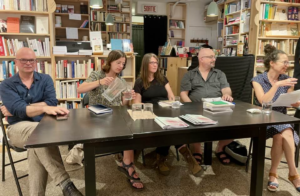
On the occasion of the visit of Virginie Maris (Centre for Functional and Evolutionary Ecology, Montpellier) who will be doing a research stay as an invited researcher at the CRÉ, Anne Desruisseaux (Université de Montréal), Francis Dupuis-Déri (Université du Québec à Montréal), and Christian Nadeau (Université de Montréal) will join Virginie to respond to questions posed by Juliette Roussin (Université Laval). An open discussion period will follow.
The event will be held at the Port de tête bookstore in Montreal.
Organization: Véronica Ponce (Marianapolis college, GRÉEA) and Valéry Giroux (CRÉ, GRÉEA).
-
Listening to our silences: Technologies, communication and marginalization @ Room C-1017-02, Carrefour des Arts & Sciences, Université de Montréal
13 Jun – 14 Jun All day

The graduate fellows of the Center for Research in Ethics (CRÉ) are pleased to announce their international conference, dedicated this year to the theme “Listening to Our Silences: Technologies, Communication, and Marginalization.”
Organizers: Thomas Emmaüs Adetou (Ph.D., UdeM); Véronique Chetmi Eyali (Ph.D., ULaval); Louis Pierre Côté (Ph.D., UQTR); Ann-Sophie Gravel (Master’s, ULaval); Gabrielle Joni Verreault (Ph.D., UdeM); Alexis Morin-Martel (Ph.D., McGill); Alexandre Poisson (Ph.D., UQÀM); and Marie-Christine Roy (Ph.D., UdeM).
Program
Day 1 – June 13
8h00-9h00: Breakfast / Welcome of participants
9h00: Keynote talk 1. Kevin Macnish (University of Leeds)
10h15: Break
10h30-12h30: Panel 1. Social justice , identity and inclusion
Nick Clanchy (McGill), “Infrapolitical Strategies for Tackling Hermeneutical Injustices Amidst the Global Trans Panic”.
Sandrine Renaud (UQTR), “Causeries injustes: les campagnes de sensibilisation à la stigmatisation en santé mentale et la reproduction des injustices épistémiques”.
Alex Desrochers Yanakis (UQÀM), “La figure mythique de Cassandre selon une perspective neurodivergente ou comment faire lire un roman sur l’autisme à un public qui ne veut rien savoir sur le sujet”.
12h30-13h30: Lunch
13h30-16h00: Viewing of the film “À mort le bikini” (2023), and animated discussion with director Justine Gauthier and guiding text “The Art of Not Being Sexed Quite So Much: A Feminist Reading of Roland Barthes” (2023) Lila Braunschweig.
16h00: Closing remarks for the day
Day 2 – June 14
8h00-9h00: Breakfast / Welcome of participants
9h00-11h00: Panel 2. Silencing, marginalization and resistance
Alejandro Macías Flores (UdeM); Raquel Maroño Vázquez (IMDHD); Alexia Martínez Montalban (ind. researcher), “Practices of Silencing in the Mexican Disappearance Crisis”.
Saja Farhat (UdeM) “Silences connectés: la marginalisation dans l’ère numérique”.
Emmanuelle Chartrand (UQTR), “Soutenir la quête et construction de sens pour et avec les familles en situation de négligence: vers une
pratique participative de l’utilisation psychoéducative”.11h00: Break
11h15-12h30: Keynote talk 2. William M. Paris (University of Toronto)
12h30: Closing remarks of the conference
-
“Affective Injustice in Psychiatry: Emotion Policing and Medication Centrism” @ Room 309, hybrid
12 h 00 – 13 h 15

Midis de l’éthique series: presentation by Zoey Lavallee and Anne-Marie Gagné-Julien “Affective Injustice in Psychiatry: Emotion Policing and Medication Centrism”.
To participate on Zoom, click here.
-

As part of the CRÉ lunchtime conferences, Denise Celentano (UdeM) will give a presentation entitled “Status Labor”.
To participate via Zoom, click here.
Abstract
The concept of status is usually taken to describe people’s standing in the social hierarchy, referring to relatively static positions in the social order. Yet status norms have a dynamic side to them, too: they also require individuals to “do” status. I refer to the work of “doing status” as “status labor.” Status labor is the work that agents are implicitly expected to perform in order to act and counteract social status ascriptions. Status ascriptions are culturally mediated presumptions of competence triggered by social identifiers. The belief of lower competence in women, black or working-class people is an example. Status labor is the work implied by that belief, e.g., working harder to prove one’s competence or self-polishing to fit norms of suitability. Status labor perpetuates social hierarchies by inflicting higher contributory burdens on lower status agents. The presentation focuses in particular, but not exclusively, on the status labor that agents perform in the context of the workplace, where status-based expectations of suitability to roles are particularly relevant. The presentation has three main aims. First, partly drawing on the work of Erving Goffman and the sociology of social status, it conceptualizes status labor, providing an exploratory taxonomy through concrete examples and a differential analysis. Second, it locates status labor in a relational egalitarian framework. While ideas of “treatment” and “expression,” recurring in the relational egalitarian debate, tend to mostly focus on the interactional aspects of status, status labor focuses on the intra-personal work of complying with status scripts, thereby providing a more fine-grained understanding of dynamics of social subordination. Third, it formulates relational egalitarian as well as non-relational egalitarian objections to status labor.
-
ChatGPT and ethics: reflections around Large Language Models (LLM) and other generation algorithms @ Cegep de Saint-Jean-sur-Richelieu
9 h 30 – 17 h 30

The Centre de Recherche en Éthique (CRÉ), Martin Gibert and Thomas Adetou are pleased to invite you to a colloquium on ChatGPT and ethics, which will be held at the SPQ annual conference on June 6, 2024 at the Cégep de Saint-Jean-sur-Richelieu.
The topic will be the ethics of algorithms such as Midjourney or Dall.e (image generation) or Large Language Models such as ChatGPT (text generation). The aim will be to explore the ethical implications arising from the emergence of generative algorithms, highlighting the challenges and opportunities they offer in the contemporary philosophical landscape. The hope is to create and encourage a space for interdisciplinary dialogue conducive to exploring the interactions between generative algorithms and the field of ethics.
Program:
9:30am / Welcome
9:35am / Dave Anctil (Collège Brébeuf) Robopolis-3 : vers une éthique hybride et émergente de l’IA.
10: 15am/Hugo Bérard (Université de Montréal ; Chaire UNESCO en Paysage Urbain ; Mila). Enjeux éthiques liés à l’utilisation des données pour entrainer les algorithmes génératifs
10:55am Coffee break
11:10am/Andréane Sabourin Laflamme (Cégep André-Laurendeau) Les impacts sociaux de la démocratisation de l’IA générative : biais, discrimination et pistes d’actions.
11:50am/Roxanne Lépine & Thomas Amah Adetou (Université de Montréal) Entre réalité et représentation : les enjeux éthiques des IA génératives.
12:30 Lunch break
2:00pm / Victor Tremblay-Baillargeon (Université de Montréal). L’IA générative et délibération morale : une solution aux angles morts moraux ?
2:40pm /Khaoula Chehbouni (Université McGill) Mitigation des risques liés aux Grands Modèles de Langage : Enjeux et Solutions.
3:20pm Coffee break
3: 35pm /Martin Gibert (Centre de Recherche en Éthique) Faut-il avoir peur des conseillers moraux artificiels?
4: 15pm /Nicolas Tardif & Clayton Peterson (Université du Québec à Trois-Rivières 2 Chaire de recherche UQTR en éthique de l’intelligence artificielle). Agents moraux artificiels : Limites d’une approche maximisant l’utilité attendue.
4:55pm Closing remarks
-
Cette quatrième édition du colloque en philosophie économique francophone, organisé par Morgane Delorme dans le cadre de la Société de Philosophie du Québec, est l’occasion d’aborder à la fois de nouveaux thèmes et d’intégrer de nouveaux membres au sein d’un réseau en pleine émergence. Cette quatrième rencontre poursuit la constitution d’un réseau des praticien·nes québécois·e·s et francophones de la philosophie, de l’épistémologie ou de l’éthique économiques.
Cette année, un intérêt particulier est porté aux travaux de jeunes chercheur·se·s qui travaillent sur des thèmes innovants, témoignant d’un renouveau de l’éthique économique appliquée. Dans cette perspective, les dix interventions retenues abordent : la littératie financière, le limitarisme (plafonnement des salaires), la planification prospective, l’éthique de l’entreprise, la philanthropie, la fiscalité écologique, la justice sociale en contexte contemporain, le droit de vote pondéré favorablement pour les plus jeunes et le discount des catastrophes. Tous et toutes bienvenu·e·s.
9h00: Morgane Delorme (UdeM), “Introduction : Faire place à la philosophie économique normative”
9h40: Michaël Lemelin (UQAM), “Limitarisme économique (plafonnement des salaires & revenus)”
10h20: Saja Farhat (IDÉA/UdeM), “Repenser la philosophie et la planification prospective”
11h00: Gabriel Monette (Cégep André-Laurendeau/HEC), “Gouvernance coopérative dynamique”
14h00: Sacha-Emmanuel Mossu (Laval), ‘Philanthropie et justice – les incitatifs fiscaux pour dons de bienfaisance”
14h35: Alexis Ouellet-Simard (OttawaU), “Penser la fiscalité écologique”
15h10: Guillaume Mathelier (HEGG), “Justice sociale et écoumène” [par Zoom]
15h45: Nathanaël Colin-Jaeger (ENS Lyon), “Pondérer le vote en faveur des plus jeunes” [par Zoom]
16h20: Keven Bisson (McGill), “Le discount des catastrophes et le longtermism”
-
La psychiatrie entre vulnérabilité et émancipation : approches historiques et philosophiques @ Salle 6, Cégep de Saint-Jean-sur-Richelieu
8 h 30 – 17 h 00
Study day in philosophy of psychiatry organized by Anne-Marie Gagné-Julien (McGill, CRÉ, CREF) and Emmanuel Chaput (John Hopkins University, Cégep André-Laurendeau) as part of the SPQ Annual Congress.
La psychiatrie, l’histoire de la psychiatrie et la philosophie de la psychiatrie contemporaine se sont certainement montrées sensibles à des questionnements liés aux thèmes des limites du soin, de l’empowerment, de la vulnérabilité, de la pathologisation et de l’oppression, mais aussi des possibilités d’émancipation amenées par la thérapeutique. C’est donc dans une posture interdisciplinaire, inclusive et critique que nous aimerions pousser cette réflexion sur l’évolution du rapport qu’entretint la psychiatrie avec ces notions de vulnérabilité et d’émancipation.
8h30: Accueil
8h45: Emmanuel Chaput (Cégep André-Laurendeau/ Johns Hopkins University), “Les psychiatres sont-ielles les bons ou les mauvais génies de leurs patient-es?”
9h35: Simon Goyer (UdeM), “Proposition d’une définition de l’erreur de diagnostic en psychiatrie basée sur la théorie des réseaux”
10h25: Ouanessa Younsi (UdeM), “Philosophie du soin en psychiatrie du point de vue de la pratique clinique”
14h00: Alexandre Klein (Cegep André-Laurendeau/Université d’Ottawa), “Entre émancipation et vulnérabilité : espoirs et ratés de la désinstitutionnalisation psychiatrique au Québec (1961-1997)”
14h50: Anne-Marie Gagné-Julien (McGill, CRÉ, CREF), “Autonomie et internalisation de l’oppression: le cas du trouble dysphorique prémenstruel”
15h40: Luc Faucher (UQAM), “Fonctionnalité et préjudice”