
Past events
Calendar archives
-
Reading group in philosophy of economy @ salle CSC-02-840, HEC bâtiment Côte-Ste-Catherine
13 h 30 – 14 h 30

7th session of the Reading Group in Philosophy of Economy
Discussion session on the text by François Genest, “L’économie mathématique”, in a work edited by Alain Deneault to be published soon.
To participate or receive the excerpts by email, contact the organizers (Morgane Delorme: morgane.delorme.1@umontreal.ca; or Gabriel Monette: gabriel.monette@hec.ca).
-
“Responsibility, Occupational Risk, and Epistemic Duties” @ Room 309, UdeM, hybrid.
12 h 00 – 13 h 15

Paola Ferretti (Goethe University of Frankfurt on Main) will give a lecture titled “Responsibility, Occupational Risk, and Epistemic Duties” in our lunch talk series.
To participate via Zoom, click here.
Abstract
In response to the growing number of reported work-related accidents, public opinion often favours punitive measures and stricter penalties against managers responsible for decision making about risk. This paper challenges this notion and suggests a broader focus on organizational responsibility as more effective strategy for improving workplace safety. The paper asks what the appropriate moral standards for holding CEOs accountable in cases involving occupational risks are. It explains that the epistemic standards governing acceptable risk-taking should play a central role in assigning responsibility both ex ante (at the moment of taking decisions about risk and precaution) and ex post (in case, for example, some workers are injured). Furthermore, it argues that these standards should be largely shaped by the organization itself and in this sense the responsibility for setting safety standards should be assigned to the organisation’s members in their interrelatedness. Individual failures to adhere to those epistemic standards when making risk-related decisions should be regarded as more morally significant than the underlying motives, such as alleged disregard for the value of human life.
-
Annemarie Jutel (Te Herenga Waka / Victoria University of Wellington) @ Room: W-5215, 5e étage Pavillon Thérèse-Casgrain (W), UQAM, hybrid mode
10 h 00 – 12 h 00

Annemarie Jutel (Te Herenga Waka / Victoria University of Wellington) will give a lecture at GRIN on “The social function of diagnosis.”
Diagnosis is not just a clinical phenomenon, the labelling of a material disorder, it is a social consensus about what matters in society, and it has important social consequences. In this presentation, Annemarie Jutel will look critically at the concept of diagnosis, the process of diagnosis, and diagnostic consequences, to provide a deeply textured understanding of how it shapes health, illness and disease. The critical distance that her sociological analysis delivers will offer explanatory insights for theorists but also for those who practice or
experience diagnosis. Understanding the social function of diagnosis helps explain its importance, as well as its failure to deliver upon its promises.Biography :
Annemarie is a critical diagnosis scholar, whose ground-breaking work in the sociology of diagnosis focuses on how medical classification interacts with social and cultural interests. She has written about medicalisation and the interests of the pharmaceutical industry, the diagnostic process and delivery of the dire diagnosis, and the presence and impact of diagnosis in popular culture and literature. She was the director of Mataora: Encounters between Medicine and the Arts. Annemarie is the Head of School in the School of Health at Te Herenga Waka (Victoria University of Wellington). She has also worked as an intensive care nurse and a rural first responder, and has just finished her first graphic novel.
*The conference will also be presented on Zoom.
-
Discussion with Beata Umubyeyi Mairesse @ 4th floor, room 422
13 h 30 – 15 h 00

Discussion with Beata Umubyeyi Mairesse: ‘Using Literature to Speak of the Tutsi Genocide in Rwanda: Testimony of a Survivor-Writer.’
In collaboration with the publishing house Mémoire d’encrier, the Centre for Research in Ethics is honored to welcome Rwandan writer Beata Umubyeyi Mairesse on the occasion of the 30th commemoration anniversary of the Tutsi genocide in Rwanda. The author will share her testimonies and reflections based on her two latest publications, “Culbuter le malheur” (Mémoire d’encrier, 2024) and “Le convoi” (Flammarion, 2024).
Featuring participation from Sandrine Ricci, feminist sociologist and author, and Josias Semujanga, Full Professor at the University of Montreal.
An in-person event. The discussion will be held in French.
-

In the next session of the Philosophy of Psychiatry Webinar, Erin Soros (Simon Fraser University) will give a lecture titled “I Do: On Psychosis and Romantic Fantasy.”
Organized by Anne-Marie Gagné-Julien and Sarah Arnaud, for the Research group on philosophy of psychiatry.
Abstract:
This presentation takes listeners into the narrative and logic of psychotic delusion, revealing the specific ways that psychosis can function as response to loss and fear that are grounded in life events. The work is a creative, autobiographical presentation that builds from lived experience as itself insight. Here psychosis is translated to intimate meaning.
Open to everyone, no charge. Please, register here: site web.
-
Tom Angier (U. of Cape Town) @ Salle 309, 3e étage, UdeM - Mode hybride
12 h 00 – 13 h 15
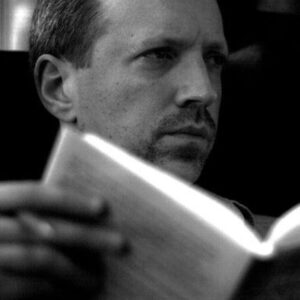
At the initiative of Yann Allard-Tremblay, Tom Angier (University of Cape Town) will give us a presentation titled “Perfectionism and Its Critics.”
The content of this presentation is from chapter 4 of a monograph in preparation. Important background information is introduced in chapter 3 of the book, where our guest defends his brand of “natural perfectionism” against challenges from evolutionary theory and neo-Aristotelian naturalism. To get both chapters of the monograph, download them here (ch. 3) and here (ch. 4).
To participate by Zoom, it’s here.
-
Reading group in philosophy of economy @ Room CSC-02-840, HEC Côte-Ste-Catherine, 2nd floor
11 h 00 – 12 h 00
6th session of the Reading Group in Philosophy of Economy
Discussion session on the theme of Robert J. Shiller’s narrative economics. Excerpts will be studied, including the preface and chapters 5, 8 and 15, from Narrative Economics: How Stories Go Viral and Drive Major Economic Events (2019, Princeton University Press).
To participate or receive the excerpts by email, contact the organizers (Morgane Delorme: morgane.delorme.1@umontreal.ca; or Gabriel Monette: gabriel.monette@hec.ca).
-
Maxime Doyon (Université de Montréal) @ Room W-5215, 5th floor, Pavillon Thérèse-Casgrain (W), UQAM
10 h 00 – 12 h 00
“Perceptual Learning and Agency”
GRIN conference by Maxime Doyon (Université de Montréal)
The conference will also be presented on Zoom.
Abstract
The presentation focuses on perceptual learning, which philosophers and scientists alike standardly take to involve long-lasting change in our perceptual capacities and dispositions that results from practice or experience (E. Gibson 1963). Although phenomenology has traditionally shown little interest in the question of perceptual learning per se, my aim in this talk is to show how it can contribute to the ongoing discussion over both the nature and scope of perceptual learning. By drawing insights and conceptual tools from both the classical and more contemporary repertoire, I will sketch out a new account of perceptual learning and defend two theses. It will be argued, first, that both skill acquisition and the formation of motor habit are not just physiological phenomena but real instances of perceptual learning. Taking into consideration the embodiment of our perceptual skills will bring me to slightly alter the traditional definition of perceptual learning and consider an array of new cases. Secondly, I will argue that these bodily transformations shows that perceptual learning can have a yet under-appreciated function in the contemporary scientific and philosophical literature on the topic. In addition to freeing up cognitive resources (Connolly 2019) and enhancing our discriminatory power (Jenkins 2023), I will contend that learning can impact agency by demonstrating how skilled behaviour facilitates the way we navigate the world.
-
Gilles Campagnolo (Université Paris 1, CNRS) @ Room 309, UdeM, Hybrid mode
12 h 00 – 13 h 15
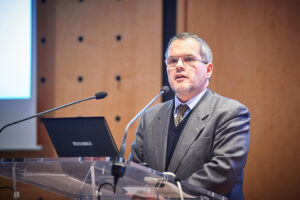
As part of the CRÉ lunchtime conferences, Gilles Campagnolo (Université Paris 1, CNRS) will offer us a presentation [in French] entitled “Questions d’épistémocratie et primauté du discours économique dans les considérations socio-politiques”.
To participate online, click here.
A former student of ENS (Ulm), professor and doctor of philosophy, former Fellow of Harvard and Tokyo universities, Gilles Campagnolo is director of research at the CNRS and member of the Center for Contemporary Philosophy at the Sorbonne (Institute of Legal and Political Sciences from the Sorbonne), as well as associated with the London School of Economics until 2023. Specialist in economic philosophy, he discusses questions of justice, interest(s), responsibility, coordination. Also an expert on the Austrian school of economic thought, he recently edited the 1871 Principes d’économie politique by Carl Menger (first French translation, Paris Le Seuil, 2020) and the youthful texts of Karl Popper (Apprentissage et Découverte , Editions de l’École normale supérieure la rue d’Ulm, 2019).
-
“Éthique et emballement médiatique: le cas de la loi sur l’ immigration en France” @ Room 309, UdeM, hybrid mode
11 h 30 – 12 h 45

Brice Arsène Mankou will give a presentation titled “Éthique et emballement médiatique : le cas de la loi sur l’ immigration en France”, as part of the lecture series Les midis de l’éthique du CRÉ.
To participate on Zoom, it is here.
-
Michael Cholbi (University of Edinburgh) @ Online
12 h 00 – 13 h 00

As part of the activities of the Philosophy of Work Network organized by Denise Celentano (Université de Montréal) and Pablo Gilabert (Concordia University), Michael Cholbi (University of Edinburgh) will give a presentation entitled: “Fit for beachcombers and workaholics alike: Productive pluralism as a post-work vision.”
More details to come!
Abstract
The notion of ‘post-work’ has been ascendant in both popular and academic discourses, but there is not yet a consensus on the nature of post-work or a cataloguing of different social visions that might plausibly be labelled post-work. Here I articulate and defend my own ‘productive pluralism’ as an attractive post-work vision. Productive pluralism imagines social arrangements in which individuals can (if they wish) be largely free from work, particularly paid work, but also free to work (if they wish). This vision is post-work not in striving for the elimination of work altogether but for (a) the withering away of harmful work-centred norms and assumptions, (b) fostering or celebrating a wider array of relationships to the productive sphere than are validated under work-centred norms, and (c) liberating the goods of work from work’s current dominant place among means for satisfying basic material needs.
-
In the next session of the Philosophy of Psychiatry Webinar, Lucy Osler (Cardiff University) will give a lecture titled “Losses and Loneliness in Anorexia Nervosa.”
Organized by Anne-Marie Gagné-Julien and Sarah Arnaud, for the Research group on philosophy of psychiatry.
Abstract:
Anorexia nervosa (AN) is an eating disorder characterized by self-starvation. Talking of loss in the context of AN is not surprisingly associated with weight loss. However, in this presentation, I consider how AN can involve experiences of social loss in the form of recognition and understanding. While loneliness is not generally considered a core diagnostic feature of AN, many individuals with AN report being lonely. They describe feeling stigmatized, stereotyped, and cut off from communities who can understand and support them. I suggest that individuals with AN can experience a loss of access to the social resources, relationships, and recognition that others take for granted. I explore how loneliness can prompt the start of, return to, and continuation of disordered eating. On the one hand, AN can give rise to experiences of loneliness and isolation. On the other hand, attempts to find community and support can encourage people to enter social spaces, such as ProAnorexia sites, that both scaffold disordered eating practices and cement one’s identity as an anorectic person by providing recognition that is missing from other communities. In these ways, loss and loneliness drive and even exacerbate the disorder. In order to successfully — and respectfully — treat AN, therefore, it seems likely that we need to understand the key role loneliness plays in perpetuating it.
Open to everyone, no charge. Please, register here: site web.
-
“Marginal Epistemic Injustice” @ Room 309, UdeM, hybrid mode
12 h 00 – 13 h 15
-
CRÉ 2023-2024 Scholarship Graduate Scholars Recipient Seminar – 2nd session @ Room 309, UdeM, hybrid mode
9 h 00 – 11 h 15

You are warmly invited to the 2nd session of the CRÉ Graduate Scholars Seminar 2023-2024. In turn, 4 of the 8 CRÉ scholarship recipients will present their work. The goal of the seminar is to provide our master’s and doctoral students with feedback, constructive criticism, and recommendations that will help them improve their research projects.
We propose the following program:
9:00 – 9:45 AM Presentation by Ann-Sophie Gravel, master degree in philosophy at Université Laval, working with Catherine Rioux and Patrick Turmel: “La rationalité de l’amour au XXIe siècle : ludification de l’amour et éthique des applications de rencontre”.
9:45 – 10:30 AM Presentation by Thomas Emmaüs Adetou, PhD in philosophy at Université de Montréal, working with Christine Tappolet and Martin Gibert: “Agentivité artificielle et responsabilité morale”.
10:30 – 10:45 AM Break
10:45 – 11:30 AM Presentation by Véronique Chetmi Eyali, PhD in political science at Université Laval, working with Sylvie Loriaux and Thierry Rodon: “Injustices épistémiques et résistances épistémiques : expériences de dix femmes militantes autochtones au Canada”.
11:30 AM – 12:15 PM Presentation by Alexandre Poisson, PhD in philosophy at Université du Québec à Montréal, working with Amandine Catala and Mauro Rossi: “Import conceptuel et interdisciplinarité: les apports épistémiques de la philosophie féministe, de la théorie critique de la race et des études critiques du handicap pour l’éthique animale”.
12:15 PM Lunch, room 309 – bring your lunchbox!
To participate via Zoom, click here (secret code 758885).
-
Marc-Antoine Fournelle (PhD, Religious Studies, UQAM) @ Salle 309, UdeM, mode hybride
12 h 00 – 13 h 15

During this CRÉ and Obvia ethics lunch talk, Marc-Antoine Fournelle (PhD, Religious Studies, UQAM) will present in French various theoretical frameworks that shed light on a blind spot in loving and intimate relationships between humans and conversational agents. His presentation is titled “Éros dans l’algorithme (sur quelques enjeux entourant les relations humains-IA).”
Hybrid mode: zoom link here.
-
Epistemic Injustice and Religious Identities Workshop @ McGill - Leacock, room 429
6 Mar – 7 Mar All day
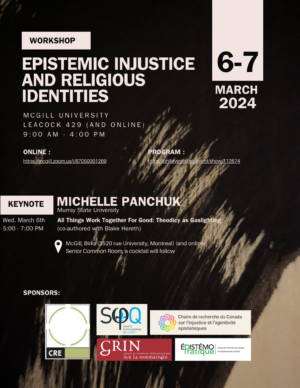
Epistemic Injustice and Religious Identities Workshop
Venues are accessible and it is possible to participate online
Day 1 – March 6, 2024
McGill – Leacock (855 Rue Sherbrooke Ouest, Montreal), room 4298h30: Coffee
9h00: Welcome and preliminary remarksReligious identities in the political realm
Chair: Maëlle Turbide
9h10 – 10h00: Rethinking Democratic Deliberation Religion, Secularism and Epistemic Injustice – A. Sophie Lauwers (KU Leuven) – Online
10h10 – 11h00: Whose Freedom of Conscience Should Laicity Protect? – Gilles Beauchamp (McGill)
11h10 – 12h00: Obstacles to the Epistemic Agency of Atheists in Islamic Countries – Zoheir Bagheri Noaparast (Catholic University of Eichstätt-Ingolstadt) – Online12h00 – 13h00: Lunch
Normativity and religion
Chair: Gilles Beauchamp
13h15 – 14h05: Philosophy Religion on Trial – A Problem of Epistemic Injustice – Zoe Longworth (University of Groningen)
14h15 – 15h05: The Concept of Religion as a Tool of Hermeneutical Marginalization – David Spewak (Marion Military Institute)
15h15 – 16h05: Mitigating Epistemic Injustice in the Realm of Normative Explanation – Rachel Finlayson (Columbia)McGill, Birks (3520 Rue University, Montreal), Senior Common Room
17h00 – 18h00 (Keynote address): All Things Work Together For Good: Theodicy as Gaslighting (co-authored with Blake Hereth) – Michelle Panchuk (Murray State University)18h – 19h: Cocktail
Day 2 – March 7, 2024
McGill – Leacock (855 Rue Sherbrooke Ouest, Montreal), room 4298h30: Coffee
Religious insights on epistemic injustice
Chair: Maëlle Turbide
9h00 – 9h50: Jain Perspectivalism and (Religious) Epistemic Justice – Raja Rosenhagen (Ashoka University, University of Pittsburgh) – Online
10h00 – 10h50: Intercepting Epistemic Domination of Religions: An Indian Perspective – Baiju P. Anthony (BITS Pilani) – Online
11h00 – 11h50: Vandalization of a world-picture: Religious Offense and Hermeneutical Injustice – Mehdi Ebrahimpour (Independent Scholar)12h00 – 13h00: Lunch
Religion in education and in the media
Chair: Gilles Beauchamp
13h15 – 14h05: Epistemic injustice in the RE classroom – Lina Snoek Hauan (University of South-Eastern Norway) – Online
14h15 – 15h05: Risks of structural epistemic injustice when reporting religious testimony in the news – Maëlle Turbide (Université de Sherbrooke)
15h15 – 16h05: Religious Freedom, LGBTQ+ Non-Discrimination, and Epistemically Vicious Media – Louise Richardson-Self and Sharri Lembryk (University of Tasmania)Organizers: Gilles Beauchamp (McGill) et Maëlle Turbide (UdeS).
This event is made possible by financial support from the following organizations:
- La Chaire de recherche du Canada en épistémologie pratique
- Le Centre de recherche en éthique (CRÉ)
- Le Groupe de recherche interuniversitaire sur la normativité (GRIN)
- La Société de philosophie du Québec
- La Chaire de recherche du Canada sur l’injustice et l’agentivité épistémique
- PPSMUA Postgraduate Philosophy Students of McGill University Association
-
“Epistemic Injustices and Participatory Research” @ Room 309, UdeM, hybrid mode
12 h 00 – 13 h 15

Anne-Marie Gagné-Julien will give a presentation on “Epistemic Injustices and Participatory Research.”
To participate via Zoom, it’s here (Meeting ID: 817 0167 0760; Passcode: 100251).
-
5th session of the Reading Group in Philosophy of Economy
Discussion session around the text by Lisa Herzog & Frauke Schmode ” ‘But it’s your job!’ the moral status of jobs and the dilemma of occupational duties” (Critical Review of International Social and Political Philosophy, 2022).
To participate or receive the article by email, contact the organizers (Morgane Delorme: morgane.delorme.1@umontreal.ca; or Gabriel Monette: gabriel.monette@hec.ca).
-
Nancy Nyquist Potter (University of Louisville) @ Online
12 h 00 – 13 h 30
For the next session of the Philosophy of Psychiatry Webinar, we will have the pleasure of welcoming Nancy Nyquist Potter (University of Louisville) for a lecture titled “Traumatic Lives and Trustworthy Psychiatrists.”
Abstract
The central virtue of psychiatrists and, indeed, of all of us, is to be trustworthy. Psychiatrists are trained in many facets of care for service users. But for some service users’ difficulties, psychiatrists may be inadequately prepared for working with those who experience living with trauma. Others may have the needed skills but are unsure of how to strengthen their skills for interpersonal and institutional improvement, thus decreasing distrust whether in the institution itself or in particular psychiatrists. This paper draws together the relationship between people living traumatic lives and what it might look like for psychiatrists to be trustworthy to them. I set out various definitions of trust and trustworthiness, distrust, and trauma, with commentary on strengths and weakness of those definitions. Next, I set out several different kinds of trauma, mindful of the overlaps and the problem of generating too many distinctions. The last section of the paper offers a number of epistemic and ethical qualities that trustworthy psychiatrists need in order to be trustworthy—and to be seen to be trustworthy—to those who live with the aftermath of trauma as well as those who live with everyday ongoing trauma in their lives.
The conference will be in English. Participation in the webinar is free, but registration is required on our website.
Organized by Anne-Marie Gagné-Julien and Sarah Arnaud, for the Philosophy of Psychiatry Research Group.
-
“Ethics by (Organizational) Design: The Structure of Ownership and Governance” @ Room 309, UdeM, hybrid mode
12 h 00 – 13 h 15

Dominic Martin (UQÀM) will offer a presentation titled “Ethics by (Organizational) Design:
The Structure of Ownership and Governance”, as part of the lecture series Les midis de l’éthique du CRÉ.To participate through Zoom, clic here.