Environmental and animal ethics
Environmental and animal ethics
-
“A Law-Led Transition to Animal-Free Research” @ SHIFT Centre for Social Transformation
17 h 00 – 19 h 00

Lecture by Maneesha Dekha (Postcolonial animal law scholar, author of Animals as Legal Beings and Professor at the University of Victoria, in British Columbia)
On Monday, July 20, 2026, from 5:00 p.m. to 7:00 p.m., Maneesha Dekha (University of Victoria) will give a lecture titled “From Resource Object to Legal Subject: A Law-Led Transition to Animal-Free Research.” The lecture will take place at the SHIFT Center for Social Transformation, in the J.W. McConnell Building at Concordia University, located at 1400 De Maisonneuve Boulevard in Montreal.
In this talk, Maneesha Deckha will address the rising scientific and political momentum to finally replace the use of animals in laboratories with animal-free methods and underscore the importance of law to ensure a relatively swift rather than indefinite transition.
Registration is free. To join in person or online, click here. For more information, please consult the following page.
About the speaker
Maneesha Deckha is Professor and Lansdowne Chair in Law at the University of Victoria in British Columbia where she directs the Animals & Society Research Initiative. Her research expertise includes critical animal law, vegan ecofeminist theory, and postcolonial theory. She is the author of Animals as Legal Beings: Contesting Anthropocentric Legal Orders and director of the open access documentary series, A Deeper Kindness: Youth Activism in Animal Law and on YouTube: @ASRI-UVic.
Co-organized by Concordia University’s Social Justice Centre (SJC), the CRÉ, the Groupe de recherche en éthique animale et environnementale (GRÉEA), the Observatoire québécois en droit animalier (OQDA), the Canadian Society for Critical Animal Studies (CSCAS) and the SPCA of Montréal.
-
Animals at Large: Critical Animal Studies Perspectives on Wild, Feral, and Free-Living Animals @ SHIFT Centre for Social Transformation, J.W. McConnell Building, Concordia University
6 Aug – 7 Aug All day
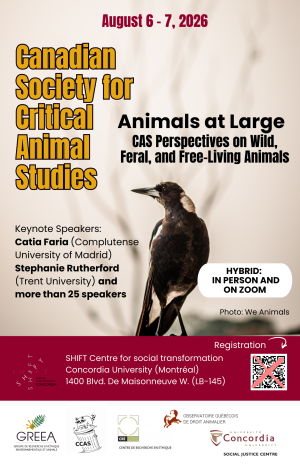
Animals at Large: CAS Perspectives on Wild, Feral, and Free-Living Animals is co-organized by the Canadian Society for Critical Animal Studies, the Centre interuniversitaire de recherche en éthique (CRÉ) and the Social Justice Centre at Concordia University, the Groupe de recherche en éthique animale et environnementale (GREEA) and the Observatoire québécois en droit animalier (OQDA) based at the Université de Sherbrooke.
The conference will be hybrid, register here.
Program
Animals at Large: CAS Perspectives on Wild, Feral, and Free-Living Animals
August 6
8:30 – 9:00 Arrival/Continental breakfast, coffee/tea/juice available
9:00 – 10:15 – Welcome and Opening Keynote: Catia Faria
10:15 – 10:30 – Coffee/tea Break
10:30 – 12:00 – Wild Politics
- Pablo Castello, “The Territorial Rights of Wild Animals: Justification”
- Agata Kowaleska, “Feralizing: Reimagining Future Liberations in Europe”
- Christiane Bailey, “Renouncing violence and doing politics with wild and liminal animals in Donaldson and Kymlicka’s Animals and the right to politics”
12:00 – 1:00 – Catered Lunch
1:00 – 2:30 – Wild Horses
- Sabine Sassner, “Movement vs. Behaviour: Visibility and Agency of Equines”
- Lucy Horswill, “From ‘Semi-Wild’ to Surplus: Language and Disposal at British Drift Sales”
- Kelly Struthers Montford & Chloë Taylor, “Wild Mustang Prison Programs in the American Southwest”
2:30 – 2:45 – Coffee/tea Break
2:45 – 4:15 – Vermin, Pests, and Invasive Species
- Karen Morin, “An ‘Animal Turn’ for Rats?”
- Mathieu Chaput & Jacinthe Dupuis, “The Communicative Constitution of Liminal Animals in the ‘Deer Saga’”
- Zoei Sutton and Kate Hall, “Feral Catastrophe: Analyzing the Narrative Construction of Australian Cats”
4:15 – 4:30 – Coffee/tea Break
4:30 – 6:00 – Intersection of Behavioural Ecology and Critical Animal Studies: The Ethical Costs and Benefits of Primate Research in Wild, Free-Ranging, and Rehabilitative Contexts
- Mikaela Gerwing (facilitator), Nève Djevalikian-Couture (presenter), Italo Ferreira Perreira (presenter), Maya Moghrabi (presenter), Viviane Aurora Oliviera (presenter), & Brogan M. Stewart (presenter)
August 7
8:30 – 9:00 – Arrival/Continental breakfast, coffee/tea/juice available
9:00 – 10:30 – Sanctuary and Salvation
- Darren Chang (remote from Australia), “Contesting Wildness: The Farmed Animal Sanctuary as Liminal Contact Zone”
- Sal Renshaw, “Saving By Any Other Name: Sanctuaries, Arks, and the Governance of Animal Lives in the Anthropocene”
- Stephanie Eccles, “Farmed Animals in Extreme Weather Events: Disaster Response Pathways and Foreclosures of Wildness”
10:30 – 10:45 – Coffee/tea break
10:45 – 12:15 – Animal Capital
- Esther Palm, “Travail Animal et critique du sauvage en théorie politique”
- Briana Magnuson & Tony Weis, “HPAI in the Wild: A Critical Analysis of Media Coverage of the Panzootic Crisis”
- Branislava Vičar, “The Conservation Discourse of Native Animal Species as Nationalist Narrative: The Case of the Marble Trout”
12:15 – 1:15 – Catered Lunch
1:15 – 2:45 – Feral Intimacies: Care and Control in Interspecies Relations
- Misha Solomon, “Goon at Love Park”
- Ishaan Selby, “‘Big, Furry, Asymmetrical Balls’: Wildness, Feral Sex, and Ownership in Marian Engel’s Bear”
- Jesse Arsenault, “The Wildness of Interspecies Desire in South African Literature and Law”
2:45 – 3:00 – Coffee/tea break
3:00 – 4:30 – The Wild and the Monstrous
- Emelia Quinn, “When Animals Attack: The Comedy and Camp of Wild Animal Revenge”
- Emily Major, “The Boogeymen of Our Forests: Anti-Possum Rhetoric and the Construction of Fear in Dominant Conservation Messaging in New Zealand”
- Ian Hanesworth, “Wolf Mothers & Man Things: Agency, Emotionality, and Personhood in Ursula LeGuin’s ‘The Wife’s Story’”
4:45 – 6:00 – Closing Keynote: Stephanie Rutherford, “Canids and Canada: Wolves, Coyotes and Regimes of Violence and Belonging”
6:00 – 7:00 – Closing Reception