
Past events
Calendar archives
-
“Experiential Knowledge in the Making: Lessons and Perspectives from the DIY-AIDS Movement” @ W-5305, Pavillon Thérèse-Casgrain (W)), UQAM
30 May – 31 May All day
SCHEDULE
THURSDAY, MAY 30
09:30 – Welcome address10:00-11:15 – Shane O’Donnell (School of Sociology / School of Medicine – University College Dublin) “Transformations in Diabetes Care Lessons from Commons-based, Peer-produced Citizen Science.”
11:15-11:30 – Coffee break
11:30-12:45: – Vololona Rabeharisoa (Centre de sociologie de l’innovation, Mines Paris – PSL Université) “On the Multiplicity of Lay Expertise: An Empirical and Analytical Overview of Patient Associations’ Achievements and Challenges”
13:00-14:30 Lunch break
14:30-15:45 – Aude Bandini (département de philosophie – Université de Montréal) “Experiential Knowledge: Conceptual Promises and Challenges in Epistemology”
15:45-16:00 – Coffee break
16:00-17:15 – Jonathan Garfinkel (Medical and Health Humanities – U. of Alberta) & Brian Cleal (Steno Diabetes Center – University of Copenhagen) “The divine comedy of diabetes and long Covid: an autoethnographic dialogue.”
19:00 – Workshop’s Diner
FRIDAY, MAY 31
09:00-10:15 – Henriette Langstrup (Departement of Public Health – University of Copenhagen) “Looping for (Self)Care—Personal Digital Health Technology and Algorithmic Systems.” (with Bianca Jansky)10:15-11:30 – Clay Davis (Department of sociology – Northwestern University) “The routinization of lay expertise: A diachronic account of the invention and stabilization of an open-source artificial pancreas.”
11:30-11:45 – Coffee break
11:45-13:00 – Susi Geiger (Market Studies – University College Dublin) “Between activist, healer and entrepreneur: the fluid boundaries around marketizing one’s patient expertise” (with Olya Loza)
13:00-14:30 – Lunch
Thanks for their generous financial support :


-
International Conference on Epistemic Oppression and Decolonization @ Université du Québec à Montréal (UQAM
29 May – 31 May All day
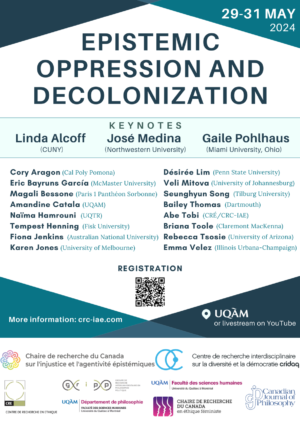
The International Conference on Epistemic Oppression and Decolonization organized by Amandine Catala (UQAM)’ Canada Research Chair on Epistemic Injustice and Angency will be held at the Université du Québec à Montréal (UQAM) on May 29-31, 2024.
With keynotes from:
- Gaile Pohlhaus (Miami University, Ohio)
- José Medina (Northwestern University)
- Linda Alcoff (CUNY)
**The conference is free and open to all and it is possible to attend online via livestream on May 29-31 (no registration required) or in person at UQAM (registration required by May 8).
DAY 1 – 29 May 2024
10:00 – 11:15 (Keynote) Gaile Pohlhaus (Miami University, Ohio), Epistemic Pressure and Intersectional Interdependence
Chair: Kristin Voigt (McGill University, CRÉ)
11:15 – 11:25 Break
11:25 – 12:15 Abe Tobi (Université de Montréal, CRÉ, CRC-IAE), Towards a Relational Account of Epistemic Agency
Chair: Anne-Marie Gagné-Julien (McGill University, CRÉ, CRC-IAE)
12:15 – 1:15 Lunch
1:15 – 2:05 Cory Aragon (Cal Poly Pomona), Faces of Epistemic Oppression
Chair: Gilles Beauchamp (McGill University, CRC-IAE)
2:05 – 2:15 Break
2:15 – 3:05 Eric Bayruns García (McMaster University), Anti-Critical Race Theory Legislation, History of Racial Injustice and Hermeneutical Injustice
Chair: Nick Clanchy (McGill University, CRÉ, CRC-IAE)
3:05 – 3:25 Coffee break
3:25 – 4:15 Tempest Henning (Fisk University), Bad (White) Epistemic Luck
Chair: Michelle Martineau (Université de Montréal, CRIDAQ)
4:15 – 4:25 Break
4:25 – 5:15 Karen Jones (University of Melbourne), Defund the Police: How to Identify and Undermine Common Strategies for White Policing of the Borders of Philosophy
Chair: Muhammad Velji (Wesleyan University)DAY 2 – 30 May 2024
10:00 – 11:15 (Keynote) José Medina (Northwestern University), Epistemic Border-Crossing: Polyphonic Decolonial Resistance and Collective Epistemic Self-Empowerment
Chair: Yann Allard-Tremblay (McGill University, CRÉ, GRIPP)
11:15 – 11:25 Break
11:25 – 12:15 Emma Velez (University of Illinois, Urbana-Champaign), Latinx Decolonial Feminisms & Epistemologies Hecho a Mano
Chair: Mirjiam Fines-Neuschild (Université de Montréal, CERC, CRC-IAE)
12:15 – 1:15 Lunch
1:15 – 2:05 Jorge Sanchez Perz (University of Alberta), Mestizaje as a Political Project and the Limits of Latin American Philosophy
Chair: Éliot Litalien (Université de Montréal, CRÉ)
2:05 – 2:15 Break
2:15 – 3:05 Bailey Thomas (Dartmouth College), Conceptualizing Africana Decolonial Epistemologies
Chair: Leena Abdelrahim (University of Toronto)
3:05 – 3:25 Coffee break
3:25 – 4:15 Fiona Jenkins (Australian National University), Acknowledgment of Country and the Staging of History: Can Practices of Acknowledgment Alleviate Colonial Epistemic Oppression?
Chair: Dominique Leydet (UQAM, CRIDAQ, GRIPP)
4:15 – 4:25 Break
4:25 – 5:15 Rebecca Tsosie (University of Arizona), Non-Ideal Theory and Reparative Justice: The Logic of “Indigenous Rights”
Chair: Karine Millaire (Université de Montréal)DAY 3 – 31 May 2024
10:00 – 10:50 Veli Mitova (University of Johannesburg), Decolonial Epistemic-Authority Reparations
Chair: Ryoa Chung (Université de Montréal, CRÉ, GRIPP)
10:50 – 11:00 Break
11:00 – 11:50 Magali Bessone (Université Paris 1 Panthéon Sorbonne), Specters of Haiti: Epistemic Reparations in a Postcolonial Context
Chair: Cheldy Belkhodja (Concordia University, CRIDAQ)
11:50 – 12:50 Lunch
12:50 – 1:40 Naïma Hamrouni (UQTR, CREF, CRÉ, CRIDAQ), The Importance of Colonial Memory in the Conceptualization of Structural Injustices
Chair: Amin Perez (UQAM, CRIDAQ)
1:40 – 1:50 Break
1:50 – 2:40 Seunghyun Song (Tilburg University), Epistemic Responsibility for Structural Remedies
Chair: Marie-Pier Lemay (Carleton University)
2:40 – 3:00 Coffee break
3:00 – 3:50 Désirée Lim (Penn State University), Decolonization, Museums, and the Right to Be Unknown
Chair: Soufia Galand (Université de Sherbrooke, CRC-IAE)
3:50 – 4:00 Break
4:00 – 5:15 (Keynote) Linda Alcoff (CUNY), Imperial Museums and the Claim to Universal Knowledge
Chair: Phoebe Friesen (McGill University, CRÉ)This conference is made possible thanks to the generous support of the following sponsors::
– Chaire de recherche du Canada sur l’injustice et l’agentivité épistémiques/Canada Research Chair on Epistemic Injustice and Agency (CRC-IAE)
– Centre de recherche interdisciplinaire sur la diversité et la démocratie (CRIDAQ)
– Centre de recherche en éthique (CRÉ)
– Groupe de recherche interuniversitaire en philosophie politique (GRIPP)
– Canadian Journal of Philosophy (CJP)
– Faculté des sciences humaines, UQAM
– Département de philosophie, UQAM
– Chaire de recherche du Canada en éthique féministe (CREF) -
“Partnering with Patients and Communities in Healthcare Ethics” @ Centre Mont-Royal
29 May – 31 May All day

The 18th annual International Conference on Clinical Ethics and Consultation (ICCEC) and the 32nd annual Canadian Bioethics Society (CBS) conference will be held jointly. The conference on Partnering with Patients and Communities in Healthcare Ethics is co-organized by, among others, by two co-researchers from the CRÉ, Nathalie Gaucher and Marie-Ève Bouthillier, and a member of its Committee of Practical Experts, Antoine Payot. Please visit the event website for more details here.
The plenary conference entitled ‘Epistemic Injustices in Clinical Settings’ will be offered by Ryoa Chung (UdeM, co-director of the CRÉ), Naïma Hamrouni (CREF and UQTR), Agnès-Berthelot-Rafard (York), and Alexandra Pierre (president of the Ligue des droits et libertés and Concordia).
-
Reading group in philosophy of economy @ Room CSC-02-840, HEC bâtiment Côte-Ste-Catherine, 2ème étage
11 h 00 – 12 h 00

9th session of the Reading Group in Philosophy of Economy
Discussion session on the text “The Power of Private Creditors and the Need for Reform of the International Financial Architecture”, from Anahí Wiedenbrüg and Patricio López Turconi, chapter 16 of Wealth and Power – Philosophical Perspectives, edited by Michael Bennet, Huub Brower and Rutger Claassen, published in 2022 at Routledge.
To participate or receive the excerpts by email, contact the organizers (Morgane Delorme: morgane.delorme.1@umontreal.ca; or Gabriel Monette: gabriel.monette@hec.ca).
-
W. Jared Parmer (RWTH Aachen University) @ Online
12 h 00 – 13 h 00

As part of the activities of the Philosophy of Work Network , W. Jared Parmer (RWTH Aachen University) will offer a presentation entitled: “Meaning and Alienation in Work”.
The activities of the Philosophy of Work Network are open to researchers and graduate students with research interests in this area. Please write to the organizers, Denise Celentano (denise.celentano@umontreal.ca) and Pablo Gilabert (pablo.gilabert@concordia.ca), to receive the zoom link.
Abstract
In this talk, I give a synoptic view of philosophical treatments of meaning in work, and how these treatments point to varieties of alienation in work, too. I suggest that there are neoliberal, liberal, and perfectionist approaches of meaningful work. These approaches distinguish themselves by how they answer two key questions: first, must meaningful work be in some way objectively good? and, second, is work somehow special when it comes to living a meaningful life? They generate different paradigm cases of alienated work as the opposite of meaningful work. I will finally offer some reasons for why I, tentatively, endorse a perfectionist approach to meaningful work.
-

Workshop co-organized by Ophélie Desmons (INSPE Paris, Sorbonne University) and Martin Gibert (Université de Montréal).
With the support of GREEA (environmental and animal ethics research group), CRÉ (Centre de recherche en éthique) and UMR 8011 “Sciences, Normes, Démocratie”, Sorbonne University.
To participate, click here.
Program
9:00 am (Montreal)/03:00 pm (Paris)
Mark Ryan (Wageningen), Leonie N. Bossert (U. of Vienna)
Dr. Doolittle Uses AI: Should We Try to Speak Whale?
AI technologies are increasingly applied on nonhuman animals. In this talk, we will focus on a particular application of AI to other animals, namely, using AI to decode animal communication, in particular whale communication. We will discuss a variety of ethical aspects of using AI to decode whale communication, as well as the risks and benefits involved.
9:30 am/03:30 pm
Ophélie Desmons (Sorbonne)
Une IA qui parle baleine, anticiper le pire et évaluer les bénéfices potentiels
Des projets récents de développement de l’IA laissent entrevoir la possibilité de communiquer avec les baleines. Cette intervention s’appuie sur les ressources offertes par une ouvre de fiction (Extrapolations, Saison 1, épisode 2, AppleTV, 2023) pour examiner la question de savoir si une telle IA est susceptible de produire de nouvelles injustices à l’égard des animaux concernés ou au contraire d’apporter des éléments de réponse à l’un des problèmes fréquemment souligné dans le champ de l’éthique et de la justice animales : le fait que les animaux ne disposent pas d’une “voix” leur permettant de faire entendre leurs intérêts et de revendiquer le respect de leurs droits.
Recent AI technologies point to the possibility of communicating with whales. This talk draws on the resources offered by a work of fiction (Extrapolations, Season 1, Episode 2, AppleTV, 2023) to examine the question of whether such an AI is likely to produce new injustices for the animals concerned or, on the contrary, to provide elements of a response to one of the problems frequently highlighted in the field of animal ethics and animal justice: the fact that animals do not have a “voice” enabling them to make their interests heard and claim respect for their rights.
10:00 am/04:00 pm
Soenke Ziesche, Yip Fai Tse (Princeton)
AI alignment for nonhuman animals: next steps
In our talk we present our latest research, which comprises further arguments why nonhuman animals ought to be included in AI alignment efforts and why we believe this is possible. In short, we propose to provide AI systems access with all types of data of nonhuman animals according to animal welfare methods and let the AI systems analyse the data and learn about the interests and preferences of nonhuman animals through (inverse) reinforcement learning.
10:30 am/04:30 pm
Jean-Cassien Billier (Sorbonne)
La pluralité des mondes moraux : les implications métaéthiques des interactions entre l’IA et les animaux non-humains
On sait déjà que l’IA peut créer des mondes moraux inédits, constitués d’agents moraux artificiels modulaires. L’interaction entre l’IA et les animaux non-humains ouvre une perspective plus radicalement nouvelle, et bien plus hétérodoxe : celle de mondes moraux constitués par des relations entre des entités morales non-humaines de deux types : les unes naturelles, les autres artificielles. Ces nouveaux mondes moraux pourront être dépourvus d’agents moraux humains ou de relation directe à ces derniers. Quelles sont les implications métaéthiques de cette potentielle multiplication des mondes moraux ?
11:00 am/05:00 pm – break
11:15 am/05:15 am
Augusta Gaze (Sorbonne)
Comment Zoopolis éclaire les relations entre systèmes d’IA et animaux non-humains?
Après une présentation de la Théorie des Droits des Animaux développée dans Zoopolis, nous partirons du cadre normatif posé par les auteurs afin de penser des cas qui ne sont pas intuitivement faciles à traiter. D’abord, nous analyserons l’exemple des systèmes d’IA capables d’éduquer les animaux de compagnie. Puis, nous poursuivrons avec l’interaction des voitures autonomes avec les kangourous.
11:45 am/05:45 pm
Angela Martin (Basel), Leonie N. Bossert (U. of Vienna)
Large Language Models, Search Engine Ranking, and Justice for Animals
In this talk, we focus on the manifold forms of harms that nonhuman animals can experience because of Large Language Models (LLM) and Search Engine Ranking (SER). We show how LLMs and SERs regularly disrespect animal interests, which amounts to speciesism. In a first step, we outline that LLMs and SERs should, in an ideal world, minimally not cause any harm to animals. In a second step, we argue that in the currently non-ideal world, LLMs and SERs should be actively altered to educate people about animals and speciesism. Finally, we discuss several objections to our arguments.
12:15 pm/06:15 pm
Martin Gibert (U.Montréal) et / and Nick Clanchy (Centre de recherche en éthique)
Qu’est-ce qui est spécial avec le spécisme algorithmique?
Le spécisme algorithmique, entendu comme l’ensemble des effets discriminatoires des algorithmes sur les animaux, se distingue des autres manifestations du spécisme par ses aspects plus automatiques et contrôlables – et donc plus facilement réversible. Il se distingue par ailleurs du racisme algorithmique car il est moins reconnu et par le fait que les victimes ne peuvent qu’être passives face à ces discriminations: elles ont besoin de notre epistemic care. Nous considérerons plusieurs exemples.
Algorithmic speciesism, understood as all the discriminatory effects of algorithms on animals, differs from other manifestations of speciesism in being more automatic and controllable – and therefore more easily reversible. It also differs from algorithmic racism in that it is less recognized, and its victims can only be passive with regard to such discrimination: they need our epistemic care. We will consider several examples.
12:45 pm/06:45 pm – closing remarks
-
Angie Pepper (University of Roehampton) and Richard Healey (LSE) @ Room 309, UdeM, Hybrid
12 h 00 – 13 h 30

Members of the CRÉ and GREÉEA are delighted to welcome Angie Pepper (University of Roehampton) and Richard Healey (LSE), who will offer a presentation titled “Animals, Inferiory, and Abolition.”
To participate via Zoom, please click here.
Abstract
In The Pecking Order, Niko Kolodny argues that natural persons have an irreducible claim against inferiority: a claim “that we not be set beneath another in a social hierarchy” (p. 5). Such social hierarchies, Kolodny suggests, are constituted by untempered disparities in power, authority, and regard. Though Kolodny acknowledges that the lives of many social animals are organised around the “pecking order” (p. 1, p. 87), other animals barely feature in his analysis of relations of inferiority. This omission is striking because many of our relations with nonhuman animals, especially those who have been domesticated, do not arise in “chance, one-off encounters”, but are rather “entrenched in an established, ongoing social structure” (p. 98). Think, for example, of our relations to livestock animals, laboratory animals, and pets. In each of these cases, animals are systematically subordinated by a pattern of social and legal norms that involve untempered asymmetries in power, authority, and regard.
These observations raise the question: Do non-human animals have a claim against inferiority within human-animal communities and hierarchies? In this paper, we argue that they do. Moreover, we suggest that nonhuman animals’ complaint against inferiority supports an abolitionist approach to animal rights. The basic idea is that to fully respect the rights of other animals, we must desist from using them as means to our ends. Importantly, the claim against inferiority not only supports the abolition of practices that clearly cause animals suffering but also those that need not, such as pet keeping.
The paper is structured as follows. First, we defend the claim that sentient nonhuman animals can have claims against inferiority against humans. We consider the view that only those capable of adequately recognising their position within a social hierarchy can have claims against inferiority. In response, we observe that while one’s ability to recognise one’s social position will likely have implications for what constitutes appropriate treatment, nothing in Kolodny’s account necessitates a recognition condition for the claim against inferiority. We further argue that the lack of a recognition condition is independently plausible if we wish to allow, for example, that young children in lower castes and individuals with severe cognitive disabilities can have claims against inferiority. Second, we argue that some nonhuman animals do have claims of inferiority against us. To illustrate this we show that animals have a complaint against being socially positioned as pets, which is grounded in a claim against inferiority. Specifically, we contend that the practice of pet-keeping is a socio-political institution which is constituted by untempered asymmetries in power, authority, and regard between humans and nonhuman animals. Furthermore, we argue that it is not possible to effectively temper these asymmetries while maintaining the practice of living with pets. This is because the tempering factors that undercut objections to social hierarchy in the human case (see Kolodny §5.2 and Ch. 8) either cannot be made to work for other animals (e.g., democratic governance) or otherwise require that the practice be dismantled. If our argument is correct, the implications are significant. Not only does this give us a further reason to abandon practices that harm other animals such as farming and biomedical research, but it suggests that the seemingly more benign practice of keeping animals as pets should be abolished.
-

We’re delighted to welcome Richard Healey (LSE) for a lunch talk on immoral promises.
To participate via Zoom, click here.
Abstract
It is a familiar part of common-sense morality that we are duty bound to keep our promises. However, the creative nature of promissory duties – the fact that the promisor and promisee choose the content of the promises they make – prompts a natural question: Are there substantive constraints on the content of the promises we can make? For instance, can we make binding promises to murder, maim, and steal? Many have the intuition that such promises fail to bind. Taking this intuition as my starting point, this paper develops a novel account of the nature and explanation of the constraints that apply to our power to promise. Most existing views attempt to explain these constraints by appeal to independent duties to which the promisor or promisee are subject. Yet while initially appealing, these views struggle to achieve extensional adequacy, and lack a clear rationale. On the account that I develop, we should instead appeal to the values that underpin the power to promise itself. I argue that a promise creates a form of special relationship between promisor and promisee, and the constraints that apply to that power track the value of this promissory relationship.
-
Julia D. Hur (New York University) @ Salle 309, 3e étage, UdeM - Mode hybride
12 h 00 – 13 h 30

As part of the CRÉ lunchtime conferences, Julia D. Hur (NYU) will offer us a presentation entitled « Money on Mind: Performance Incentive, Attention to Money, Environmental Sustainability ».
To participate via Zoom, click here.
Abstract
Environmental sustainability is one of the most pressing problems of our time, raising significant questions as to how to motivate organizational decision-makers to make substantive investments in environmental protection. The current work identifies performance incentives as a critical barrier that prevents organizational decision-makers from supporting sustainability initiatives. We also offer a novel psychological mechanism of how monetary incentives activate managers’ attentional fixation on money, intensifies their zero-sum mindset, and ultimately undermines commitment to investing in sustainability. Across two laboratory experiments (n = 702) and one archival study with a combination of data on executive compensation, corporate annual reports, and environmental performance (n = 14,126), we show that decision-makers whose pay is more contingent on financial performances are more likely to develop attentional fixation on money and less likely to support sustainability initiatives of their organization. Together, our findings demonstrate a novel pathway of how one of the most prevalently used types of financial incentives inadvertently undermine progress toward one of the most urgent organizational changes.
-
‘Housing and Social Justice’ conference @ Université de Montréal
9 May – 10 May All day

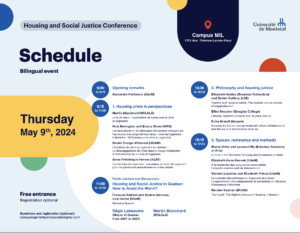
Housing and Social Justice Symposium, during which speakers will explore and discuss the intersection of housing issues, property rights, redistribution and inheritance, in the context of social justice concerns.
Organized by Alexandre Petitclerc (Université de Montréal) and Christian Nadeau (Université de Montréal), in partnership with the Centre de recherche en éthique (CRÉ), the Groupe de recherche interuniversitaire en philosophie politique (GRIPP), the Faculté des Arts et Sciences de l’Université de Montréal, and the Département de philosophie de l’Université de Montréal.
Download program in .pdf. For updates, visit the Facebook Page.

-
GRIN Graduate Fellow’s Conference @ Room W-5215, Department of philosophy, UQAM
6 May – 7 May All day
 The event will begin on May 6th with a talk by Katarina Nieswandt of Concordia University entitled What Is a Common Good?, and will continue on May 7th with a talk by Marc-Kevin Daoust of the École de technologie supérieure entitled Rationalité substantive, rationalité procédurale et approximation des idéaux.
To participate via Zoom, click here.
Program:
DAY I – Monday / May 6 2024
Time Lenght Chair Présentations et commentaires 10h00-10h50 50 min Aude Bandini Katarina Nieswandt (Concordia) What Is a Common Good?
10h50-11h00 10 min BREAK 11h00-11h30 30 min Karl-Antoine Pelchat Léonard Bédard (ULaval) Brouiller la frontière pour mieux exclure. Réflexion critique sur le droit d’exclusion territoriale exercé à l’encontre des réfugié-e-s en contexte canadien
Commentary: Gilles Beauchamp
11h30-12h00 30 min Véronique Armstrong (UdeM) Vers un écoholisme cynique : comment favoriser les touts écologiques dans un contexte de prédation ?
12h00-13h00 60 min LUNCH 13h00-13h30 30 min Alejandro Macías Flores Emmanuel Cuisinier (UdeM) Perception, Heroism, and The Problem of Expression in Merleau-Ponty
Commentary: Alejandro Macías Flores
13h30-14h00 30 min Pascal-Olivier Dumas-Dubreuil (UdeM) Phénoménologie linguistique, mutisme des sens et normativité chez John L. Austin
Commentary: Alejandro Macías Flores
14h00-14h10 10 min BREAK 14h10-14h40 30 min Karl-Antoine Pelchat Guillaume Soucy (UQAM) Une caractérisation constructiviste du point de vue esthétique
14h40-15h10 30 min Frédéric Beaulac (UdeM) Est-ce que les certitudes basiques sont des connaissances?
Commentary: Guillaume Soucy
15h10-15h20 10 min PAUSE 15h20-15h50 30 min Alex Carty Alexis Morin-Martel (McGill) Trust as a Respectful Attitude
Commentary: Alex Carty
15h50-16h20 30min Samuel Carlsson Tjernström (McGill) Why We Cannot Gnostically Wrong
Commentary: Karl-Antoine Pelchat
DAY II – Tuesday, May 7 2024
PÉRIODE DURÉE ANIMATION PRÉSENTATIONS ET COMMENTAIRES 10h00-10h50 50 min Aude Bandini Marc-Kevin Daoust (ÉTS) Rationalité substantive, rationalité procédurale et approximation des idéaux
10h50-11h00 10 min BREAK 11h00-11h30 30 min Karl-Antoine Pelchat Michaël Lemelin (UQAM) Une production moindre peut-elle nuire à l’égalité politique ?
11h30-12h00 30 min Alexandre Poisson (UQAM) Conceptual Import and Interdisciplinarity: Epistemic Contributions of Feminist Philosophy, Critical Race Theory, and Critical Disability Studies to Animal Ethics
12h00-13h00 60 min LUNCH 13h00-13h30 30 min Félix Tremblay Vincent Rochelle (ULaval) Transition émotionnelle et formation du groupe : le deuil comme exemple du paradoxe de l’émotion collective diachronique
13h30-14h00 30 min Ellena Thibaud Latour (UdeM) Undone Science et santé des femmes : politique de l’ignorance et injustices structurelles
Commentary : Laurence Dufour-Villeneuve
14h00-14h10 10 min PAUSE 14h10-14h40 30 min Alex Carty Jingzhi Chen (McGill) Being a Good Friend and a Good Believer
14h40-15h10 30 min Mingqiu Xue (McGill) Epistemic Impartiality in Friendship
Commentary : Jingzhi Chen
-
Reading group in philosophy of economy @ Room CSC-02-840, HEC Côte-Ste-Catherine
12 h 00 – 13 h 00
8th session of the Reading Group in Philosophy of Economy
Discussion session on the text by Marc Fleurbaey “Workplace Democracy, the Bicameral Firm, and Stakeholder Theory” (2023), published in Politics & Society.
The session will be held in hybrid mode : Marc Fleurbaey will attend on Zoom.To participate, have the Zoom link and/or receive the artcile by email, contact the organizers (Morgane Delorme: morgane.delorme.1@umontreal.ca; or Gabriel Monette: gabriel.monette@hec.ca).
-
Dimensions of Gratitude Workshop @ UQÀM, Pavilon Thérèse-Casgrain, local W-5215
9 h 30 – 17 h 00

Organized by Max Lewis (Yale) with the help of Christopher Howard (McGill) and Mauro Rossi (UQÀM) for the CRÉ, with the support of the Canadian Journal of Philosophy, the GRIN, the GRIPP and the Département de philosophie de l’UQÀM.
Schedule
9:30-9:40 Welcome
9:40-11:00 Julia Driver (UT Austin), “Misplaced Gratitude”
Commentary by Alex Carty (McGill)11:00-11:10 Break
11:10-12:30 Arash Abizadeh (McGill), “Sorry, not Sorry: The Practice of Conditional Apologies”
Commentary by Guillaume Soucy (UQAM)12:30-2:00 Lunch
2:10-3:30 Max Lewis (Yale), “The Annulment Thesis and The Dynamics of Gratitude”
Commentary by Melissa Hernandez Parra (UdeM)3:30-4:00 Coffee Break
4:00-5:00 Stephen Darwall (Yale), “’Much obliged’: On Gratitude and Obligation”
Commentary by Jordan Walters (McGill)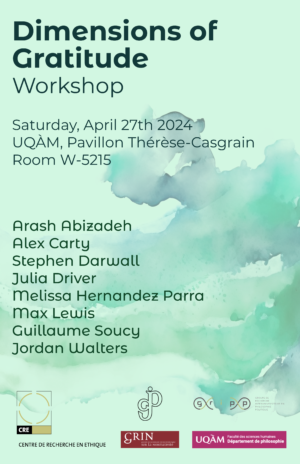
-
XLII Colloquy of the American Weil Society @ C-3061 (Carrefour des Arts et des Sciences) Pavillon Lionel-Groulx
26 Apr – 27 Apr All day

XLII Colloquy of the American Weil Society
The Politics and Ethics of Labour
Simone Weil’s posthumous La condition ouvrière has now been in circulation for over 70 years, and the texts of which it is composed are yet older still. And while this book might not be widely read in the anglophone world, Weil’s most-read works, such as The Need for Roots or Gravity and Grace, also offer extended reflections on labour. But despite Weil’s thorough and subtle critiques of Marxism, her moving plea to make of labour the spiritual core of modern society, her engaged participation in factory life, and an enthusiastic reception by thinkers like Hannah Arendt, she is not always considered amongst the canon of post-Marxist labour theorists. This Colloquy will seek contributions that can help to establish (or question) Weil’s importance as a theorist of labour. We hope to collectively explore Weil’s continued importance in our post-industrial, neoliberal economy.
The complete program and abstracts are available here.
Day 1—Friday, April 26th, 2024
Words of Welcome (8:45)
PANEL 1 – WEIL AND THE MARXIST TRADITION(S) (9:00-10:30)
Eric Springsted (Santa Fe): “What Is the Point of ‘Is There a Marxist Doctrine’?”
Samuel O’Connor Perks (University of Manchester): “Simone Weil, the Catholic Worker
Movement, and contested readings of Marx”
Kenneth Novis (University of Oxford): “The Factory Journals as Worker’s Inquiry”Break (10:30-10:45)
PANEL 2 – TOWARDS A THEORY OF LABOUR? (10:45-12:15)
Inese Radzins (California State University, Stanislaus): “Method (rather than a theory)
for Considering the Politics of Labour”
Alexandre Crépeau (University of Ottawa): “Impactful and Dignified: Simone Weil and
David Graeber’s Shared Ideal of Work”
Joanna Winterø (Københavns Universitet): “How much against your will?”Lunch (12:15-2:15)
PANEL 3 – LABOUR IN SOCIAL AND POLITICAL PRACTICE: EDUCATION,
CARE, COMMUNITY (2:15-3:45)
Alexandre Martins (Marquette University): “Insights from Weil for the Challenge of
Moral Destress in Health Care”
Sarah Dunford (Catholic University of America): “Neither Left nor Right: Intertwining
Community and Labour”
Ryan Poll (Northeastern Illinois University): “The Education Crisis and the Sanctity of
Labor in Simone Weil’s Political Theory”Break (3:45-4:00)
PANEL 4 – LABOUR AND SPIRITUALITY (4:00-5:30)
Connor Williams (Union Theological Seminary): “Labour (justice) as spiritual exercise
in Weil and Process and Womanist theologians”
Rachel Matheson (McMaster University): “A Little Pile of Inert Matter: Flesh and Body
in Simone Weil’s Spirituality of Work”
Noemi Faustini (Pontificia Università Gregoriana): “Simone Weil’s Concept of Slavery
and Jewish Mysticism”Day 2—Saturday, April 27th, 2024
PANEL 5 – WEIL IN CONVERSATION: HEIDEGGER, ARENDT, BATAILLE
(9:00-10:30)
Jacob Wilson (Carleton University): “Weil and Bataille on Political Community”
Robert Reed (Boston College): “Decreative Phenomenology and the Problem of Unjust
Labour”
Peli Meir (University of Haifa): “The Power of Speech and Silence in Weil and Arendt”Break (10:30-10:45)
PANEL 6 – CONTEMPORARY APPLICATIONS OF WEIL’S THOUGHT (10:45-
12:15)
Manuel Ruelas (Ind. Scholar): “Where are we standing?”
Alejandra Novoa Echaurren (Universidad de los Andes): “Simone Weil and prerequisite
to dignity of labour in the actual neoliberal society”
Julia Morrow (Wheaton College): “Analyzing 21st century understandings of labour and
gender through a Weillien lens”Lunch (12:15-2:15)
PANEL ON SIMONE WEIL’S POLITICAL PHILOSOPHY: FIELD NOTES FROM
THE MARGINS (BENJAMIN P. DAVIS) (2:15-3:45)
Discussants: Scott B. Ritner (University of Colorado Boulder)
Sophie Bourgault (University of Ottawa)
Mac Loftin (Harvard University)
Break (3:45-4:00)AMERICAN WEIL SOCIETY BUSINESS MEETING (4:00-5:30)
-
First annual symposium Everything Agency, Université Laval @ Université Laval, Québec (PQ) Canada
25 Apr – 26 Apr All day
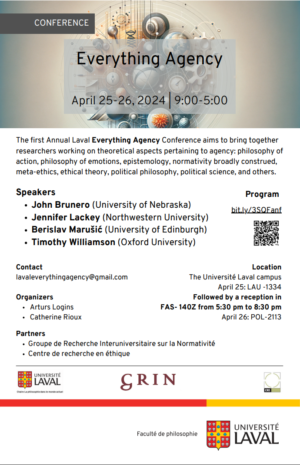
The first Annual Laval Everything Agency Conference will be held on April 25-26, 2024, at Université Laval, Québec City, Canada. The conference aims to bring together researchers working on theoretical aspects pertaining to agency: philosophy of action, philosophy of emotions, epistemology, normativity broadly construed, meta-ethics and ethical theory in connection to agency, political philosophy, political science, foundational issues in artificial intelligence, and philosophy of biology. In addition to the keynote talks, there will be eight slots for papers selected through the call for papers.
Our keynote speakers for 2024 are:
- John Brunero (University of Nebraska, Lincoln)
- Jennifer Lackey (Northwestern University)
- Berislav Marušić (University of Edinburgh)
- Timothy Williamson (University of Oxford)
Everyone is welcome to the conference, attendance is free, but registration is required. Please register by email at lavaleverythingagency@gmail.com. The deadline for registration is April 15, 2024, 9:00. To register, please write to lavaleverythingagency
![[here goes you know what sign]](https://philevents.org/images/o.gif) gmail.com.
gmail.com.Organisateur.rices: Arturs Logins (Laval) (arturs.logins@fp.ulaval.ca) and Catherine Rioux (Laval) (catherine.rioux@fp.ulaval.ca).
If you are a member of the Centre for Research in Ethics, you may be eligible for a reimbursement of your expenses for traveling (by buse or car) and accommodation. Please contact Éliot Litalien (eliot.litalien@umontreal.ca) beforehand to discuss this possibility.
Program
Thursday, April 25th, Pavillon Laurentienne, 1030 Ave. du Séminaire, Québec
Room LAU-1334 (Auditorium Jean-Paul Tardif)8h30-9h00 Welcome/coffee
Coffee and pastries will be available for all participants, courtesy of Laval University and its partners.9h00-10h30 Berislav Marušić (University of Edinburgh) “The Ethicist and the Ontologist: On self-Prediction in Practical Reasoning.”
Chair: Patrick Turmel (Université Laval)
10h30-10h45 Coffee pause
10h45-11h30 Derek Lam (California State University, Sacramento) “Not being sure of Myself.”
Chair: TBD
11h30-12h15 Yuan Tian (Harvard) “An Interpersonal Form of Faith.”
Chair: TBD12h15-13h30
Lunch
Participants will be handed a coupon in the morning for a free lunch at Saveur Campus food court in Maurice Pollack Pavillon.
13h30-15h00 John Brunero (University of Nebraska-Lincoln) “Reasons for Action, Reasons for Intentions, and Agency.”
Chair: Catherine Rioux (Université Laval)15h00-15h15 Coffee pause
15h15-16h00 Eugene Chislenko (Temple University) “Blame as Attention.”
Chair: Laura Silva (Université Laval)
16h00-16h45 Yair Levy (Université de Tel Aviv) “Trying to Act.”
Chair: David James Barnett (Toronto University )17h30-20h30 Cocktail. The Everything Agency Conference organizers are pleased to invite our guests to a cocktail reception held in our very own ward, the Félix-Antoine Savard Pavillon. The event, where refreshments and appetizers will be served, is courtesy of Laval University and our partners.
Friday, April 26th, Pavillon Maurice Pollack, 2305 Rue de l’Université, Québec
Rom POL-2113 (Théâtre de poche)8h30-9h00 Welcome/coffee
Coffee and pastries will be available for all participants, courtesy of Laval University and its partners.9h00-10h30 Timothy Williamson (Oxford) “Decision theory and acting on what one knows”
Chair: Artūrs Logins (Université Laval)10h30-10h45 Coffee pause
10h45-11h30 Alison Springle (The University of Miami) “Acting for Reasons : An Acorn Account.”
Chair: Pierre-Olivier Méthot (Université Laval)
11h30-12h15 Austen McDougal (Princeton) “Motives, the New Frontier for Control.”
Chair: Joshua Brecka (University of Toronto)12h15-13h30 Lunch. Participants will be handed a coupon in the morning for a free lunch at Saveur Campus food court in Maurice Pollack Pavillon.
13h30-15h00 Jennifer Lackey (Northwestern University): “Epistemic Agency in Action”
Chair: Chris Blake-Turner (Oklahoma State University)15h00-15h15 Coffee pause
15h15-16h00 Rowan Mellor (Northwestern University) “Why Cooperate? Team Reasoning and Unwillingness.”
Chair: Nathan Howard (University of Toronto)
16h00-16h45 Jay Jian (National Academy of Taiwan) “Instrumental Agency and the Pre-conditions of Ends.”
Chair: Miriam Schleifer McCormick (University of Richmond)16h45-17h00 Closing Remarks
-
Anca Gheaus (Central European University) @ Online
12 h 00 – 13 h 00
As part of the activities of the Philosophy of Work Network, Anca Gheaus (Central European University) will offer a presentation entitled: “One crisis to solve another? The place of care in the future of work”.
The activities of the Philosophy of Work Network are open to researchers and graduate students with research interests in this area. Please write to the organizers, Denise Celentano (denise.celentano@umontreal.ca) and Pablo Gilabert (pablo.gilabert@concordia.ca), to receive the zoom link.
Abstract
Two work-related crises are looming large: technological unemployment (possibly on mass scale) and a crisis of care (care for the elderly, healthcare, and the “loneliness epidemic”). I argue that we should think about these crises together, rather than separately, because each can provide practical and justificatory solutions to the other. On the practical side, we should aim to match the demand for care with the supply of labour freed by technological unemployment. On the justificatory side, the care crisis is relevant to the unemployment crisis because it fills in a gap in arguments to the conclusion that we should respond to automation by minimising involuntary unemployment. Reasons for the latter are: because the goods of work are important contributors to a good life; because work is integral to a good life insofar it is driven by the desire to serve others; and because, in a Dworkinian hypothetical insurance scheme, people would ensure against involuntary unemployment. If automation eliminated all necessary work, then realising some of the goods of work would be precluded, making the aspiration to serve needs unfulfillable, and providing re-training and new jobs would be very wasteful and hence unaffordable. The care crisis indicates there is, and there will always be, necessary work to be done. The unemployment crisis is relevant to the care crisis because we ought to meet emotional care needs in a politically legitimate manner. Alternative proposals are coercive, hence worrying for liberals. Moreover, coercion is corrosive to some aims of emotional care work, which is ideally motivated by caring about particular individuals.
-
Muriel Mac-Seing (CReSP/ESPUM) @ Online
11 h 30 – 12 h 30

As part of this CReSP-CRÉ lunch conference, Muriel Mac-Seing, researcher at the Center for Public Health Research (CReSP) and Assistant Professor in the Department of Social and Preventive Medicine of the School of Public Health at the University of Montreal (ESPUM) will offer a presentation [in French] entitled “Équité en santé, handicap et déterminants structurels de santé dans un contexte d’injustices épistémiques et climatiques”.
The presentation will be followed by a commentary by Ryoa Chung, co-director of the Ethics Research Center (CRÉ) and Full Professor in the philosophy department of the University of Montreal.
Registration required.
-
Student Colloquium of the research group in environmental and animal ethics GRÉEA @ C-2059, Carrefour des arts et des sciences, UdeM
All day

The research group in environmental and animal ethics (GRÉEA) is pleased to announce the holding of their conference for students work on the GRÉEA’s research axes:
- The fundamental normative issues of animal ethics and/or environmental ethics;
- The practical issues surrounding our relationship with animals and nature;
- The scientific knowledge and epistemological considerations that allow us to think about our relationships with the non-human.
Objective: The objective of the conference is to encourage the sharing of ideas and discussion on the themes mentioned above. It is an opportunity and presentation experience for students interested in an environment conducive to sharing.
Program :
10h00-10h30 Brice Arsène Mankou (CRÉ invited researcher) – « Quelle Éthique pour la conservation des forêts du bassin du Congo ? »
10h30-11h00 Florence Amégan (Université Laval) – « Intérêt et limites éthiques de la permaculture de David Holmgren »11h00-11h15 Coffee break
11h15-11h45 Nancy Thurber (UQAM) – « En effet, communique-t’on? »
11h45-12h15 Raphaël Leclair (Université de Sherbrooke) – « Pour une approche plus compréhensive et responsable en matière de consentement chez les animaux non-humains »12h15-13h30 Lunch break
13h30- 14h00 Rebecca Soland (Université de Montréal) – « La division entre essentialistes et constructivistes dans l’écoféminisme »
14h00-14h30 Christian Alain Djoko (Université Laval) – « Penser la nécroécologie »14h30-14h45 Coffee break
14h45- 15h15 Véronique Armstrong (Université de Montréal) – « Vers un écoholisme cynique : comment favoriser les touts écologiques dans un contexte de prédation ? »
-

« Discussion entre les mathématiques et la philosophie sur le thème de l’équité algorithmique »
Mode hybride: lien zoom.
For the next CRÉ-Obvia ethics and AI lunchtime conference, we welcome Véronique Tremblay, data scientist and responsible AI expert at Beneva and doctoral student in data science at HEC-Montréal.
The main principles of responsible AI all insist on the need to build equitable models. However, there is no consensus on the notion of fairness, either philosophically or mathematically. Since a perfectly and universally fair model is unattainable, how can we build models that respect the principle of fairness?
As a statistician and experienced data scientist, Véronique Tremblay will share with you the path that led her to realize the importance of philosophy in the search for an algorithm that could be described as fair, but also in the overall work of the data scientist. She will present (in French) the challenges encountered and some possible solutions, with the aim of opening up a dialogue between mathematics and philosophy.
-
Pierre Charbonnier ( CNRS, Science Po Paris, EHESS) @ Online
11 h 00 – 13 h 00
On April 16, from 11 a.m. to 1 p.m., GRÉEA will receive Pierre Charbonnier (Researcher at CNRS, professor at Science Po Paris and EHESS), via Zoom, for a conference [in French] entitled “Vers l’écologie de guerre. Une histoire de la géopolitique du climat.”
To participate on Zoom, it’s here.
Summary:
“Nous sommes les héritiers d’une histoire intellectuelle et politique qui a constamment répété l’axiome suivant : pour créer les conditions de la paix entre les hommes, il faut exploiter la nature, échanger des ressources, et fournir à tous et toutes une prospérité suffisante. Pour que le désir de guerre s’efface, il faut d’abord lutter contre la rareté de la nature, qui sinon crée jalousie et conflit. Il faut aussi un langage universel à l’humanité, qui sera celui des sciences, des techniques, du développement. Autrement dit, il est possible d’écrire une histoire matérielle du pouvoir politique, de la capacité à offrir paix et sécurité à sa population.
Ces idées anciennes, que l’on peut faire remonter au 18e siècle, ont trouvé au milieu du 20e siècle une concrétisation tout à fait frappante. Au lendemain de la Seconde guerre mondiale, le développement des infrastructures fossiles a été jumelé à un discours pacifiste et universaliste, qui entendait saper les causes de la guerre en utilisant la libération de la productivité et le bas coûtdu pétrole. La naissance de l’anthropocène est donc contemporaine de l’ordre mondial organisé par les Etats-Unis autour des énergies fossiles: la paix, ou l’équilibre des grandes puissances, est en large partie un don des fossiles.
Au 21e siècle, ce paradigme risque de devenir obsolète puisque nous devons à la fois garantir la paix et la sécurité, et intégrer les limites planétaires : il nous faut apprendre à faire la paix sans détruire la planète. C’est ce que nous apprend en particulier la guerre livrée par la Russie contre l’Ukraine, mais aussi l’émergence d’un discours qui lie l’indépendance stratégique de l’Europe et la décarbonation de son économie. Aujourd’hui, les relations internationales et les politiques climatiques sont étroitement liées, et ce n’est pas un hasard : nous avions parié sur les énergies fossiles pour maintenir la paix, il faut à présent un autre socle matériel pour la paix.”