
Past events
Calendar archives
-
« Il faut une faute pour faire un fautif » @ Salle 309, CRÉ - Hybride
11 h 30 – 12 h 45
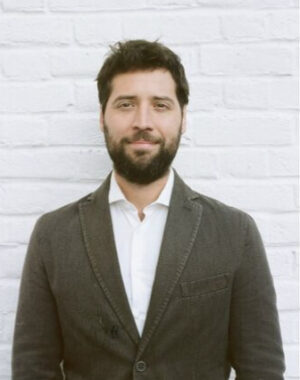
Simon-Pierre Chevarie-Cossette (Université de Neuchâtel) will give a presentation (in person and on Zoom) titled « Il faut une faute pour faire un fautif ». The presentation will be offered in French. But those who wish to obtain the text in English need only write to valery.giroux@umontreal.ca.
To attend via Zoom, it’s here.
Abstract
Anyone blameworthy for an action had a duty not to do that action. This principle seems almost trivial; yet it has important consequences in the debate on free will, but also on moral luck and on the conceptual unity of responsibility. Even more, it makes it possible to account for the way in which we defend our conduct before our relatives or before the law. However, this principle has formidable adversaries (Scanlon, Zimmerman, Haji, Graham) to whom it will be necessary to respond by addressing, among other things, the nature of homework. The principle holds, provided that we avoid overly subjectivizing blame or overly objectivizing duties.
-
Emmanuel Picavet (U. Paris 1 Panthéon-Sorbonne) @ Salle 422, 4e étage, UdeM - mode hybride
13 h 00 – 14 h 30

Emmanuel Picavet (Paris 1 Panthéon-Sorbonne) sera à Montréal pour nous offrir une présentation intitulée “Dimensions de l’internormativité”.
Pour y participer par Zoom, c’est ici.
-
7th Social Justice Theory Workshop
8 Jun – 9 Jun All day

The aim of the Social Justice Theory Workshop is to enable sustained exploration in the theory of social justice. It addresses topics such as the articulation of ideals and principles of economic, political, gender, race, environmental, and cultural justice; the critique of inequality, domination, exploitation, and alienation; and the illumination of political institutions, practices and processes of transformation that might foster progressive change.
Workshop papers will be pre-circulated, and participation implies a commitment to reading the papers in advance.
The workshop will be in person. Places are limited. If you would like to participate, please send your name to Christiane Bailey (sjc@concordia.ca) by May 1, 2023.
This year’s workshop is organised by Pablo Gilabert and Peter Dietsch, in association with the Social Justice Centre (Concordia University), le Centre de Recherche en Éthique (Université de Montréal) and the Department of Philosophy at the University of Victoria.
Programme
9:00 Welcome (Thursday June 8)
9:15 Peter Dietsch (University of Victoria); Commentator: Åsbjørn Melkevik (Queen’s University)
10:30 Break
10:45 Louis-Philippe Hodgson (York University), “Parental Justice: A Rawlsian Proposal”; Commentator: Pablo Gilabert (Concordia University)
12:00 Lunch
13:30 Sabine Tsuruda (Queen’s University); Commentator: Denise Celentano (Université de Montréal)
14:45 Break
15:00 Jan Kandiyali (Durham University, UK), Commentator: Will Roberts (McGill University)
18:30 Dinner
9:30 Welcome (Friday June 9)
9:45 Martin O’Neill (University of York, UK), “Public Goods, Public Provision, and the Sense of Justice”; Commentator: Eleni Schirmer (Concordia University)
11:00 Break
11:15 Avia Pasternak (University of Toronto); Commentator: Sylvie Loriaux (Université Laval)
12:30 Lunch and Farewell
The workshop will take place in the seminar room of the Library Building (LB-362) and the food will be served in the adjacent Friends of the Library Room (LB-361).
WHERE:
Sir George Williams Campus
McConnell Building,
Library 3rd floor (Room LB-362)
1400 de Maisonneuve Blvd. W.
Montreal, Quebec, Canada H3G 1M8
For more information.
-
‘First Among Equals’, by Teresa Bejan (U. of Oxford) – GRIPP @ Stewart-Bio room S/3-4, Université McGill
24 May – 25 May All day

GRIPP Manuscript Workshop
‘First Among Equals’ by Teresa Bejan (U. of Oxford)
Programme
9h00: Coffee & croissants
9h30 : Welcome
9h45 — 11h30 : Chair: Ryoa Chung (philosophy, UdeM)
Chapter One: “An Equal Commonwealth”: Balance
Commentator: Will Roberts (politics, McGill)
Chapter Two: “Omnes Homines Aequales Sunt”: Indifference
Commentator: Jacob Levy (politics, McGill)11h30 — 13h00: Lunch
13h00 — 14h45: Chair: Rob Goodman (politics, Toronto Metropolitan)
Chapter Three: “Peers or Equalls”: Parity
Commentator: Yves Winter (politics, McGill)
Chapter Four: “Equals in the Creation”: Levelling Down
Commentator: Jeffrey Collins (history, Queen’s)
14h45 — 15h00: Coffee break15h00 — 16h45: Chair: Pablo Gilabert (philosophy, Concordia)
Chapter Five: “Too Noble a Being”: Blind Spots and Smoking Guns
Commentators: Lisa Shapiro (philosophy, McGill) and Natalie Stoljar (philosophy, McGill)
Chapter Six: Conclusion: Peers and Equals
Commentator: Robert Sparling (politics, Ottawa)18h30: Dinner
-
Rencontre annuelle transatlantique de philosophie pratique #2 @ Online
4 May – 5 May All day

Annual Transatlantic Workshop in Practical Philosophy #2, on May 4 & 5, 2023, online.
Programme (.pdf)
Day 1: May 4 (Thursday) To get the zoom link, please contact valerygiroux@gmail.com Time (EST) Time (CET) Program 9:00 15:00 Foreword Chair: Magali Bessone (NoSoPhi) 9:05 15:05 Presentation 1 Amine Benabdallah (NoSoPhi)
A Comparative Landscape of the Criminal Liability of States
9:30 15:30 Discussion 10:00 16:00 Presentation 2 Meredith Sheeks (Parr)
The Guilt of the Moral Minimalist
10:25 16:25 Discussion 10:55 16:55 Break 11:10 17:10 Presentation 3 Emil Andersson (CRÉ)
Liberal Legitimacy and Future Citizens
Chair: Ryoa Chung (CRÉ) 11:35 17:35 Discussion 12:05 18:05 Presentation 4 John Lain Miller (Parr)
The Islamic Moral Epistemology of Abolqasem Fanaei
12:30 18:30 Discussion 13:00 19:00 End of day 1 Day 2: May 5 (Friday) To get the zoom link, please contact kristin.voigt@ mcgill.ca Time (EST) Time (CET) Program 9:00 15:00 Foreword Chair: Axel Gosseries (Hoover) 9:05 15:05 Presentation 5 Manuel Sá Valente (Hoover) What do children owe their ageing parents?
9:30 15:30 Discussion 10:00 16:00 Presentation 6 Grégory Ponthière (Hoover) Are Long-Lived Persons Utility Monsters?
10:25 16:25 Discussion 10:55 16:55 Break 11:10 17:10 Presentation 7 Eraldo Souza dos Santos (NoSoPhi)
A Plea for a Conceptual History of Civil Disobedience
Chair: Sarah Stroud (Parr) 11:35 17:35 Discussion 12:05 18:05 Presentation 8 Frauke Albersmeier (CRÉ)
Are some animals more equal than others? An egalitarian challenge for animal rights theory
12:30 18:30 Discussion 13:00 19:00 End of day 2 Co-organisé par Ryoa Chung et Kristin Voigt pour le Centre de recherche en éthique; Axel Gosseries et Pierre André pour la Chaire Hoover; Magali Messone pour le NoSoPhi et Sarah Stroud pour le Parr Center for Ethics.
-
Normativité et justice sociale / Normativity and Social Critique @ Room C-3061, Pavillon Lionel-Groulx, Université de Montréal
1 May – 2 May All day

Colloque “Normativité et justice sociale”, les 1-2 mai 2023 / Conference “Normativity and Social Critique”, May 1-2 2023.
The members of the Centre for Research in Ethics (CRÉ) are pleased to announce this year’s graduate Fellows’ conference, organized with the support of the CRÉ and University of Montreal (UdeM) is entitled “Normativity and Social Justice”. It will be held on May 1-2, 2023 at the UdeM. The goal of the conference is to explore recent work on social criticism and social movements.
Registration is free. Please do register in advance via this link.The keynote speakers are:
Agnès Berthelot-Raffard – “Resisting Medical Colonialism: the case of Black Women’s reproductive health knowledge and community care’’; and
Yann Allard-Tremblay – “Avancer vers nos ancêtres en théories politique normative”
Here is the program. If you have any questions, please contact: creconference2023@
gmail.com Organizing Committee: Frédérique Drouin, Dean Joseph, Alexia Leclerc, Yanie Pierre-Jérôme, Robyn Mellett, Sandrine Renaud and Jordan Walters.
-
 Dans le cadre des midis de l’éthique CRÉ-OBVIA, Joé Martineau (HEC Montréal) offrira une présentation intitulée “Tour d’horizon des enjeux éthiques liés à l’IA en santé”.Pour y participer par Zoom, c’est ici.
Résumé
Le développement et le déploiement de technologies numériques et de l’IA en santé engendrent différents enjeux éthiques et sociaux. La présentation se veut un tour d’horizon des principaux enjeux éthiques liés à l’IA dans le domaine de la santé, basé sur les travaux menés par une équipe de chercheurs de l’OBVIA pour le compte du Ministère de la Santé et des Services sociaux du Québec. -

Dans le cadre des midis de l’éthique CRÉ-OBVIA, Alexis Morin-Martel (McGill U.) nous offrira une présentation intitulée “L’IA et les décisions de libération sous caution : une question de confiance?”.
Pour y participer par Zoom, c’est ici.
Résumé
À l’heure actuelle, l’utilisation d’algorithmes d’intelligence artificielle pour aider à la prise de décision dans les procès criminels est l’objet de débats éthiques et juridiques très houleux, notamment à cause des effets discriminatoires que certains algorithmes engendrent. Cependant, de nouveaux algorithmes semblent particulièrement efficaces pour les décisions de libération sous caution, puisque ces décisions ont un caractère probabiliste et mobilisent des données statistiques auxquelles les décideurs humains ont du mal à donner une importance adéquate. En me basant sur un modèle relationnel de la justice procédurale, j’explore la possibilité que l’usage de certains algorithmes pourrait contribuer à rendre les juges davantage dignes de confiance.
-
4e journée CRÉ et Obvia en éthique de l’IA @ École des sciences de la gestion UQAM, Montréal - en mode hybride
All day

4e journée d’étude en éthique de l’IA: Informatique affective
Le programme complet de la 4e journée CRÉ et Obvia en éthique de l’IA est maintenant disponible. Elle se tiendra le 3 février prochain à l’UQAM et a pour thème l‘informatique affective.
Pour y participer par Zoom, c’est ici. Si vous comptez venir, merci d’écrire à Hazar Haidar (hazar_haidar@uqar.ca) avant le 31 janvier pour que nous commandions suffisamment de boîtes à lunch véganes (offertes gracieusement par nos partenaires).
Chair: Hazar Haidar (UQAR)
9h30: A. Prégent (Leiden U.) Les systèmes de reconnaissance des émotions: ami ou ennemi de l’agentivité?
Quels sont les impacts des systèmes de reconnaissance des émotions (SRÉ) sur les structures sociales, sur nos relations humaines, sur le bien-être? Je propose d’explorer les impacts que l’utilisation de ces systèmes peut avoir sur certaines de nos valeurs fondamentales telles que la vie privée, les relations humaines (amitié, amour) ainsi que sur notre possibilité d’atteindre le bien-être en tant qu’agent autonome.
10h15: J. Martineau et M. Lafond, (HEC Montréal) Enjeux éthiques et acceptabilité sociale des technologies mobilisant l’informatique affective.
Les systèmes d’IA mobilisant la reconnaissance, l’expression et l’utilisation de données émotionnelles à diverses fins sont de plus en plus développés et déployés dans les organisations privées et publiques, et leur utilisation soulève de nombreux questionnements et débats. Cette présentation vise à cerner certains des enjeux éthiques liés aux technologies d’informatique affective, et à discuter des facteurs et conditions d’acceptabilité sociale de celles-ci dans les organisations et dans la société.
10h45 : M. Gibert, (U. de Montréal) Intelligence émotionnelle artificielle: le cas ChatGPT.
L’intelligence émotionnelle (IE) désigne notre capacité à réguler nos émotions et celles des autres (Salovey et Mayer). À quelles conditions peut-on dire qu’un algorithme comme ChatGPT fait preuve d’intelligence émotionnelle et qu’est-ce qui distingue cette IE artificielle d’une IE humaine? Quelles sont les implications morales? Je m’appuierai notamment sur L’emprise insidieuse des machines parlantes de Serge Tisseron et proposerai un lien avec l’hypothèse des robots vertueux.
11h15: (pause)
Chair: Alexandra Prégent (U. Leiden)
11h30: M-H Tessier, C. Pouliot, J. N. Phuong Trieu et P. Jackson (U. Laval) Les progrès et dangers des algorithmes de reconnaissance automatique de la douleur.
Les systèmes de reconnaissance automatique des expressions faciales ont le potentiel de devenir un atout pour la gestion de la douleur. Ils peuvent détecter rapidement et précisément les manifestations de douleur, surpassant même des observateurs humains entraînés. Cependant, il est important de saisir leurs limites, comme les informations partielles relatives à la douleur ressentie, et de formuler des recommandations pour circonscrire certains risques à leur utilisation tels que le sous-traitement de la douleur.
12h00: T. Adetou, (U. de Montréal), Une machine sans émotion peut-elle être un agent moral ?
Les carebots, les chatbots, etc., sont parfois considérés comme des agents moraux artificiels. Or traditionnellement, l’agentivité morale se fonde sur la rationalité (Kant), la responsabilité ou les émotions (Hume). Si nous prenons au sérieux la centralité des émotions dans la décision morale (Rietti), comment alors, des agents artificiels sans émotions peuvent réellement agir moralement. Nous discuterons cette question en évoquant notamment l’approche perceptuelle de Mark Coekelbergh.
12h30: (lunch)
Chair: Martin Gibert (U. de Montréal)
14:00 P. Plusquellec (EmoScienS), Mobiliser éthiquement l’informatique affective pour promouvoir la santé mentale ?
Une personne sur 4 va déclarer un trouble de santé émotionnelle au travail. À la suite de la pandémie de covid-19, cette proportion a tellement augmenté que nous craignons une pandémie de troubles de santé mentale. Les progrès en apprentissage profond dans la reconnaissance automatique d’émotions peuvent être mobilisés pour faire face à ce problème global. Le développement d’un outil qui permettrait à chacun de veiller sur ses émotions en temps réel présente cependant son lot de défis éthiques que nous adresserons.
14:30 J. Pierre (U. Sherbrooke) et M-J. Catoir-Brisson, (U. Audencia Nantes), L’IA émotionnelle face aux émotions de ses concepteurs
Dans le cadre d’une recherche-intervention, nous avons accompagné un industriel souhaitant développer une IA émotionnelle pour la famille. En repartant de l’empathie supposée de l’artefact, nous avons proposé aux concepteurs de prendre la place de la machine et de capturer les éléments de vie affective dans leurs familles. Ce dispositif d’enquête a permis de cadrer une éthique de la conception pour les technologies affectives, combinant les valeurs morales des innovateurs et le potentiel commercial de l’innovation.
15:00: (pause)
Chair: Hazar Haidar (UQAR)
15:15 A. Sabourin Laflamme et F. Bruneault (UQAM), Le statut moral de nos restes numériques à la lumière de l’éthique de l’information.
Nous lèguerons après notre mort un héritage numérique imposant. La quantité astronomique de données personnelles recueillies de notre vivant couplée aux progrès fulgurants en intelligence artificielle permettent d’envisager des types de relations affectives inédites aux défunts. Nous proposons, partant de l’éthique de l’information telle que développée par Luciano Floridi, de réfléchir à la question du statut moral des restes numériques ainsi qu’aux question éthiques que soulèvent les nouveaux produits offerts par l’industrie de l’après-vie numérique.
15:45 Table ronde avec Philip Jackson (U. Laval), Pierrich Plusquellec (EmoScienS), Dominic Martin (UQAM), Joé Martineau (HEC Montréal).
16:45- fin
-
6th Social Justice Theory Workshop, 2022
14 Jul – 15 Jul All day
The aim of the Social Justice Theory Workshop is to enable sustained exploration in the theory of social justice. It addresses topics such as the articulation of ideals and principles of economic, political, gender, race, environmental, and cultural justice; the critique of inequality, domination, exploitation, and alienation; and the illumination of political institutions, practices and processes of transformation that might foster progressive change.
This year’s workshop will be in person. Places are limited. If you would like to participate, please send your name to Christiane Bailey (sjc@concordia.ca) by July 1, 2022. Workshop papers will be pre-circulated, and participation implies a commitment to reading the papers in advance.
This year’s workshop is organised by Pablo Gilabert and Peter Dietsch, in association with the Social Justice Centre (Concordia University) and Centre de Recherche en Éthique (Université de Montréal).
Preliminary program
(All listed times are in EDT)
Thursday 9:15
ANNULÉ! Author: Thomas Christiano (University of Arizona)
Paper: “Worker Participation and The Egalitarian Conception of Fair Market Exchange.” Commentator: Arash Abizadeh (McGill University)10:30 Welcome coffee / breakfast 10:45 Author: Suzanne Love (Georgia State University)
Paper: “Freedom from the Market.” Commentator: Sylvie Loriaux (Université Laval)12:00 Lunch 13:30 Author: Colin Macleod (University of Victoria)
Paper: “The Demands of Justice.” Commentator: Patti Lenard (University of Ottawa)14:45 15:00 Author: Pablo Gilabert (Concordia University)
Paper: “Self-esteem and Social Competition.” Commentator: Daniel Weinstock (McGill University)Friday 9:45 Welcome 10:00 ANNULÉ! Author: Peter Dietsch (University of Victoria)
Paper: “Markets, power, and (in)equality”. Commentator: Patti Lenard (University of Ottawa)11:00 Coffee 11:15 Author: Ingrid Robeyns (Utrecht University)
Paper: “What can egalitarian political philosophy learn from visions for a green egalitarian future (and vice versa)?” Commentator: Alexandre Gajevic Sayegh (Université Laval) -
Annual Transatlantic Workshop in Practical Philosophy @ Online
28 Apr – 29 Apr All day
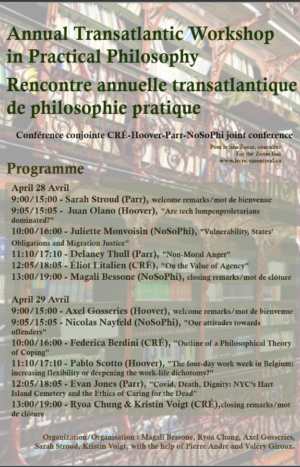
Annual Transatlantic Workshop in Practical Philosophy
Rencontre transatlantique annuelle de philosophie pratique
CRÉ-Hoover-Parr-NoSoPhi joint conference
April 28-29, 2022
Pour y participer par Zoom, c’est ici.
Day 1: April 28 Time (EST) Time (CET) Program 9:00 15:00 Welcome remarks – Sarah Stroud (Parr) 9:05 15:05 Juan Olano (Chaire Hoover), “Are tech lumpenproletarians dominated?” 9:30 15:30 Discussion 10:00 16:00 Juliette Monvoisin (NoSoPhi), “Vulnerability, States’ Obligations and Migration Justice” 10:25 16:25 Discussion 10:55 16:55 Break 11:10 17:10 Delaney Thull (Parr), “Non-Moral Anger” 11:35 17:35 Discussion 12:05 18:05 Éliot Litalien (CRÉ), “On the Value of Agency” 12:30 18:30 Discussion 13:00 19:00 Closing remarks – Magali Bessone (NoSoPhi) Day 2: April 29 Time (EST) Time (CET) Program 9:00 15:00 Welcome remarks – Axel Gosseries (Chaire Hoover) 9:05 15:05 Nicolas Nayfeld (NoSoPhi), “Our attitudes towards offenders” 9:30 15:30 Discussion 10:00 16:00 Federica Berdini (CRÉ), “Outline of a Philosophical Theory of Coping”. 10:25 16:25 Discussion 10:55 16:55 Break 11:10 17:10 Pablo Scotto (Chaire Hoover),”The four-day work week in Belgium: increasing flexibility or deepening the work/life dichotomy?” 11:35 17:35 Discussion 12:05 18:05 Evan Jones (Parr), “Covid, Death, Dignity: NYC’s Hart Island Cemetery and the Ethics of Caring for the Dead” 12:30 18:30 Discussion 13:00 19:00 Closing remarks – Ryoa Chung & Kristin Voigt (CRÉ) Organization : Magali Bessone, Ryoa Chung, Axel Gosseries, Sarah Stroud, Kristin Voigt, with the help of Pierre André and Valéry Giroux.
-

The precarity of living through ecological and health crises inevitably leads us to consider the question of the unlivable. What constitutes liveability and unliveability in our modern context? In order to answer this question, we must consider precarity as a politically induced condition under which certain groups are differentially exposed to injury, violence, and death. How are systems of precarity and unliveability connected, especially in the case of the intensive exploitation of nature, women, racialized people, and non-human living beings? What does it mean to contribute to the livability of certain people to the detriment of others? Given the social and political constraints imposed on certain individuals along lines of race, gender, class, and ability, how can we ensure that the livability of some is not tied to the destruction of the living conditions of others or of life as a whole?
The Center for Research in Ethics (CRE) is honored to invite you all to think about these questions with two distinguished keynote addresses: Frédéric Worms (École Normale Supérieure) and Katharine Jenkins (University of Glasgow).
Keynote adresses
Frederic Worms 9h30 to 10h30
In Le vivable et l’invivable (2021) Judith Butler and Frédéric Worms argue that the condition of unliveability refers to the lives of people who have suffered such huge trauma that they lose touch with their own subjectivity. Social, political and physical violence produce ruptures and can engender the end of the recognition of oneself as an acting subject in the world. In this conference, we will explore the ethical and philosophical tools to not only think about this unliveability, but also to better understand what is needed in terms of political and social support structures to ensure that all lives are livable and thus hope to move towards non-violence.
Katharine Jenkins 11h to 12h
Katharine Jenkins’ research considers the precarity of ontological categories themselves, as well as the ways in which emancipatory social movements can best respond to these categories. In their forthcoming book, Ontology and Oppression: Race, Gender, and Social Construction, Jenkins identifies a distinctive form of injustice in which an individual is wronged by the fact of being socially constructed as a member of a certain social kind. Their recent work on disability is concerned with the relationship between a person’s bodily capacities and their social world.
Lunch break 12h to 13h
Conference presentations
13h00 à 14h30
13h à 13h30 : “Pas juste une autre femme autochtone” : redéfinition de la vulnérabilité dans les témoignages à l’ENFFADA – Miriam Hatabi
13h30 à 14h00 : Writing Ungrievable Lives in Car-Dependent Cities: Erín Moure’s Sitting Shiva on Minto Avenue, by Toots – William Brubacher
14h00 à 14h30 : Droits des migrant.es et nationalismes autochtones : au-delà des catégories politiques coloniales – Alexia Leclerc
14h45 à 16h15
14h45 à 15h15 : Addiction as a response to unlivable conditions – Zoey Lavallee
15h45 à 15h45 : “Doctor, I’m going to die”: Psychic Trauma, Racial Wounds, and Colonial History – Sujaya Dhanvantari
15h45 à 16h15 : Technology and Unliveability – David Collins
Organization: Celia Edell, Laurie Gagnon-Bouchard, Annie Liv, Guillaume Soucy et Em Walsh.
Registrations : https://umontreal.zoom.us/meeting/register/tZIvf-6hqTwoE9Xl9LdKyvf02_z4AXxwEKv9
-
“Rawlsian Contractualism and Future Generations: The Case of Winding Up” @ Mode hybride - Carrefour des arts et des science, C-2017-02
12 h 30 – 13 h 45

As part of the CRÉ ethics lunchtime, Emil Andersson will give us a presentation entitled “Rawlsian Contractualism and Future Generations: The Case of Winding Up”.
To participate via Zoom, it’s here.
Abstract
Rawlsian contractualism is based upon a conception of society as a fair system of intergenerational cooperation. This conception, as formulated by Rawls, appears to imply that “winding up” – the act of intentionally bringing a just society to an end – would be unjust. However, the original position appears to result in principles that allow winding up. In this paper I discuss this problem, and consider the prospects of revising Rawlsian contractualism so that it better coheres with its underlying conception of fair intergenerational cooperation. The most plausible solution, I suggest, is to slightly revise the account of the reasoning of the parties in the original position. This is a revision based on the ideal of free and equal persons, and thus motivated by elements already present in Rawlsian contractualism.
-
 Vous êtes convié.es à la 3e journée d’étude du CRÉ et de l’Obvia en éthique de l’intelligence artificielle.
Éthique et simulation: de l’IA à la réalité virtuelle.
Pour s’inscrire (gratuitement), c’est ici.Programme
9:00 – Ryoa Chung, co-directrice du CRÉ, Université de Montréal: mots d’introduction.
Chair: Hazar Haidar, UQAR.
9:05 – Martin Gibert, Université de Montréal.
Éthique et réalité virtuelle: le tour du propriétaire
Des mind crimes à l’argument de la simulation, des crimes virtuels à l’amoralisme virtuel, de l’intuition de l’animal numérique à la propriété d’objets digitaux, cette présentation offrira un tour d’horizon des principaux enjeux éthiques qui apparaissent avec les environnements virtuels.
10:05 – Éloïse Boisseau, Université d’Aix-Marseille.
Les machines conversationnelles : imitation, simulation, illusion.
L’intervention portera sur les notions d’authenticité et d’artificialité dans le cadre des performances exécutées par les machines dites « conversationnelles ». Elle sera l’occasion d’interroger le rapport que nous entretenons avec celles-ci. L’analyse conceptuelle sera organisée autour de notions clés : celles d’imitation, d’émulation, de duplication, de simulation et d’illusion.
10:35 – Pause
Chair: Alexandra Prégent, Leiden University.
10:45 – Amah Adetou, Université de Strasbourg.
Un agent moral peut-il être virtuel?
Avatars, personnages non-joueurs, ou encore chatbots évoluent et agissent selon des modalités et des caractéristiques diverses dans le monde virtuel, avec des conséquences variées. Pouvons-nous les qualifier d’agents moraux virtuels ? Cette question nous amène à réfléchir précisément à la notion d’agentivité dans l’univers virtuel, ainsi qu’à son sens moral.
11:15 – Odile Bellenguez et Gilles Coppin, IMT Atlantique (France).
De l’usage de la simulation pour renforcer la place de l’éthique dans les trois systèmes de pensée.
Nos décisions peuvent être prises sur la base de trois différents systèmes de pensée introduits par Kahneman et Houdé. Chacun peut être enrichi par la simulation, qui nourrit également le développement de mécanismes essentiels permettant de prendre en compte la réflexion éthique en situation de décision critique.
11:45 – Roman MALO et Louis DEVILLAINE, Université de Grenoble.
Modélisation, prédiction, hyperréel : vers une construction normée de la réalité.
Les modèles d’apprentissage machine, nourris notamment par les mesures de comportement effectuées grâce à la réalité virtuelle, sont de plus en plus utilisés pour non plus seulement décrire, prédire le réel, mais aussi pour le normer. Le concept d’hyperréel, de Jean Baudrillard, nous éclairera sur les enjeux éthiques de ces pratiques.
12:15 – Pause midi
Chair: Hazar Haidar, UQAR.
13:15 – Marie-Hélène Tessier et Audrey Marcoux, CIUSSS du Nord de l’Île de Montréal.
Personnages virtuels en santé mentale… et l’éthique dans tout ça?
Les personnages virtuels ont le potentiel d’offrir des solutions innovatrices face aux besoins criants en santé mentale. Cette présentation abordera les enjeux éthiques que soulèvent leur développement et leur utilisation en santé mentale en plus de discuter de quelques recommandations favorisant un usage éthique de cette technologie.
13:45 – Al Hassaniyah Khouiyi, Université du Québec à Trois-Rivières.
Enjeux éthiques du métaverse dans la sphère médiatique québécoise.
Notre recherche présente les résultats de l’analyse de la médiatisation du changement du nom de Facebook et de ses implications sur la perception du métaverse dans la sphère publique québécoise. Par l’étude du cadrage de la presse québécoise, nous présentons ainsi les enjeux éthiques qu’un mode socionumérique virtuel soulève.
14:15 – Casey Côtes-Turpin, Université du Québec à Montréal.
IA, biométrie et jeux vidéo : quels sont les enjeux éthiques ?
Grâce aux nouveaux appareils de réalité virtuelle et à leurs capteurs biométriques intégrés, les développeurs ont maintenant accès à l’activité cognitive du joueur, ce qui pourrait leur permettre d’influencer son comportement en temps réel. Cette utilisation potentielle soulève des questionnements éthiques auxquels nous tenterons de répondre.
14:45 – Pause
Chair: Alexandra Prégent, Leiden University
15:00 – Sylvain Munger, Université de Montréal.
Simuler la « guerre des intelligences » avec Terminator et Matrix.
Avec les films Terminator et Matrix, je vais montrer comment la « guerre des intelligences » reproduit la vision cybernétique d’origine militaire dans laquelle l’intelligence rivale est un adversaire à vaincre. Je vais aussi cerner les liens entre l’intelligence et la domination pour faire une critique de la méritocratie.
15:30 – Table ronde animé par Martin Gibert: Dave Anctil (OBVIA), Maxime Delongchamps (UdeM), Oriane Morriet (UdeM), Marie-Hélène Parizeau (U.Laval).
16:30 – fin
Cette journée d’étude est organisée par Martin Gibert (Université de Montréal), Hazar Haidar (UQAR) et Alexandra Prégent (Leiden University) en collaboration avec le Centre de Recherche en Éthique et l’OBVIA.
-
5th Social Justice Theory Workshop
10 Jun – 11 Jun All day
5th Social Justice Theory Workshop
[Montreal time]
It is a closed event.
June 10th
9h45 – Welcome
10h00-11h15 Anca Gheaus (Central European University): “Feminism without Gender Identity.”
Commentator: Amandine Catala (Université du Quebec à Montréal).11h30-12h45 Lisa Herzog (University of Groningen): “The epistemic-trust argument for social justice.”
Commentator: Natalie Stoljar (McGill University).13h30-14h45 Pablo Gilabert (Concordia): “Equality and Dignity.”
Commentator: Adam Hosein (Northeastern University).June 11th
9h45 Welcome
10h00-11h15 Miriam Ronzoni (University of Manchester): “Constructivist Justice as a Problem Solving Concept.”
Commentator: Julie Rose (Dartmouth College)11h30-12h45 Martin O’Neill (University of York) and Markus Furendal (University of Stockholm): “Justice and Collective Capital Institutions: Revisiting Rudolf Meidner, and the Case for Wage-Earner Funds.”
Commentator: Louis-Philippe Hodgson (York University).13h30-14h45 Peter Dietsch (Université de Montréal); “Endogenous comparative advantage and its implications for the incentives argument.”
Commentator: Joseph Heath (University of Toronto).Organizers: Peter Dietsch and Pablo Gilabert, for the Social Justice Centre and Centre de Recherche en Ethique.
-
“Qui en est responsable ? / Who’s Responsible for This?”
11 May – 12 May All day

The recipients of the 2020 Centre for Research on Ethics (CRE) scholarship are pleased to announce the CRE’s 3rd student annual conference entitled “Who’s Responsible for This?”, on Zoom plateform.
The conference will focus on various aspects of individual and collective responsibility as a concept, value, and principle, and on how these intersect with contemporary ethical theory and practice in all fields, including, but by no means limited to, philosophy, political science, human and animal health, and environmental science, among others.The program includes four guest speakers:
Phoebe Friesen who is, at McGill University, an Assistant Professor in the Biomedical Ethics Unit and the Department of Social Studies of Medicine.
Mona Gupta who is a psychiatrist at the Centre Hospitalier de l’Université de Montréal (CHUM) and a researcher in bioethics at the Centre de Recherche du Centre Hospitalier de l’Université de Montréal (CRCHUM) as well as a clinical associate professor in the Department of Psychiatry and Addictology at the Faculty of Medicine of the Université de Montréal.
Allison Marchildon who is a professor in the Department of Philosophy and Applied Ethics at the University of Sherbrooke.
Dale Jamieson who is a Professor of Philosophy and Environmental Studies at NYU College of Arts and Sciences
Summaries of the other presentations can be found here.
Organized by Emmanuel Cahen, Robert Dillon, Simon Goyer, Tierry M. Laforce, Sihem Neila Abtroun and Erika Olivaux.

-

Rencontre annuel des chercheur.se.s du CRÉ, du Parr et de la Chaire Hoover!
Co-organisé par Christine Tappolet, Sarah Stroud et Axel Gosseries.
Via Zoom.
Le programme préliminaire est le suivant:
Le 6 mai
Le 6 mai
9h00 Jules Salomone-Sehr (CRÉ), “Dissociated Agency: How to Φ at Will Without Intending to Φ”
10h00 Michael Prinzing (Parr), “Meaningfulness as Mattering: Can Insight be Gained by Exploring the Implications of a Platitude?”
11h00 Pause
11h15 Rodrigo Diaz (CRÉ), “The role of emotion in moral thought and action”
12h15 Fernanda Pérez Gay Juárez (CRÉ), “Belief in conspiracy theories throughout the COVID-19 crisis : An ethical approach to epistemic mistrust”
Le 7 mai
9h00 Niko Väänänen (Chaire Hoover): “Should pension (benefit) depend on the number of children?”
10h00 Denise Celentano (CRÉ), “When Your Boss Is an Algorithm: The Problem with the Re-Taylorization of Labor and Algorithmic Management”
11h00 Pause
11h15 Manuel Valente (Chaire Hoover) : “Two Types of Age-Sensitive Taxation”
12h15 Karl Martin Adam (Parr), “The Problem of Supererogation: A Rossian Response”
/home/lecreumo/public html/wp content/uploads/2021/03/poster copie
-

Cette seconde journée d’étude sur l’IA organisée par Martin Gibert, Hazar Haidar et Alexandra Prégent avec le Centre de recherche en éthique (CRÉ) et l’Observatoire international sur les impacts sociétaux de l’IA et du numérique (OBVIA) se veut un espace de réflexion autour des différentes manières de combiner éthique et programmation d’un système d’IA.
Avec la multiplication et le perfectionnement des systèmes mobilisant des algorithmes, il devient de plus en plus nécessaire de traduire des principes moraux en code informatique. Qu’il s’agisse de programmer un robot ou une application, l’éthique est convoquée pour analyser les enjeux de la programmation et évaluer les différentes options. On peut notamment penser aux dilemmes de voitures autonomes (comment la programmer en cas d’accident inévitable?) ou aux règles qui structurent le fil d’actualité de Facebook ou d’une recherche Google. Bref, il faut qu’on parle d’éthique des algorithmes.
Pour plus d’information.
HORAIRE DE L’ÉVÉNEMENT
8 h 55 MOT D’INTRODUCTION ET DE BIENVENUE: HAZAR HAIDAR
9 h Martin Gibert (U. de Montréal). Pourquoi l’éthique des algorithmes ?
9h30 Odile Bellenguez (IMT Atlantique). Conception de plannings : ce que les algorithmes optimisent
10h Karine St-Denis (U. Laurentienne). Le portrait composite : éthique et usage judiciaire de la génétique humaine10H30 PAUSE
10h50 Alexandre Bretel (Institut de Philosophie de Grenoble). L’apport de la notion de responsabilité d’Hans Jonas, Hannah Arendt et Gunther Anders à l’éthique des algorithmes
11h20 Andréane Sabourin Laflamme et Frédérick Bruneault (Collège André-Laurendeau). Quel rôle pour la soft ethics dans l’encadrement normatif des algorithmes : de l’éthique algorithmique au droit
11h50 Anne-Marie Boisvert (UQAM). Le problème du problème de la boîte noire12H20 PAUSE REPAS
13h30 FredericMarty (CNRS-GREDEG-Université Côte d’Azur) et Thierry Warrin (HEC Montréal, CIRANO). Plateformes numériques, algorithmes et éthique : une illustration par les enjeux liés aux ententes algorithmiques
14h00 Anne Boisly (U. de Montréal). Tensions en éthique des algorithmes : surveillance et protection de la vie privée
14h30 Jean-Christophe Bélisle-Pipon (Simon Fraser U.), Vincent Couture (U. Laval) et Marie-Christine Roy (U. de Montréal). L’exceptionnalisme de l’IA et l’évaluation des technologies de la santé15H00 PAUSE
15h20 Dominic Martin (UQAM) et Travis Lacroix (MILA). AI Human compatibility and Russell’s approach: What is the right Proxy for Artificial Moral Agency
15h50 Florian Manuch (U. Laval). Systèmes d’armes létaux autonomes : des impacts éthiques et juridiques
16h20 Audrey Durand (U. Laval), Dominic Martin (UQAM), Vardit Ravitsky (U. de Montréal) et Daniel Weinstock (McGill U.). Table ronde animé par Martin Gibert sur l’éthique des algorithmes
17H00 FIN
/home/lecreumo/public html/wp content/uploads/2021/01/cré obvia
-
Atelier intitulé “Social Justice Theory Workshop”
Organisé par Pablo Gilabert (Concordia) et Peter Dietsch (UdeM).
Thursday, August 27, 9:00 – 16:15; Friday, August 28, 9:45 – 12:45.
The aim of the Social Justice Theory Workshop is to enable sustained exploration in the theory of social justice. It addresses topics such as the articulation of ideals and principles of economic, political, gender, race, environmental and cultural justice; the critique of inequality, domination, exploitation and alienation; and the illumination of political institutions, practices and processes of transformation that might foster progressive change. Workshop papers will be pre-circulated, and participation implies a commitment to reading the papers in advance.
List of Participants / Titles :
SPEAKERS
- Elvira Basevich (University of Massachusetts Lowell) “W.E.B. Du Bois’s Constructivist Theory of Justice”
- Lucas Stanczyk (Harvard University) “Ambedkar and DuBois’s Pragmatist Approach to the Caste Problem”
- Meena Krishnamurthy (Queen’s University) “Climate Change and the Structure of Intergenerational Justice”
- Amandine Catala (Université du Québec à Montréal) “Correcting a Capital Mistake: Towards a New Political Economy of Taxing Capital”
- Peter Dietsch (Université de Montréal) “Metaepistemic Injustice and Intellectual Disability: A Pluralist Account of Epistemic Agency”
- Pablo Gilabert (Concordia University) “Domination and Dignity”
COMMENTATORS:
- Agnes Tam (Concordia University)
- Daniel Weinstock (McGill University)
- Natalie Stoljar (McGill University)
- Jules Salomone-Sehr (Centre de Recherche en Éthique)
- Dominic Martin (Université du Québec à Montréal)
- Will Roberts (McGill University)
-
Journée d’étude en éthique de l’IA – L’intelligence artificielle entre philosophie et bioéthique @ Salle C-2059, Carrefour des arts et des sciences, Pavillon Lionel-Groulx, UdeM
All day

Le centre de recherche en éthique propose une journée d’étude sur l’intelligence artificielle intitulée : l’intelligence artificielle entre philosophie et bioéthique.
PROGRAMME
9 h 30 MOT DE BIENVENUE (Martin Gibert)
Martin Gibert. Comment programmer moralement un agent conversationnel ?
10 h 10 Erica Monteferrante. Détresse morale et intelligence artificielle
10 h 40 Christophe Abrassart. IA et climat : synergie ou contradiction ? Les termes du débat
11 h 10 PAUSE CAFÉ
11 h 40 Alexandra Prégent. Les problèmes sociaux de la transparence dans les SIA
12 h 10 Dominic Martin et Carl Mörch. The idea of moral competence in the scientific
literature: A critical review of a thin concept.
12 h 40 DÎNER
13 h 40 Frédérick Bruneault et Andréane Sabourin Laflamme. Les données massives
en santé à la lumière de l’éthique de l’information.
14 h 10 Jonathan Simon. What is it like to be AlphaGo?
14 h 40 PAUSE CAFÉ
15 h Bryn Williams-Jones. IA et innovation responsable : gouvernance par qui?
15 h 40 Philippe Beaudoin. Vers une IA digne de confiance, survol des lignes directrices
proposées par la commission européenne
16 h 10 Table ronde. Robots et humains: quels clivages moraux ?
Vardit Ravitsky, Jocelyn Maclure, Daniel Weinstock, Bryn Williams-Jones,
Philippe Beaudoin.
17 h MOT DE CLÔTURE (Martin Gibert)
Organisation: Martin Gibert, Hazar Haidar et Erica Monteferrante.