Past events
Calendar archives
-
Jean-François Pradeau (Université de Lyon 3) @ Room 422, Department of philosophy, Université de Montréal
12 h 00 – 13 h 30

The GRÉEA and the CRÉ are pleased to welcome Jean-François Pradeau (Université de Lyon 3), who will be giving a talk titled “Philosophizing Without Meat: Abstaining from Flesh in the Platonic Tradition.”
Session Chair: Louis-André Dorion.
To join via Zoom, click here (Meeting ID: 812 5326 4221; Passcode: 688603).
-
“ART expansion and the new imagined landscapes of care” @ Room 309, CRÉ, hybrid, 2910 Edouard-Montpetit, Montreal
12 h 00 – 13 h 15

As part of the Ethics Lunchtime series, Anat Rosenthal (Ben-Gurion University of the Negev) will give a presentation on her current work.
To join on Zoom, click here.
-

We are pleased to invite you to the Philosophy and Ethics of Economics reading group, to be held in hybrid format (Zoom) on April 17, 2025 at 9:30 a.m. (Montreal time). The meeting will take place in room 2.840, 2nd floor at HEC, 3000 Côte Ste-Catherine (next to the library).
We will discuss the text by Filippo Santoni de Sio, Txai Almeida and Jeroen van den Hoven entitled “The future of work: freedom, justice and capital in the age of artificial intelligence” published in Critical Review of International Social and Political Philosophy (2024).
In addition, we also invite you to read the text by Danaher entitled “In Defence of the Post-Work Future: Withdrawal and the Ludic Life” published in The Future of Work, Technology, and Basic Income (2019). This second reading is optional, for those who wish to go a little further.
We hope to see many of you there, and would be delighted if you could share this invitation with anyone who might be interested.
To participate via Zoom, click here.
Organized by Nicolas Pinsonneault, Morgane Delorme and Gabriel Monette.
-
“Neutralité de l’Etat et éducation morale”, Ophélie Desmons @ Room 309, UdeM
12 h 00 – 13 h 15

As part of the CRÉ’s Ethics Lunchtime series, Ophélie Desmons will be giving a presentation titled “State Neutrality and Moral Education.” A discussion will follow.
To join via Zoom, click here.
The presentation will be in French but the questions may be asked in English.
-
Eugene Chislenko (Temple University) @ Room 309, CRÉ, hybrid, 2910 Edouard-Montpetit, Montreal
12 h 00 – 13 h 30

As part of the Ethics Lunchtime Series, Eugene Chislenko (Temple U.) will give a talk entitled “Respect and the Standing to Blame”.
To join on Zoom, click here.
Abstract:
Many philosophers believe that hypocritical, complicit, or meddling blamers lose their standing to blame. Some hesitate to use the notion of standing. ‘Standing’ can seem too ambiguous, too binary in contexts rife with degrees, inapplicable to relevant mental kinds such as belief and emotion, and not really distinct from other evaluative notions. I argue that talk of standing can be made both coherent and useful if it models itself not on legal standing but, instead, on social and academic standing. I introduce the Disrespect View of Standing to Blame: To have standing to blame someone for something is to be in a relation to the relevant norms that enables one to blame her for it without disrespect. I argue that the Disrespect View addresses concerns about talk of standing, and offers an account of standing that is illuminating in assessing and applying conditions on standing. The Disrespect View also reorients attention toward the many interesting, tricky cases of partly undermined standing, and resists an overly legalistic conception of personal relationships.
-

On Friday, April 4, 2025, from 3:40 p.m. to 4:45 p.m., Frédéric Côté-Boudreau (Université du Québec à Trois-Rivières) will present “Should Animals Have Labour Rights?” as part of Concordia University’s Social Justice Fellows seminar series.
The event will take place in room 14.250 (14th floor) of Concordia University’s John Molson Building, located at 1600 De Maisonneuve Boulevard West. It is also possible to participate via Zoom.
Vegan food and refreshments will be served. Registration is free, and everyone is welcome.
For more details, click here.
Summary
Domesticated animals contribute to the wealth and functioning of our societies: it is the very reason why they are exploited in the first place. Their time, efforts, skills, and bodies are used to produce goods and services but almost always through coercion and at the cost of their own lives. While scientific and legal institutions increasingly recognize that most exploited animals are sentient–and not mere things–, they are still treated, in economic terms, as resources and merchandise, as machines and tools.
This situation is untenable. Some philosophers, legal scholars, and sociologists argue that domesticated animals deserve labour rights—they indeed provide genuine labour, but one that goes unrecognized and virtually unprotected. Beyond simply improving their working conditions, this “labour rights” approach to animal rights seeks to guarantee breaks, holidays and leisure time, a right to retirement, fair monetary compensation, and a right to be represented in the workplace. It promises to go beyond the welfarist paradigm, which keeps animals under human dominion, and posits that human-animal relationships can truly be mutually beneficial if properly regulated.
Despite its best intentions, I will argue that this strategy might fail animals and offers only limited parallels with human labour rights. First, I will map out the various ways in which domesticated animals work (or are worked upon). Second, I will outline the case for labour rights for animals. Third, I will present four key issues with this approach—some pragmatic, others more normative. Finally, I will argue that animals’ flourishing is better secured through unconditional socio-economic rights, which can recognize the value of their care work and social reproduction work without making them vulnerable to productivist systems.
-
Jay Bernstein (New School for Social Research) @ Concordia University
15 h 00 – 17 h 00

On Friday, April 4, 2025, from 3:00 p.m. to 5:00 p.m., Jay Bernstein (New School for Social Research) will give a presentation entitled “Earth Justice: Emergency Ethics in the Age of Climate Catastrophe”. The presentation will take place in Room 362 of Concordia University’s J.W. McConnell Building, located at 1400 De Maisonneuve Boulevard West, Montréal, Quebec.
Organized by the Philosophy Department of Concordia University and the Groupe de recherche interuniversitaire sur la normativité (GRIN).
For more details, click here.
-

Next Friday, April 4, from 12:45 p.m. to 2:00 p.m., Patrick Garon-Sayegh (Université de Montréal), a member of GRIN, will give a presentation entitled “Entre preuve et confidentialité dans l’affaire Maillé. Tensions théoriques et méthodologiques” as part of the activities of the Centre interuniversitaire de recherche sur la science et la technologie (CIRST).
The event will take place in room N-8510 of the Pavilion Paul-Gérin-Lajoire at UQÀM, located at 1205 Saint-Denis Street, Montréal, Québec.
For more information and to register, click here.
-
Book Launch for “The Dynamics of Epistemic Injustice: Situating Epistemic Power and Agency” @ Université du Québec à Montréal
17 h 00 – 19 h 00

On Thursday, April 3, 2025, from 5:00 p.m. to 7:00 p.m., join us for the book launch of The Dynamics of Epistemic Injustice: Situating Epistemic Power and Agency (OUP, 2025), written by Amandine Catala (Université du Québec à Montréal). The event will take place on the 5th floor of the Pavillon Thérèse-Casgrain, room W-5215, Université du Québec à Montréal, 455 René-Lévesque East, Montreal.
Organized by UQÀM’s Department of Philosophy, in collaboration with the Chaire de recherche du Canada sur l’injustice et l’agentivité épistémiques (CRC-IAE), the Groupe de recherche interuniversitaire en philosophie politique (GRIPP), the Centre de recherche interdisciplinaire sur la diversité et la démocratie (CRIDAQ), and the Centre de recherche en éthique (CRÉ).
We look forward to seeing you there!
Summary
Adopting standpoint theory as both a theoretical and a methodological framework, Catala considers several pressing social questions, such as deliberative impasses in divided societies, colonial memory, academic migration, the underrepresentation of members of non-dominant groups in certain fields, the marginalization of minoritized minds such as intellectually disabled people, and the underdiagnosing of autistic women. By analyzing these social questions through the lens of the dynamics of epistemic injustice, this book makes two main contributions: it develops a systematic account of epistemic power and agency that highlights the interaction between individual and structural factors, and it offers a pluralist account of epistemic injustice and agency that reveals their non-propositional and non-verbal dimensions.
-

Theron Pummer (University of St. Andrews) and Ben Sachs-Cobbe (University of St. Andrews) will give a presentation entitled “Taking Jobs and Doing Harm”, as part of the activities of the Philosophy of Work Network.
The activities of the Philosophy of Work Network are open to researchers and graduate students with research interests in this area. Please write to the organizers, Denise Celentano (denise.celentano@umontreal.ca) and Pablo Gilabert (pablo.gilabert@concordia.ca), to receive the zoom link.
Summary
One can, and often does, do harm or commit to doing harm by accepting a job offer. Yet in popular discourse and in the philosophical literature there is almost no reflection on the morality of such decisions. To the contrary, workers are valorised simply for having a job. It is as if the moral domain is discontinuous, such that certain activities that would be morally questionable when done not as part of a job are exempt from moral examination when done as part of a job. Our paper’s target is one sharpening of this discontinuity thesis. We call it Permissivism and define it as follows: one does no wrong by accepting a job offer, and thus committing to doing a certain kind of work, unless the work is cartoonishly evil. We sense that there are two potential justifications for Permissivism, and that therefore two versions of it can be articulated. According to Structural Permissivism, the institutional nature of the market economy substitutes for the moral agency of the offeree; it makes it so that she need not consider the moral consequences of her decision (except in cases of cartoonish evil). On Situational Permissivism, by contrast, the circumstances of the job offeree matter morally and it happens that in almost every case of doing-harm-by-accepting-a-job-offer those circumstances provide a defeater of the wrongness of doing that harm. We consider multiple arguments for both versions of Permissivism and conclude that all but one of them are fatally flawed. We concede that there is an argument for Situational Permissivism that establishes something important, though nothing as strong as Situational Permissivism.
-

We are pleased to invite you to the next meeting of the reading group on the Philosophy and Ethics of Economics reading group. The meeting will be held in-person and online on March 20, 2025 at 9:30A.M. (Montreal time). For those attending in-person, the meeting will take place in room 840, 2nd floor at HEC, 3000 Chemin Côte Ste-Catherine (next to the library). We will discuss Oliver D. Hart, Luigi Zingales and Hélène Landemore’s text entitled “How To Implement Shareholder Democracy”, published in George J. Stigler Center for the Study of the Economy & the State (2024).
To participe via Zoom, click here.
Organized by Nicolas Pinsonneault, Morgane Delorme and Gabriel Monette.
-
Abraham Roth (Ohio State University) @ Leacock 927, McGill University
15 h 30 – 17 h 30

Abraham Roth (Ohio State University) will present on March 28th, from 3:30 to 5:30 pm at McGill (Leacock 927). His presentation is entitled “Normativity and Psychology in Agreement – the Case of Promising.”
More details here.
Organization: Natalie Stoljar.
-
“What is a Reasonable Cost for Open Borders Egalitarians? Refugee Protection Under Non-ideal Conditions” @ Room 309, CRÉ, hybrid mode
11 h 30 – 12 h 45

As part of our lunch talks, Jan Turlej, a PhD candidate at the Cracow University of Economics (Poland) currently visiting the CRÉ, will give a presentation entitled “What is a Reasonable Cost for Open Borders Egalitarians? Refugee Protection Under Non-ideal Conditions.”
Anna Milioni will chair the session.
To participate on Zoom, clic here.
-
CRÉ 2024-2025 Scholarship Graduate Scholars Recipient Seminar – 2nd session @ Room 309, CRÉ, hybrid
13 h 00 – 16 h 00

You are warmly invited to the 2nd session of the CRÉ Graduate Scholars Seminar 2024-2025. Two of the six CRÉ scholarship recipients will present their work. The goal of the seminar is to provide our master’s and doctoral students with feedback, constructive criticism, and recommendations that will help them improve their research projects and practice giving an academic presentation in front of colleagues.
We propose the following program:
13h – 13h50. Presentation by Léon Gatien, Comment conceptualiser l’animalisation ?
13h50 – 14h. Break
14h – 14h50. Presentation by Roxanne Lépine, De la possibilité du comportement des plantes : le problème de la clôture causale et la réduction au mécanisme.
To participate on Zoom, click ici (ID de réunion: 875 1379 7171; Code secret: 721288).
-
We are pleased to invite you to the next meeting of the reading group on the Philosophy and Ethics of Economics reading group. The meeting will be held in-person and online on March 20, 2025 at 9:30A.M. (Montreal time). For those attending in-person, the meeting will take place in room 840, 2nd floor at HEC, 3000 Chemin Côte Ste-Catherine (next to the library). We will discuss the text by Friedemann Bieber and Maurits de Jongh entitled “Reconfiguring essential and discretionary public goods”, published in Economics and Philosophy, 2024.
To participate via Zoom, click here.
Organized by Nicolas Pinsonneault, Morgane Delorme, and Gabriel Monette, in collaboration with the HEC, the Institut international des coopératives Alphonse-et-Dorimène-Desjardins (IICADD), and the Centre de recherche en éthique (CRÉ).
-
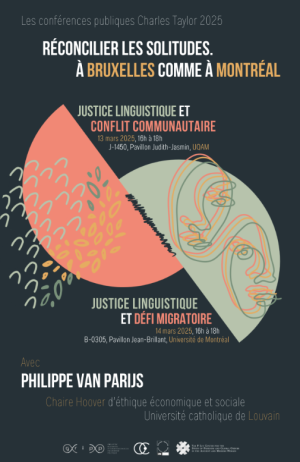
Join us for the Charles Taylor 2025 public lecture series: Réconcilier les solitudes. À Bruxelles comme à Montréal, to be held on March 13 and 14, 2025, from 4 p.m. to 6p.m. The first conference, entitled “Justice linguistique et conflit communautaire”, will take place on March 13, at UQÀM, in room J-1450, Judith-Jasmin Pavilion, located at 405 Sainte-Catherine street. The second conference, titled “Justice linguistique et défi migratoire”, will take place on March 14, at UdeM, in room B-0305, Jean-Brillant Pavilion, located at 3200 Jean-Brillant street.
With the participation of Philip Van Parijs, Hoover Chair in Economic and Social Ethics, Université catholique de Louvain.
Organized by the Centre de recherche en éthique (CRÉ), the Groupe de recherche interuniversitaire en philosophie politique (GRIPP), et the Yan P. Lin Centre for the Study of Freedom and Global Orders in the Ancient and Modern Worlds.
-
Launch Event of Qu’est-ce que la responsabilité? @ Librairie Le Port de tête
18 h 30 – 20 h 30
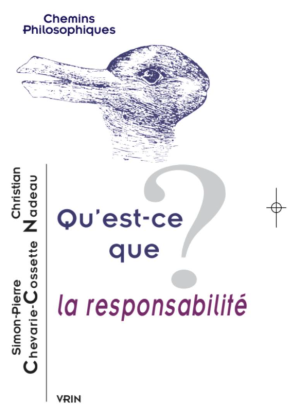
We are pleased to invite you to the launch of Qu’est-ce que la responsabilité? co-authored by Christian Nadeau and Simon-Pierre Chevarie-Cossette and published by Vrin in November 2024. The launch will take place on 14 February from 6.30 to 8.30 pm at Le Port de tête (269 avenue Mont-Royal Est). Refreshments and vegan nibbles will be served.
We look forward to seeing you there!
Book summary :
Être responsable de notre conduite passée, c’est, en un sens, devoir en répondre. Cela signifie d’accepter qu’on en est l’auteur, à titre d’individu ou de membre d’un groupe. Mais cela implique aussi de devoir la défendre, c’est-à-dire de la justifier si possible ou de l’excuser et parfois d’en accepter les conséquences négatives. Bref, si nous sommes responsables, c’est que nous sommes concernés et que nous devons réagir. À la difficulté psychologique de cette prise de responsabilité s’ajoutent des défis intellectuels majeurs. Peut-on être responsables si notre conduite est due à des mouvements d’atomes déterminés ou soumis au hasard? Comment pourrait-il y avoir responsabilité à titre de membre d’un groupe qui échappe à notre contrôle?
-
“Le problème de la foutaise” by Simon-Pierre Chevarie-Cossette @ Room 309, CRÉ, hybrid, 2910 Edouard-Montpetit, Montreal
12 h 00 – 13 h 15

As part of the Ethics Lunchtime Series, Simon-Pierre Chevarie-Cossette will give a talk entitled “Le problème de la foutaise”.
To join on Zoom, click here.
Abstract:
Harry Frankfurt a fait entrer la foutaise (ou « baratin ») dans le domaine de l’investigation philosophique avec son opuscule sur le sujet, On Bullshit (1984). Baratiner n’est pas mentir, mais de quoi s’agit-il et pourquoi est-ce répréhensible ? Selon Frankfurt (et selon plusieurs autres dont Carson, Webber, Fallis, Stoke, Moberger), l’essence de la foutaise est l’indifférence à l’égard de la vérité (ou quelque chose de connexe comme la raison, la connaissance ou l’enquête) : le baratineur parle sans se demander si ses paroles s’accordent ou non avec les faits. Un deuxième courant, initié par Gerry Cohen (et bonifié par Wreen et Cova), l’associe à un énoncé défectueux plutôt qu’à un énonciateur mal intentionné. Ainsi l’astrologue qui croit dur comme fer à ses théories baratine tout de même puisque ses propos sont insensés, sans fondements ou triviaux. Dans cet exposé, je donnerai deux arguments qui donnent raison à Cohen contre Frankfurt : d’une part, si Frankfurt avait raison, le baratin serait toujours blâmable, ce qu’il n’est pas ; d’autre part, la théorie de Cohen explique mieux en quoi la foutaise est nuisible que la théorie de Frankfurt.
-
We are pleased to invite you to the next meeting of the Philosophy and Ethics of Economics Reading Group, to be held in hybrid format, on February 13, 2025 at 9:30 a.m. (Montreal time). The meeting will take place in room 840, 2nd floor at HEC, 3000 Chemin Côte Ste-Catherine (next to the library). We will discuss Daniel Burkett‘s article “A Legacy of Harm? Climate Change and the Carbon Cost of Procreation”, published in Journal of Applied Philosophy, 2021.
We hope to see many of you there, and would be delighted if you could share this invitation with anyone else who might be interested.
To receive the text under discussion and/or the Zoom link, please write to the organizers, Morgane Delorme (morgane.delorme.1@umontreal.ca) or Gabriel Monette (gabriel.monette@hec.ca).
Organized by Nicolas Pinsonneault, in collaboration with the HEC.
-
Pierre-Yves Néron (Université catholique de Lille) @ Room 309, CRÉ, hybrid, 2910 Edouard-Montpetit, Montreal
12 h 00 – 13 h 15
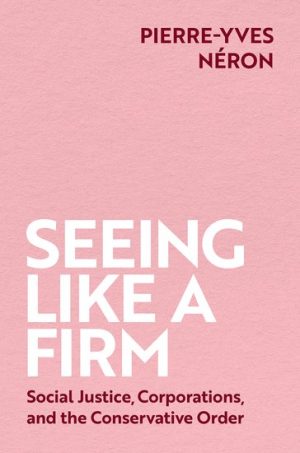
As part of the Ethics Lunchtime series, Pierre-Yves Néron (Université catholique de Lille) will present his recent book Seeing Like a Firm: Social Justice, Corporations, and the Conservative Order (Oxford University Press, 2024).
To join on Zoom, click here.
Summary of the book:
Business corporations are political entities and need to be considered as such. Seeing Like a Firm invites readers to do just that by providing a political theory of the business firm and, in doing so, offering new perspectives on the recent history of social justice, neoliberalism, and conservatism.
This book challenges the usual way of thinking about corporations in two ways. Firstly, it argues that firms ‘see’ in a conservative way and embrace a ‘conservatism of commerce’ that requires socioeconomic inequality. In doing so, it challenges our usual interpretation of neoliberalism and its connections with the contemporary business corporation. Secondly, it argues that we need a relational concept of equality and justice to think about corporations. Given that the corporate ‘optic’ is built on dismissing demands for equal standing, Pierre-Yves Néron asserts that relational egalitarians should deconstruct it, argue against it, tackle it.
By offering a new interpretation of conservatism based not on a desire to simply preserve the existing system but on an ‘aesthetics of inequality’, Néron provides an alternative way to think about the main challenges that proponents of equality face.