Past events
Calendar archives
-
Thierry Ngosso (EthicsLab, U. catholique de l’Afrique Centrale, Yaounde, Cameroon) @ Room 309, UdeM, hybrid mode
10 h 30 – 12 h 00
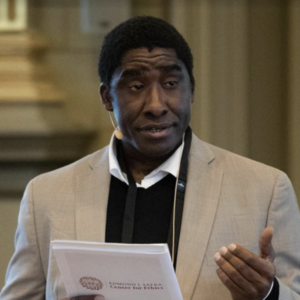
The CRE is delighted to welcome Thierry Ngosso (EthicsLab, Catholic University of Central Africa, Yaounde, Cameroon), who will give, in French, a presentation entitled “Thinking Post-State in Africa“.
Thierry is visiting Montreal as part of a pilot project for an annual partnership between the CRÉ and EthicsLab, based at the Catholic University of Central Africa in Yaoundé, Cameroon, which he founded and has been leading since. Moreover, Thierry Ngosso is a researcher at the Institute of Business Ethics at the University of St.Gallen, a Swiss National Foundation Ambizione Fellowship awardee (2019-2023) focusing on the ‘Human Right to Health in Africa and the obligations of African societies themselves’. He was also researcher at the Chaire Hoover, and Visiting Researcher 2021-2022 at both the EJ Safra Center for Ethics of Harvard University and at the Center for Population-Level Bioethics at Rutgers University. With Ernest-Marie Mbonda, he is also the co-founder, of the Yaoundé Doctoral Seminar.
To participate on Zoom, clic here.
-
Protéger les écosystèmes: Enjeux philosophiques @ Local C2-165, Collège Ahuntsic
14 h 00 – 16 h 00
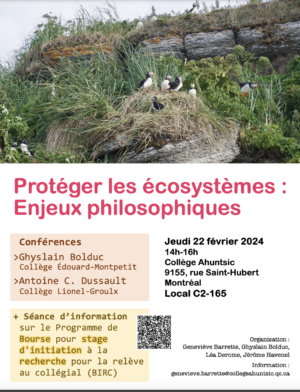
Conferences by Antoine C. Dussault (Collège Lionel-Groulx) and by Ghyslain Bolduc (Collège Édouard-Montpetit).
Organized by Geneviève Barrette, Ghyslain Bolduc, Léa Derome, Jérôme AHavenel.
Information: genevieve.barette@collegehuntsic.qc.ca
-
“Contemplating Authenticity in a Changing World with Eboussi Boulaga” @ Room 309, UdeM, hybrid mode
10 h 30 – 12 h 00
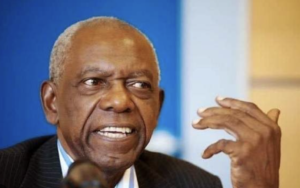
A critical dialogue between Ernest-Marie Mbonda (Catholic University of Central Africa & Cégep de Sherbrooke) and Thierry Ngosso (Ethics Lab / Catholic University of Central Africa & University of St. Gallen) to restore and update the stakes of authenticity in the work of philosopher Eboussi Boulaga. The session will be facilitated by Ryoa Chung.
To participate via Zoom, click here.
Please note that the conversation will be held in French.
-
Mathias Girel (École normale supérieure) @ Room: W-5505, 5th floor, Pavillon Thérèse-Casgrain (W), UQAM
10 h 00 – 12 h 00

La production d’ignorance: avec ou sans intention?
Conference by Mathias Girel (École normale supérieure)
When : 16 février, 2024 @ 10:00 – 12:00
Where : Room W-5505, 5th floor, Pavillon Thérèse-Casgrain (W), UQAM (455, Boulevard René-Lévesque Est)
*The conference will also be presented on Zoom.
Abstract: Les études de l’ignorance (Ignorance Studies/Agnotologie) qui se sont développées au cours des deux dernières décennies ont abordé des thèmes et domaines extrêmement différents, allant du rapport aux produits toxiques à l’ignorance dans les rapports culturels et sociaux. Il semble difficile aujourd’hui de les rassembler sous une rubrique unique, tant les styles et les présupposés méthodologiques sont différents. La présente conférence s’attachera à comparer deux grandes approches qui s’opposent méthodologiquement sur de nombreux points: celles qui font figurer des motifs stratégiques et intentionnels dans leurs explications et estiment qu’ils sont irréductibles, et celles qui s’attachent davantage à des motifs structuraux. Tout en reconnaissant les spécificités de chaque approche, la conférence montrera sur quels points cette opposition frontale reste par bien des aspects stérile.
-
Reading group in philosophy of economy @ HEC (Côte-Ste-Catherine building), 2nd floor, room CSC-02-840.
16 h 00 – 17 h 00

4th session of the Reading Group in Philosophy of Economy
Discussion session around the text by Kian Mintz-Woo and Justin Leroux, “What do climate change winners owe, and to whom?” (2021, Economics & Philosophy), in the presence of Justin Leroux.
To participate or receive the article by email, contact the organizers (Morgane Delorme: morgane.delorme.1@umontreal.ca; or Gabriel Monette: gabriel.monette@hec.ca).
-
Anna Drożdżowicz (Inland Norway University of Applied Sciences) & J.P. Grodniewicz (Jagiellonian University) @ Online.
12 h 00 – 13 h 30

In the next session of the Philosophy of Psychiatry Webinar, Anna Drożdżowicz (Inland Norway University of Applied Sciences) and J.P. Grodniewicz (Jagiellonian University) will give a lecture titled ‘Epistemic Injustice in Psychotherapy.’
Abstract:
Psychotherapy is a form of psychological service that involves a collaborative process based on the relationship between a psychotherapist and a client/patient. Arguably, the main goal of psychotherapy is practical, i.e., alleviating mental suffering and/or enabling patients/clients to live a more fulfilling life. Nevertheless, in virtually all therapeutic traditions, the achievement of the practical goal is accompanied or even mediated by the achievement of auxiliary epistemic goals. We will focus on what we take to be the primary epistemic goal of psychotherapy, i.e., the acquisition or deepening of one’s self-understanding, characterized as grasping coherence-making relations between constituents of a body of information about oneself. Crucially, the epistemic interdependence between psychotherapists and clients raises important questions concerning epistemic authority and power, as well as epistemic injustice, i.e., a kind of injustice that arises when one’s capacity as an epistemic subject is wrongfully denied. Our goal in this talk is to characterize, categorize, and discuss how epistemic injustice can be perpetrated in psychotherapy. To this end, we will provide examples that illustrate ways in which three forms of epistemic injustice (testimonial, hermeneutical, and contributory) can arise in psychotherapeutic encounters. We will explain how these forms of epistemic injustice threaten one’s ability to deepen self-understanding through psychotherapy. We will close by briefly discussing some ways to mitigate the risk of epistemic injustice in psychotherapy.
Open to everyone, no charge. Please, register here: site web.
Organized by Anne-Marie Gagné-Julien and Sarah Arnaud, for the Research group on philosophy of psychiatry.
-
Basak Kus (Wesleyan University) @ Room 309, UdeM, hybrid mode.
12 h 00 – 13 h 30

At the initiative of Frédéric Mérand and in collaboration with the research team “La mondialisation sous tension” (FRQSC) as well as the CÉRIUM, the Centre for research in ethics (CRÉ) will have the pleasure of welcoming Basak Kus (Wesleyan University), who will offer a presentation titled “Guardians of Prudence: Economists, Risk Regulation, and the Protective State.”
To participate via Zoom, it’s here.
-
5th day in ethics of AI CRÉ/OBVIA: Surveillance @ Salle C-2059, Pavillon Lionel-Groulx, UdeM (hybride)
10 h 00 – 17 h 00
-
The Philosophy of Psychiatry Webinar presents Daniel Buchman (Dalla Lana School of Public Health) who will give a lecture on “Chronic Pain as a Disease of the Brain and the Implications for Stigma”.
Please, register here.
Abstract
Chronic pain is an individual and subjective condition that is often refractory to objective assessment. Chronic pain is also highly stigmatized, creating barriers in access to care and causing those who live in pain to be subjected to epistemic injustices. Advances in the neuroscience of chronic pain have encouraged advocates to argue that chronic pain should be considered a disease in itself, and not merely a symptom of some other condition, to legitimize the experience of chronic pain and reduce stigma. In many ways, these are similar arguments that were advanced in favour of considering addiction and mental illness as brain diseases. However, as the history of and evidence from brain disease models of addiction and mental illness suggest, brain disease models may inadvertently increase some aspects of stigma, such as fear and prognostic pessimism, while reducing others, such as blame and personal responsibility. In this presentation, I discuss the parallels between brain disease models of addiction and mental illness and the emerging idea of chronic pain as a disease and a disease of the brain specifically. I draw upon multidisciplinary scholarship from philosophy, bioethics, sociology, psychology, and social science research, and explore how stigma is enmeshed with concepts of identity, agency, technology, evidence, and objectivity. I argue that the ethics lessons from brain disease models of addiction and mental illness offer a cautionary tale for chronic pain with respect to stigma.
-
Democratic innovation and democratic governance workshop @ Room CSC-02.840 (Pavillon Côte Sainte-Catherine), HEC Montreal
9 h 00 – 11 h 00

The Institut International des Coopératives Alphonse-et-Dorimène-
Desjardins (IICAD) in partnership with the Centre de Recherche en Éthique (CRÉ) invites you to participate in a workshop on democratic innovation and democratic governance in cooperatives. The workshop will provide a space for exchange and discovery around current research on the subject. Schedule and speakers
- Chair: Denise Celentano
- 9:00 à 9:50 “Republicanism and Democratic Innovation: Realizing the Republican Ideal through Cooperative Governance” – Gabriel Monette (HEC Montréal), Rafael Ziegler (HEC Montréal) et Simon Pek (University of Victoria)
- 10:00 à 10:50 “Cooperative network governance for circular economy” par Sonja Novkovic (Saint Mary’s University)
- Pause
- 11:10 à 12:00 “Enjeux et paradoxes de la gouvernance des coopératives” Myriam Michaud (Université TELUQ)
Online participation : yes
Language : English – comments in French are welcome
Reservation : if you would like to participate, please confirm your participation with Nara Meli (nara.meli@hec.ca) before the 25 January.
-
Reading group in philosophy of economy @ HEC, Côte-Ste-Catherine, 2nd floor, room CSC-02-825.
13 h 30 – 14 h 30
Third meeting of the reading group in philosophy of economyFollowing the seminar to which Simon Pek, of the Institut Coop HEC-Montréal will participate, the reading group organize a discussion with the author. The article that will be discussed is: “The Role of Deliberative Mini-Publics in Improving the Deliberative Capacity of Multi-Stakeholder Initiatives” (Business Ethics Quarterly).To participate to the seminar at the Institut Coop HED, write at institutcoop@hec.ca.To participate to the discussion organized afterward by the reading group, contact the organizers: Morgane Delorme: morgane.delorme.1@umontreal.ca; ou Gabriel Monette: gabriel.monette@hec.ca. -
CRÉ 2023-2024 Scholarship Graduate Scholars Recipient Seminar – 1st session @ Room 309, UdeM, hybrid mode
9 h 00 – 12 h 15

You are warmly invited to the 1st session of the CRÉ Graduate Scholars Seminar 2023-2024. In turn, 4 of the 8 CRÉ scholarship recipients will present their work. The goal of the seminar is to provide our master’s and doctoral students with feedback, constructive criticism, and recommendations that will help them improve their research projects.
We propose the following program:
9:00 – 9:45 AM Presentation by Louis-Pierre Côté, Le contrat carcéral: reconsidérer le complexe industriel carcéral au moyen du contrat de domination de Charles W. Mills.
9:45 – 10:30 AM Presentation by Gabrielle Joni-Verreault, Game of drones and Lord of the Memes: L’éthique civile autorégulée dans la guerre technologique et démocratisée en Ukraine.
10:30 – 10:45 AM Break
3. 10:45 – 11:30 AM Presentation by Marie-Christine Roy, « Slow fashion » ou le ralentissement de l’industrie de la mode: une solution décroissanciste aux injustices structurelles dans l’industrie du vêtement.
11:30 AM – 12:15 PM Presentation by Alexis Morin-Martel, The Value of Epistemic Trust in Public Experts.
12:15 PM Lunch in room 309 – bring your lunch!
To participate via Zoom, click here. Meeting secret code: 486288.
The second session of the seminar will be held in March 2024.
-
Hugo Cossette-Lefebvre (U. of Aarhus) @ Room 309, UdeM, hybrid mode
12 h 00 – 13 h 30
-
“Practising Conservation: the Intersection of Decolonisation and Ubuntu thought.” @ Salle 309, mode hybride
12 h 00 – 13 h 15

“Practising Conservation: the Intersection of Decolonisation and Ubuntu thought.” Olusegun Samuel will offer us a presentation for the “Midis de l’éthique du CRÉ” series.
To participate via Zoom, it’s here.
-
The second meeting of the reading group in philosophy of economy, organized by Morgane Delorme and Gabriel Monette, will be on Morgane Delorme’ working paper titled “La création monétaire face au second principe de justice de Rawls”. The manuscript will be send on demand. Please contact Morgane Delorme.The goal of the reading group is to hold discussions on current articles in the philosophy of economics, covering topics such as business ethics, the ethics of environmental economics, distributive justice in a capitalist context, and monetary and financial ethics.To participate, you can contact the organizers (Morgane Delorme: morgane.delorme.1@umontreal.ca; or Gabriel Monette: gabriel.monette@hec.ca).
-
Richard Healey (LSE) and Angie Pepper (U. of Roehampton) @ Online, via Zoom
12 h 00 – 13 h 30

The CRÉ’s research axis Éthique environnementale et animale and the Groupe de recherche en éthique environnementale et animale (GRÉEA) are please to announce that Richard Healey (London School of Economics) and Angie Pepper (University of Roehampton) will be giving us an online presentation on “Pets, Power, and the Problem of Human Tyranny.”
To participate on Zoom, click here.
Abstract
A central tenet of liberal political philosophy is that no individual naturally has legitimate power or authority over another. In this paper, we consider the legitimacy of the power wielded over a largely neglected population, namely, pets. While everyone objects to the abuse or neglect of pets, many of those writing in animal ethics assume that there is nothing inherently problematic about the social and political practices that assign “guardians” extensive power over the lives of “pets.” Against this, we argue that our power over pets and other domesticated animals amounts to an objectionable form of subordination. More specifically, we argue that the relations of power that obtain between humans and pets are illegitimate because they (i) unnecessarily subject dependent and vulnerable individuals to serious risks of harm, and (ii) involve a problematic form of total control over domesticated animals’ lives. We further argue that the power wielded by humans cannot be legitimated by revisions to existing practices. The practical upshot is that, while we must continue to care for the pets already here, we have a strong reason to bring about an end to the practice of living with companion animals.
-
Dave Anctil (Obvia, Brébeuf) @ Room 309 du CRÉ, hybrid mode
12 h 00 – 13 h 00

As part of the CRÉ + Obvia lunch talks, Dave Anctil (Obvia, Brébeuf) will present a lecture entitled “Robopolis. Prolegomena to a political philosophy of AI“.
Abstract: Foundation models (LLM and LMM) need to be evaluated in their growing agential capabilities to understand the ethical and political issues raised by AI. In particular: their abilities to use tools and third parties, to compensate for their limitations and to collaborate with other agents to perform an increasing diversity of tasks. Clarifying the concepts of agentivity and interaction with AIS should be the starting point for any future political philosophy.
Hybrid conference: to participate by zoom, click here.
-
“Against Hermeneutical Gatekeeping” @ Room 309, UdeM, hybrid mode
12 h 00 – 13 h 15

Nick Clanchy will be presenting on “Against Hermeneutical Gatekeeping” in the Midis de l’éthique series.
To participate by Zoom, click here.
-
Max Lewis (McGill U. & CRÉ) @ Room: W-5305, 5th floor, Pavillon Thérèse-Casgrain (W), UQAM
15 h 00 – 17 h 00
-
Reading group in philosophy of economy @ Room 840 (2nd floor), HEC
17 h 00 – 18 h 00
Morgane Delorme and Gabriel Monette are launching a reading group in the philosophy of economics. The goal will be to hold discussions on current articles in the philosophy of economics, covering topics such as business ethics, the ethics of environmental economics, distributive justice in a capitalist context, and monetary and financial ethics.To participate, you can contact the organizers (Morgane Delorme: morgane.delorme.1@umontreal.ca; or Gabriel Monette: gabriel.monette@hec.ca).
Text for the first session: Alan Thomas, “Is the Democratization of Central Banking a Technocratic Problem?” (May 22, 2023).