
Évènements passés
Archives du calendrier
-
« Epistemic Occlusion » @ Salle 309, mode hybrid
12 h 00 – 13 h 15

Dans le cadre des midis de l’éthique du CRÉ, Abe Tobi nous offrira une présentation intitulée « Epistemic Occlusion ». La présentation sera donnée en anglais, mais les questions pourront être posées en français.
Pour y participer par Zoom, c’est ici.
Résumé
J’introduis le concept d’occlusion épistémique pour désigner une forme particulière de dommage épistémique qui se produit lorsque certains savoirs, cadres conceptuels ou agents épistémiques sont systématiquement rendus invisibles au sein des pratiques épistémiques dominantes. Contrairement au silence imposé ou à l’exclusion explicite, l’occlusion épistémique renvoie à des processus qui bloquent par avance toute possibilité de reconnaissance. Elle se distingue ainsi des injustices testimoniales, qui concernent la dévalorisation injuste de la crédibilité d’un·e locuteur·rice, et des injustices herméneutiques, qui découlent de lacunes dans nos ressources interprétatives collectives. L’occlusion épistémique désigne un mécanisme plus en amont et plus difficile à saisir : une condition structurellement produite dans laquelle certains savoirs ou agents épistémiques deviennent imperceptibles. Je soutiens que ce phénomène opère à travers des mécanismes qui déterminent ce qui peut être vu, pris au sérieux ou même conçu comme un savoir.
-
The Dynamics of Epistemic Injustice (OUP, 2025) @ L'information sera transmise après l'inscription
Jour entier

Table ronde autour du livre The Dynamics of Epistemic Injustice: situating epistemic power and agency (OUP, 2025), d’Amandine Catala (CRC-IAE, UQAM).
Inscriptions obligatoires, avant le 15 octobre. Le numéro du local vous sera communiqué par courriel.
Au programme:
9.00-9.30: Accueil et café
9.30-10.40: Panel 1 – Ch. 1-2 – Présidence: Kristin Voigt (McGill, CRÉ)
– Amandine Catala (CRC-IAE, UQAM): “A Very Brief Synopsis of The Dynamics of Epistemic Injustice”
– Gaile Pohlhaus (Miami U, Ohio): “Shifting our Understanding of Epistemic Agency”
– Natalie Stoljar (McGill): “Comments on ch. 2: ‘Stereotypes and Testimonial Domination: A Structural Explanation of Epistemic Agency’”
– Amandine Catala: Réponses aux commentaires
10.40-11.00: Pause café
11.00-12.10: Panel 2 – Ch. 3-4 – Présidence: Anne Iavarone-Turcotte (McGill, CRC-IAE)
– Gilles Beauchamp (CRC-IAE, CRÉ, CRIDAQ): « Comments on ch. 3: ‘Deliberative Impasses, White Ignoring, and Hermeneutical Domination’ »
– Yann Allard-Tremblay (McGill): « Comments on ch. 4: ‘Colonial Memory, Epistemic Aaordances, and Political Equality’ »
– Amandine Catala: Réponses aux commentaires
12.10-12.30: Discussion avec le public
12.30-1.30: Dîner
1.30-2.40: Panel 3 – Ch. 5-6 – Présidence: Corinne Lajoie (Western University, UQAM, CRC-IAE)
– José Medina (Northwestern U) « Linguistic Epistemic Injustice and Hermeneutical Death »
– Nick Clanchy (CRC-IAE, CRÉ): « Comments on ch. 6: ‘Becoming Who You Are: Hermeneutical Breakthroughs, Transformative Experience, and Epistemic Empowerment »
– Amandine Catala: Réponses aux commentaires
2.40-3.00: Pause café
3.00-4.10: Panel 4 – Transversal Perspectives Transversales – Présidence: Ryoa Chung (UdeM, CRÉ)
– Abe Tobi (CRC-IAE, CRÉ): « Hermeneutical Breakthroughs in The Dynamics of Epistemic Injustice »
– Alison Wylie (UBC): « The Implications of The Dynamics of Epistemic Injustice for Standpoint Theory »
– Amandine Catala: Réponses aux commentaires
4.10-4.30: Discussion avec le public
Avec le soutien de: CRC-IAE, CRÉ, GRIPP, CRIDAQ, FSH, Département de philosophie de l’UQAM.
-
Mêmes êtres animaux, différentes lois – protections juridiques selon les espèces @ SHIFT Centre for Social Transformation, Pavillon J.‐W.‐McConnell, Concordia, hybride
18 h 30 – 20 h 00
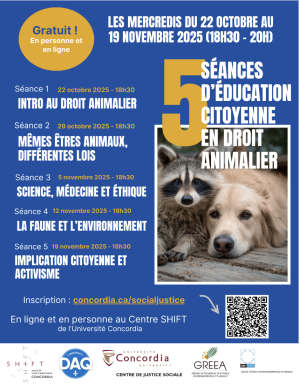
Deuxième séance de la formation citoyenne en droit animalier et en éthique, co-organisée par le DAQ – Droit animalier Québec, le Centre de justice sociale de l’Université Concordia, le Centre interuniversitaire de recherche en éthique – Axe Éthique environnementale et animale et le GREEA – Groupe de recherche en éthique environnementale et animale.
Les cinq séances sont ouvertes à toutes et à tous, et se dérouleront en français. Vous pouvez y participer en personne et ou par visioconférence en remplissant ce formulaire en ligne.
Participez à une série de conférences interactives pour mieux comprendre les enjeux complexes à l’intersection du droit animalier et de l’éthique. Discussions, analyses de cas et échanges vous permettront d’explorer les lois qui encadrent différents groupes d’animaux, leurs limites ainsi que les enjeux éthiques qui en découlent.
Les places sont limitées, inscrivez-vous ici.
-
Introduction au droit animalier – de biens meubles à êtres sentients @ SHIFT Centre for Social Transformation, Pavillon J.‐W.‐McConnell, Concordia, hybride
18 h 30 – 20 h 00
Première séance de la formation citoyenne en droit animalier et en éthique, co-organisée par le DAQ – Droit animalier Québec, le Centre de justice sociale de l’Université Concordia, le Centre interuniversitaire de recherche en éthique – Axe Éthique environnementale et animale et le GREEA – Groupe de recherche en éthique environnementale et animale.
Les cinq séances sont ouvertes à toutes et à tous, et se dérouleront en français. Vous pouvez y participer en personne et ou par visioconférence en remplissant ce formulaire en ligne.
Participez à une série de conférences interactives pour mieux comprendre les enjeux complexes à l’intersection du droit animalier et de l’éthique. Discussions, analyses de cas et échanges vous permettront d’explorer les lois qui encadrent différents groupes d’animaux, leurs limites ainsi que les enjeux éthiques qui en découlent.
Les places sont limitées, inscrivez-vous ici.
-
Atelier de l’axe Éthique & politique @ Salle 309, mode hybride
20 Oct – 21 Oct Jour entier

Atelier annuel de l’axe Éthique et politique du CRÉ
Pour y participer via Zoom, c’est ici.
Programme
Le 20 octobre 2025 après-midi
13h00 : Sylvie Loriaux (Université Laval) – « Les limites du consentement. Sur le rôle que peut et doit jouer le consentement en politique, au travail et dans la vie intime ».
14h00 : Alia Al-Saji (U. McGill) – « Gaza as a Compass for Thinking: Searching for a decolonial phenomenological method that can do justice to debilitation and resistance in colonial duration »
15h00 : Christian Nadeau (UdeM) – « Responsabilité collective, complaisance politique et compromission politique ».
Le 21 octobre avant-midi
9h00 : Arash Abizadeh (U. McGill) – « Social Power »
10h00 : Charles Blattberg (UdeM) – « Towards One, As Many ».
11h00 : Juliette Roussin (U. Laval) – « Que fait exactement la mésinformation à la délibération démocratique?».
Organisé par Christian Nadeau (UdeM) et Pablo Gilabert (Concordia).
-
Conférences Hugues-Leblanc 2025: Magali Bessone, La justice réparatrice entre normativité et historicité: le cas Haïti @ UQÀM, local W-5215
14 Oct 10 h 00 – 15 Oct 12 h 00
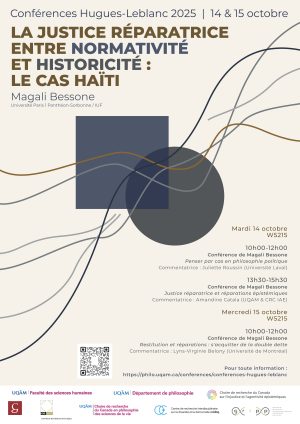
Conférences Hugues-Leblanc 2025
14 et 15 octobre 2025La conférencière invitée, Magali Bessone (Professeure de philosophie politique à l’Université Paris 1 Panthéon-Sorbonne & IUF) donnera un cycle de trois conférences, en français, sur le thème: La justice réparatrice entre normativité et historicité : le cas Haïti.
Penser par cas en philosophie politique
Mardi 14 octobre, 10h00-12h00
Commentatrice : Juliette Roussin (Laval)Justice réparatrice et réparations épistémiques
Mardi 14 octobre, 13h30-15h30
Commentatrice : Amandine Catala (UQAM)Restitution et réparations : s’acquitter de la double dette
Mercredi 15 octobre, 10h00-12h00
Commentatrice : Lyns-Virginie Belony (Université de Montréal)Toutes les activités se dérouleront en personne au W-5215 (UQAM, Département de philosophie, 455 Boulevard René-Lévesque Est, Montréal, H2L 4Y2). Des rafraîchissements suivront les conférences ainsi qu’une collation le mardi midi.
Les conférences seront aussi diffusées sur Zoom en direct. Dans tous les cas, accès libre sur inscription (obligatoire): https://uqam.zoom.us/meeting/register/HLXopPFWQ1-tfXLjIfzrrw
Partenaires de l’évènement :
Chaire de recherche du Canada sur l’injustice et l’agentivité épistémiques
Chaire de recherche du Canada en philosophie des sciences de la vie
Centre de recherche en éthique (CRÉ)
Centre de recherche interdisciplinaire sur la diversité et la démocratie (CRIDAQ)
Faculté des sciences humaines (Vice-décanat à la Recherche), UQAM
Groupe de recherche interuniversitaire en philosophie politique (GRIPP)
Groupe de recherche interuniversitaire sur la normativité (GRIN)Cette conférence annuelle célèbre la mémoire du grand logicien et philosophe québécois Hugues Leblanc (1924-1999). Se déroulant sur deux jours, cet événement se structure autour d’une série de présentations délivrées par une conférencière ou un conférencier de renommée internationale, et d’interventions de professeures et professeurs issus d’universités canadiennes ou étrangères, sur une thématique relevant de la philosophie analytique.
-
Atelier GRIN : « Medicine and Philosophy: Reasoning from Specific Cases »
9 Oct 9 h 30 – 10 Oct 17 h 00
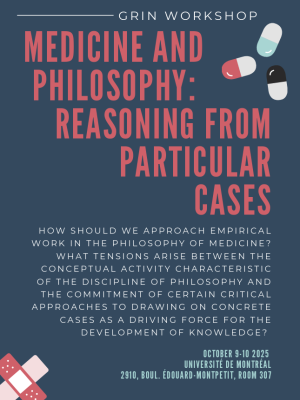
Vous êtes cordialement invité.es à l’atelier intitulé « Médecine et philosophie : raisonner à partir de cas particuliers » qui se tiendra les 9-10 octobre 2025 prochains, dans la salle 307 au département de philosophie de l’Université de Montréal, de 9h30 à 17h00, située au 2910 boulevard Édouard-Montpetit, Montréal, Québec.
Nous aurons la chance d’entendre Aude Bandini (Université de Montréal), Katrin Solhdju (Université de Mons), Patrick Garon-Sayegh (Université de Montréal), Luc Faucher (UQAM) et Miriam Solomon (Temple University) qui partageront leurs réflexions autour de ce thème. L’idée de l’atelier est de promouvoir les réflexions et les échanges sur l’apport épistémologique et méthodologique du raisonnement à partir de cas particuliers en philosophie de la médecine.
Programmation :
Jeudi 9 octobre 2025
- 9h00 : Bienvenue
- 9h30 : Annejulie Charest, Léo Portelance (Université de Montréal), et Laurence Dufour, Présentation sur les thèmes et les idées centrales de l’atelier
- 11h00 : Aude Bandini (Université de Montréal), « A Social Epistemology of « Experiential Knowledge » »
- 12h30 : Dîner
- 14h00 : Katrin Solhdju (Université de Mons), « An « Assault on Reason » or an « At Last Rational Approach » to Therapeutic Thinking? The Case of Ethnopsychiatry »
Vendredi 10 octobre 2025
- 9h30 : Patrick Garon-Sayegh (Université de Montréal), « On the Centrality of Case-Based Reasoning in Medicine »
- 11h00 : Luc Faucher (Université du Québec à Montréal), Titre à venir
- 12h30 : Dîner
- 14h00 : Miriam Solomon (Université Temple), « The Philosophical Significance of Pivotal Cases »
Afin de favoriser le maximum d’échanges et de réflexions, nous vous invitons à écrire à l’adresse suivante afin d’avoir accès à l’avance aux textes qui seront travaillés lors de l’atelier.
Il sera possible d’assister à l’atelier en ligne via le lien suivant.
Au plaisir de vous y voir en grand nombre.
*À noter que l’événement se déroulera en anglais.
-

*Veuillez noter que le lieu de l’événement a changé et qu’ilse tiendra désormais dans la Salle A-3316 du Pavillon Hubert-Aquin de l’UQÀM, située au 400 rue Sainte-Catherine Est, Montréal, Québec.
Le Groupe de recherche interuniversitaire sur la normativité (GRIN) reçoit Miriam Solomon (Université Temple), qui offrira une présentation intitulée « Stigma as an Actant in the History of Psychiatric Disorder ».
La conférence sera aussi présentée sur Zoom.
Résumé
The slogan “end the stigma” has become pervasive in mental health contexts. It makes a straightforward suggestion: if we can counter social prejudices about mental illness then we will be able to address mental illness more effectively and humanely. It is reminiscent of other medical-social movements such as the ones to reduce the stigma of breast cancer, beginning in the 1970s with Betty Ford’s openness about her own diagnosis and treatment and continuing with the work of advocacy groups such as Susan G. Komen and the National Breast Cancer Coalition to successfully fund and implement programs for early detection and intervention.
I signed on to “end the stigma” for mental illness a long time ago. However, in learning more about the history of mental health stigma, both in general and for particular conditions, I have found that stigma is a slippery beast that is often imperfectly managed by efforts that implicitly or unconsciously result in further stigmatization of some or all mental health conditions. It is not easy, and may not even be possible, to “end the stigma.” In addition, I have found that stigmatizing judgments run so deep that they have influenced professional judgments about the scope of psychiatric disorder and about the categories of psychiatric disorder. Stigma is not added to some neutral medical categories by a prejudiced society; rather, stigma was involved in making the categories themselves.
-
Katrin Solhdju (Université de Mons) @ Salle 422, Département de philosophie de l’Université de Montréal, hybride
10 h 00 – 12 h 00
Le Groupe de recherche interuniversitaire sur la normativité (GRIN) reçoit Katrin Solhdju (Université de Mons), qui offrira une présentation intitulée « « Acceptes » ! ou tu ne seras qu’un dévoyé : Sur les violences d’une psychopathologosation mal placée ».
La conférence sera aussi présentée sur Zoom.
Résumé
« Cette patiente ne réalise pas qu’elle est en train de mourir. » « Papa oublie de plus en plus de choses, mais il prétend que c’est seulement à cause de l’âge. » « Je dis toujours qu’on peut être grosse et en bonne santé, mais je panique à chaque visite chez mon cardiologue. » De telles expressions semblent tout à fait pertinentes et bien intentionnées. Pourtant, l’évocation d’un déni face à une situation médicale – d’un refus de comprendre – de la part du patient comme des proches n’est jamais anodine. La suspicion d’illusion ou d’irrationalité que cette évocation présuppose peut altérer la relation de soin. Car, en considérant qu’une personne est mal attachée à la réalité telle qu’elle est, ne risque-t-on pas de la disqualifier en lui faisant perdre son statut de sujet libre, autonome et éclairé ? Problématisant les effets de l’accusation de déni et du mot d’ordre « il faut bien accepter » qui l’accompagne, je voudrais mettre en évidence que le « déni » relève peut-être moins d’un état psychopathologique que d’un opérateur de rapports de pouvoir tout en interrogeant les formes possibles de résistance pour y faire face.
-
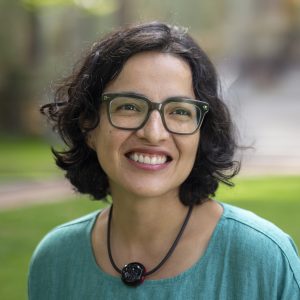
Jennifer Morton (Université de Pennsylvanie) nous offrira une présentation intitulée « Beyond ‘Bad Jobs’: Reconsidering Work’s Centrality » dans le cadre des activités du Réseau de philosophie du travail.
Résumé
Dans cet article, je soutiens que, bien que la précarité soit problématique, le travail précaire en lui-même n’est pas intrinsèquement condamnable. Je propose de distinguer deux formes de travail précaire : le travail précaire du point de vue de ses conditions et le travail générateur de précarité. Je défends l’idée que la première forme — celle où la précarité tient principalement aux termes et conditions contractuelles — peut, dans certains cas, demeurer compatible avec les conditions nécessaires à l’épanouissement humain. Toutefois, dans la mesure où le travail est devenu un facteur central d’accès à de nombreux biens essentiels contribuant à cet épanouissement, cette précarité contractuelle conduit souvent, dans les faits, à une précarité problématique. J’en conclus qu’il convient de s’inquiéter non seulement des formes de précarité liées aux conditions de travail, mais aussi de la place structurellement centrale qu’occupe le travail dans nos vies.
Les activités du Réseau de philosophie du travail sont ouvertes aux chercheur.es et aux étudiant.es diplômé.es ayant des intérêts de recherche dans ce domaine. Merci d’écrire aux organisateurs, Denise Celentano (denise.celentano@umontreal.ca) et Pablo Gilabert (pablo.gilabert@concordia.ca), pour recevoir le lien zoom.
-
Groupe de lecture en philosophie et éthique de l’économie @ HEC
12 h 00 – 13 h 30
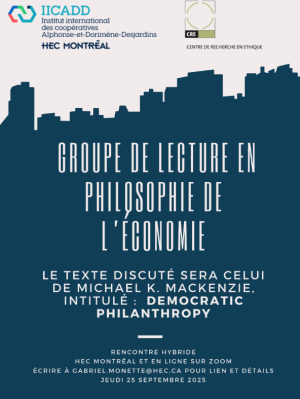
Nous avons le plaisir de vous inviter au groupe de lecture en philosophie économique, qui se tiendra en format hybride (Zoom) jeudi le 25 septembre 2025 de midi à 13h30 (heure de Montréal). La rencontre se déroulera en salle 2.880 (espace z), 2e étage à HEC, 3000 Côte Ste-Catherine (dans les locaux de l’Institut international des coopératives Alphonse-et-Dorimène-Desjardins au fond du couloir à côté de la bibliothèque).
Pour cette session, nous aborderons le texte de Michael K. MacKenzie intitulé « Democratic philanthropy », publié dans Contemporary Political Theory (2020).
Nous espérons vous voir en grand nombre et nous serions ravis que vous partagiez cette invitation avec toute personne qui pourrait être intéressée.
Pour participer via Zoom, c’est ici.
Organisé par Nicolas Pinsonneault, Morgane Delorme et Gabriel Monette.
-
REPORTÉ! « Epistemic Occlusion » @ Salle 309, mode hybrid
12 h 00 – 13 h 15
Attention! La présentation sera plutôt tenue le 5 novembre 2025
Dans le cadre des midis de l’éthique du CRÉ, Abe Tobi nous offrira une présentation intitulée « Epistemic Occlusion ». La présentation sera donnée en anglais, mais les questions pourront être posées en français.
Pour y participer par Zoom, c’est ici.
Résumé
J’introduis le concept d’occlusion épistémique pour désigner une forme particulière de dommage épistémique qui se produit lorsque certains savoirs, cadres conceptuels ou agents épistémiques sont systématiquement rendus invisibles au sein des pratiques épistémiques dominantes. Contrairement au silence imposé ou à l’exclusion explicite, l’occlusion épistémique renvoie à des processus qui bloquent par avance toute possibilité de reconnaissance. Elle se distingue ainsi des injustices testimoniales, qui concernent la dévalorisation injuste de la crédibilité d’un·e locuteur·rice, et des injustices herméneutiques, qui découlent de lacunes dans nos ressources interprétatives collectives. L’occlusion épistémique désigne un mécanisme plus en amont et plus difficile à saisir : une condition structurellement produite dans laquelle certains savoirs ou agents épistémiques deviennent imperceptibles. Je soutiens que ce phénomène opère à travers des mécanismes qui déterminent ce qui peut être vu, pris au sérieux ou même conçu comme un savoir.
-
Maeve McKeown (University of Groningen) @ Salle 422, mode hybride
10 h 00 – 12 h 00
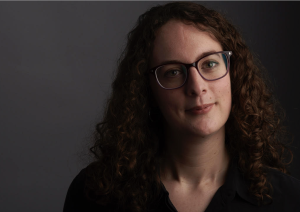 Les membres du CRÉ et du GRIN sont heureux d’accueillir Maeve McKeown (University of Groningen), qui nous offrira une conférence intitulée « With Power Comes Responsibility: The Politics of Structural Injustice ».Bienvenue à tou.tes!*La présentation sera livrée en anglais, mais les questions et réponses pourront être traduites entre le français et l’anglais.
Pour y participer via Zoom, c’est ici (ID de réunion: 816 4031 5575; Code secret: 958166)
RésuméQu’est-ce que l’injustice structurelle et qui en porte, en définitive, la responsabilité ? Quelle est la responsabilité politique des individus ordinaires ? Comment des personnes disposant de très peu de pouvoir peuvent-elles contraindre les agents puissants, moralement responsables, à s’attaquer à l’injustice structurelle ?
Pour répondre à ces questions, Maeve McKeown dépasse le récit largement accepté des conséquences non intentionnelles et de la participation sans faute afin d’expliquer comment le pouvoir et la responsabilité fonctionnent réellement dans le monde contemporain.
En s’appuyant sur des études de cas allant des ateliers de misère (sweatshops) au changement climatique, McKeown distingue trois formes d’injustice structurelle :
- L’accumulation pure et non intentionnelle d’activités disparates ;
- L’injustice évitable qui pourrait être corrigée par les acteurs puissants mais persiste néanmoins ;
- La perpétuation délibérée de processus structurels qui profitent à des agents politiques et économiques influents.
Dans chacune de ces formes, le rôle du pouvoir diffère, ce qui modifie l’attribution de la responsabilité. Cette analyse permet de développer une compréhension plus fine et plus nuancée du fonctionnement de l’injustice structurelle et de ce que nous pouvons, en tant qu’individus, faire pour y remédier.
Notice biographiqueMaeve McKeown est professeure adjointe en théorie politique à Campus Fryslân, une faculté interdisciplinaire de l’Université de Groningue. En 2024, elle a publié son premier ouvrage, With Power Comes Responsibility: The Politics of Structural Injustice (Bloomsbury Academic), ainsi qu’un volume codirigé avec la professeure Jude Browne, What is Structural Injustice? (Oxford University Press, en libre accès). Ses recherches portent notamment sur l’injustice structurelle, l’injustice historique, les réparations et le féminisme.
-

Rejoignez-nous pour une table ronde tenue dans le cadre du congrès annuel de la Société de philosophie du Québec (SPQ) ! Cette année, la table ronde proposera une analyse des enjeux philosophiques du monde végétal, en abordant la question : Pourquoi s’intéresser aux plantes ?
Programmation :
- 14h00 : Lhéo Vigneault (UdeM), « L’âme des plantes chez Aristote et les péripatéticiens : Une enquête sur la conscience et l’agentivité végétale »
- 14h30 : Marie-Pier Ladouceur (UdeM), « Le problème de l’individualité chez les plantes »
- 15h00 : Pierre Miquelon (Centre horticole de Laval), « Les plantes : des êtres vivants et complexes »
- 15h30 : Roxanne Lépine (UdeM), « L’attribution de conscience dans le monde végétal : parcimonie ou double standard? »
- 16h00 : Raphaël Marquis-Pelletier (UdeM), « Peut-on parler d’une agentivité du végétal? »
Co-organisé par Roxanne Lépine (UdeM), doctorante boursière du CRÉ, en collaboration avec le Groupe de recherche en éthique environnementale et animale (GRÉEA) et le Centre de recherche en éthique.
Pour toutes les informations, c’est ici.
-
Groupe de lecture en philosophie et éthique de l’économie @ HEC
9 h 30 – 10 h 30
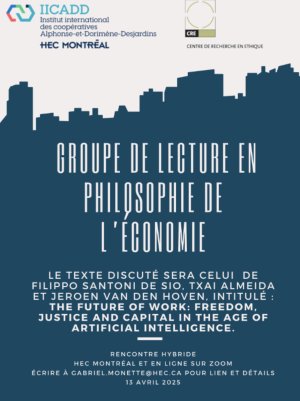
Nous avons le plaisir de vous inviter au groupe de lecture en philosophie et éthique de l’économie, qui se tiendra en format hybride (Zoom) le 5 juin 2025 à 9h30 (heure de Montréal). La rencontre se déroulera en salle 2.840, 2e étage à HEC, 3000 Côte Ste-Catherine (à côté de la bibliothèque).
Pour cette session, nous aborderons le texte de Bruno Verbeek, intitulé « Isolationism, instrumentalism and fiscal policy », publié dans Economics and Philosophy (2025).
Nous espérons vous voir en grand nombre et nous serions ravis que vous partagiez cette invitation avec toute personne qui pourrait être intéressée.
Pour participer via Zoom, c’est ici.
Organisé par Nicolas Pinsonneault, Morgane Delorme et Gabriel Monette.
-
9e édition du colloque annuel sur la théorie de la justice sociale @ Centre SHIFT, Université Concordia
29 Mai – 30 Mai Jour entier

L’objectif du colloque annuel sur la théorie de la justice sociale est de permettre une exploration soutenue de la théorie de la justice sociale. Il aborde des sujets tels que l’articulation des idéaux et des principes de justice économique, politique, raciale, environnementale et culturelle, la critique de l’inégalité, de la domination, de l’exploitation et de l’aliénation, et la mise en lumière des institutions politiques, des pratiques et des processus de transformation susceptibles de favoriser un changement progressif.
Les documents de l’atelier seront diffusés à l’avance et la participation implique un engagement à lire les documents à l’avance.
Cet atelier est organisé par Pablo Gilabert et Peter Dietsch, en association avec le Social Justice Centre (Université Concordia), le Centre de recherche en éthique (Université de Montréal) et le Département de philosophie de l’Université de Victoria.
La 9e édition de cet atelier de recherche intensive aura lieu les 29 et 30 mai 2025 dans la salle LB-145 au Centre SHIFT (Centre for Social Transformation), Pavillon J.W. McConnell, Université Concordia, 1400, boulevard De Maisonneuve, Montréal, Québec.
L’atelier se déroulera en personne. Le nombre de places est limité et l’inscription est requise. Si vous souhaitez participer, veuillez contacter Christiane Bailey à l’adresse suivante : sjc@concordia.ca.
9:00 Welcome (Thursday May 29) – Coffee and Food 9:15 Brian Berkey (University of Pennsylvania) and Kritika Maheshwari (TU Delft -The Netherlands) – « The Ethics of Partner Hiring in Academia. » Commentator: Christine Straehle (U of Ottawa)
10:30 Break 10:45 Kimberley Brownlee (University of British Columbia) – « How to Send a Message. » Commentator: Andrée-Anne Cormier (Ecole Nationale d’Administration Publique, Montreal)
12:00 Lunch 13:30 Denise Celentano (Université de Montréal) – “Temporal Agency at Work.” Commentator: Éliot Litalien (University de Montréal)
14:45 Break 15:00 Louis-Philippe Hodgson (University of York) – « Contractualism and Anti-Perfectionism » Commentator: Pablo Gilabert (Concordia University)
18:30 Dinner (speakers and commentators) 9:30 Welcome (Friday May 30) 9:45 David Estlund (Brown University) – « The Illusion of Purely Structural Wrong. » Commentator: Arash Abizadeh (McGill University)
11:00 Break 11:15 Peter Dietsch (U. of Victoria) – « The normative political economy of zero growth » Commentator: Rafael Ziegler (HEC Montreal)
12:30 3:00
Lunch Farewell
Pour plus d’information, c’est ici.
-
Rencontre auteur-critiques – Şerife Tekin, Reclaiming the Self in Psychiatry @ Salle W-5215, Département de philosophie, UQÀM
15 h 00 – 17 h 30

Le CRÉ et l’Institut Santé et Société (UQÀM) sont heureux d’annoncer la tenue d’une rencontre auteur-critiques autour du livre Reclaiming the Self in Psychiatry: Centering Personal Narratives for a Humanist Science (Routledge), écrit par Şerife Tekin, le 28 mai 2025.
L’événement aura lieu au Département de philosophie de l’UQÀM (salle W-5215), de 15h à 17h30.
Il également possible de participer à distance en joignant cette réunion Zoom.
Commentateurs:
Luc Faucher (UQÀM)
Mona Gupta (CHUM, UdeM)
Nicholas Huynh (UQÀM, UdeM)Organisatrices:
Sarah Arnaud (Cégep Édouard Montpetit)
Anne-Marie Gagné-Julien (McGill, CRÉ, CREF) -
Colloque Sud global, pluralisme et militantisme politique @ En ligne.
26 Mai 9 h 00 – 27 Mai 12 h 30

Le Centre de recherche en éthique de Montréal est ravi de vous inviter au Colloque Sud global, pluralisme et militantisme politique qui se tiendra en ligne via Zoom, les 26 et 27 mai prochains, de 9h à 12h30, heure de Montréal (GMT-4). Pour y participer, cliquez ici (ID de réunion: 842 1731 3838 et code secret 699766).
Description du colloque
Les sociétés contemporaines sont traversées de désaccords moraux sur des questions fondamentales relatives aux droits humains, à la dignité ou encore à la manière dont les gouvernements et les sociétés gèrent la diversité des mœurs et des croyances.
Le Centre de Recherche en Éthique (CRÉ) de Montréal, au Canada vous invite à participer à un colloque dont l’objectif est d’explorer les considérations éthiques entourant le pluralisme et le militantisme social et politique, ainsi que les stratégies visant à obtenir un changement local et mondial. Le colloque Sud global, pluralisme et militantisme politique vise à permettre aux étudiant-es d’échanger des idées au-delà des frontières et d’établir des liens durables entre les participants.
Déroulement du colloque
Le colloque se déroulera en ligne via Zoom les 26 et 27 mai 2025, de 9h à 12h30, heure de Montréal (GMT-4). Les horaires seront choisis en fonction des fuseaux horaires des intervenant-es. Les sessions dureront environ 50 minutes chacune – 10 minutes de présentation, suivies de 10 minutes de commentaires et 30 minutes de discussion.
Horaire détaillé
NOTE : Veuillez prendre note que toutes les heures sont à l’heure de Montréal (GMT-4).
JOUR 1 – 26 MAI 2025
- 9h00 à 9h20 : Mot d’ouverture par Ernest-Marie Mbonda (Université catholique d’Afrique centrale, UQAM, Cégep de Sherbrooke)
- 9h20 à 10h10 : Georges Claude Deutou Pouleu (Université de Douala/Laboratoire d’Éthique – UCAC), « L’éthique de la désobéissance civile et le façonnement des sociétés africaines futures »
- 10h10 à 10h20 : Pause
- 10h20 à 11h10 : Vetinkpon Gilbert Kingbe (Université d’Abomey-Calavi – Benin), « Entre gouttes et vagues : le droit à l’eau au Bénin sous le prisme de la justice constitutionnelle »
- 11h10 à 12h00 : Smaïlou Adam Chabi (Université Cheikh Anta DIOP de Dakar), « Discrimination positive et promotion des droits des femmes au Bénin »
JOUR 2 – 27 MAI 2025
- 9h00 à 9h50 : Kakmeni Yametchoua Schaller Jean (Université de Douala), « La dot en Afrique : libération ou marginalisation de la femme »
- 9h50 à 10h40 : Djia Tchadja Jude Voltaire (Université Catholique du Cameroun, Bamenda), « Injustice épistémique, auto-efficacité et engagement politique des jeunes en Afrique »
- 10h40 à 10h50 : Pause
- 10h50 à 11h40 : Mamadou Lamine NGOM (Université Cheikh Anta Diop de Dakar), « De l’idée d’un pluralisme écologique actif : entre injustices environnementales et « universalisme »
- 11h40 à 12h30 : Yawovi Agbonkou (Sorbonne Université), « Justice sociale et participation citoyenne : le cas de l’espace civique au Togo »
- 12h30 : Mot de fermeture par les membres du comité organisateur et fin du colloque
Pour toute question, vous pouvez nous écrire à l’adresse suivante : colloquedusudglobalcre2025@gmail.com.
Organisé par Ernest Mbonda (Université catholique d’Afrique centrale, Yaoundé, Cameroun, Université du Québec à Montréal et Cégep de Sherbrooke), Christian Nadeau (Université de Montréal), Thomas Emmaüs Adetou (Université de Montréal) et Virginie Simoneau-Gilbert (University of Oxford).
-
Quel féminisme pour le 21e siècle? Genre, diversité et décolonialité @ Salle 927, Leacock, McGill University
21 Mai – 22 Mai Jour entier
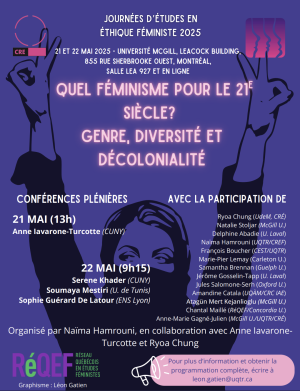
Journées d’études en éthique féministe 2025
Organisé par Naïma Hamrouni, avec l’aide d’Anne Iavaronne-Turcotte et Ryoa Chung, pour la Chaire de recherche du Canada en éthique féministe, le Réseau québécois en études féministe (RéQEF) et le Centre de recherche en éthique (CRÉ).
Mercredi le 21 mai
13h00 : Mot de bienvenu – Naïma Hamrouni (UQTR/CREF)
13h05-13h45 : Conférence plénière
- Anne Iavarone-Turcotte (CUNY) – Choisir sans préférer : le multiculturalisme et les femmes au-delà du paradigme libéral (PUL, Minerve, 2024)
13h45-14h30 : Commentaires #1
- Marie-Pier Lemay (Carleton U.)
- Sophie Guérard De Latour (École Normale Supérieure de Lyon)
Réponse aux critiques et discussion
14h45-15h30 : Commentaires #2
- Anne-Marie Gagné-Julien (McGill U./UQTR/CRÉ)
- Jules Salomone-Sehr (Oxford U.)
Réponse aux critiques et discussion
15h30-16h15 : Commentaires #3
- Jérôme Gosselin-Tapp (U. Laval)
- François Boucher (CÉST/UQTR)
Réponse aux critiques et discussion
17h30 à 19h00 : Lancement du livre d’Anne Iavaronne-Turcotte Choisir sans préférer: le multiculturalisme et les femmes au-delà du paradigme libéral (PUL, Minerve, 2024), à la librairie Le Port de Tête.
Animation: Daniel Weinstock (McGill U.) et Naïma Hamrouni (UQTR/CREF)
Jeudi le 22 mai
9h15 : Accueil
9h30-10h15 – Conférence plénière
- Sophie Guérard De Latour (ENS Lyon) – Le multiculturalisme à l’épreuve du féminisme (Vrin, 2025)
Présidence de séance: Ryoa Chung (U. de Montréal)
10h15-11h00 : Commentaires
- Anne Iavarone-Turcotte (CUNY)
- Atagün Mert Kejanlioglu (McGill U.)
Réponse aux critiques et discussion
11h15-12h00 : Conférence plénière
- Soumaya Mestiri (U. de Tunis) – Pour un féminisme décentré : recadrer, résister (Cavalier bleu, 2024)
Présidence de séance : Anne Iavaronne-Turcotte (CUNY)
12h00-12h30 : Commentaire
- Chantal Maillé (directrice du RéQEF et Institut Simone de Beauvoir, U. Concordia)
Réponse aux critiques et discussion
13h30-14h15 : Conférence plénière
- Serene Khader – Faux Feminism: Why we fall for White Feminism and What we can do about it? (Beacon Press, 2024)
Présidence de séance: Naïma Hamrouni (UQTR)
14h30-16h00 : Commentaires
- Soumaya Mestiri (U. de Tunis)
- Amandine Catala (Chaire de recherche du Canada sur l’injustice et l’agentivité épistémiques, UQÀM)
- Samantha Brennan (U. of Guelph)
Réponse aux critiques et discussion.
Présidence de séance: Natalie Stoljar (McGill U.)
-
Colloque de fin d’année des boursier.ères du GRIN @ UQAM
9 h 00 – 16 h 45
Les boursières et boursiers du Groupe de recherche interuniversitaire sur la normativité (GRIN) ont le plaisir de vous inviter à leur colloque de fin d’année, qui se tiendra le vendredi 16 mai 2025, de 9h00 à 16h40, au local W-5215 du Département de philosophie de l’Université du Québec à Montréal (UQAM), Pavillon Thérèse-Casgrain, 5ième étage, 455 Boulevard René-Lévesque Est.
Programmation :
HEUREDURÉEPRÉSENTATIONS ET COMMENTAIRESMODÉRATION9h00-9h5050 minDenise Celentano (UdeM)« Temporal Control and Agency at Work »Aude Bandini (UdeM)9h50-10h0010 minPAUSEPAUSE10h00-10h4040 minLéo Portelance (UdeM)« Considérer les patient‧es comme des acteur‧ices épistémiques : le cas de l’affection « post-COVID-19 »Commentaire de Annejulie CharestKarl-Antoine Pelchat10h40-11h2040 minFélix Tremblay (UdeM)« La vérité est poésie » : Merleau-Ponty et la phénoménologie de la littérature »Karl-Antoine Pelchat11h20-12h0040 minEllena Thibaud-Latour (UdeM)« L’indifférence en tant que vice épistémique institutionnalisé : un obstacle à la justice sociale »Commentaire de Melissa Hernandez ParraKarl-Antoine Pelchat12h00-13h0060 minDÎNERDÎNER13h00-13h4040 minSamuel Carlsson Tjernström (McGill)« The Metaphysics of Doxastic Normativity »Commentaire de Karl-Antoine PelchatFélix Tremblay13h40-14h2040 minKarl-Antoine Pelchat (UQAM)« Qu’est-ce qui cloche avec la « relation de raison » ? »Commentaire de Alexis Morin-MartelFélix Tremblay14h20-15h0040 minAlexis Morin-Martel (McGill)« The Ethics of Kingmaking » (co-écrit avec Gabriel Monette)Commentaire de Samuel Carlsson TjernströmFélix Tremblay15h00-15h2020 minPAUSEPAUSE15h20-16h0040 minSara Trépanier-Fleurant (UdeM)« Amour: entre émotion, sentiment et syndrome »Commentaire de Alex CartyEllena Thibaud-Latour16h00-16h4040 minAlex Carty (McGill)« Blame and Blameworthiness are Agent-Relative »Commentaire de Sara Trépanier-FleurantEllena Thibaud-LatourPour celles et ceux qui souhaitent y assister à distance, l’événement sera également diffusé en ligne via le lien suivant.
Nous espérons vous y retrouver nombreuses et nombreux !