
Évènements passés
Archives du calendrier
-
Theron Pummer (University of St. Andrews) et Ben Sachs-Cobbe (University of St. Andrews) @ En ligne
12 h 00 – 13 h 30

Theron Pummer (University of St. Andrews) et Ben Sachs-Cobbe (University of St. Andrews) nous offriront une présentation intitulée « Taking Jobs and Doing Harm », dans le cadre des activités du Réseau de philosophie du travail.
Les activités du Réseau de philosophie du travail sont ouvertes aux chercheur.es et aux étudiant.es diplômé.es ayant des intérêts de recherche dans ce domaine. Merci d’écrire aux organisateurs, Denise Celentano (denise.celentano@umontreal.ca) et Pablo Gilabert (pablo.gilabert@concordia.ca), pour recevoir le lien zoom.
Résumé
One can, and often does, do harm or commit to doing harm by accepting a job offer. Yet in popular discourse and in the philosophical literature there is almost no reflection on the morality of such decisions. To the contrary, workers are valorised simply for having a job. It is as if the moral domain is discontinuous, such that certain activities that would be morally questionable when done not as part of a job are exempt from moral examination when done as part of a job. Our paper’s target is one sharpening of this discontinuity thesis. We call it Permissivism and define it as follows: one does no wrong by accepting a job offer, and thus committing to doing a certain kind of work, unless the work is cartoonishly evil. We sense that there are two potential justifications for Permissivism, and that therefore two versions of it can be articulated. According to Structural Permissivism, the institutional nature of the market economy substitutes for the moral agency of the offeree; it makes it so that she need not consider the moral consequences of her decision (except in cases of cartoonish evil). On Situational Permissivism, by contrast, the circumstances of the job offeree matter morally and it happens that in almost every case of doing-harm-by-accepting-a-job-offer those circumstances provide a defeater of the wrongness of doing that harm. We consider multiple arguments for both versions of Permissivism and conclude that all but one of them are fatally flawed. We concede that there is an argument for Situational Permissivism that establishes something important, though nothing as strong as Situational Permissivism.
-
Groupe de lecture en philosophie et éthique de l’économie @ HEC
9 h 30 – 10 h 30

Nous avons le plaisir de vous inviter à la prochaine rencontre du groupe de lecture en philosophie et éthique économique, qui se tiendra en mode hybride le 3 avril 2025 à 9h30 (heure de Montréal). La rencontre se déroulera dans la salle 840, 2e étage à HEC, 3000 Chemin Côte Ste-Catherine (à côté de la bibliothèque). Nous aborderons le texte de Oliver D. Hart, Luigi Zingales et Hélène Landemore intitulé « How To Implement Shareholder Democracy », publié dans la revue George J. Stigler Center for the Study of the Economy & the State (2024).
Pour participer via Zoom, c’est ici.
Organisé par Nicolas Pinsonneault, Morgane Delorme et Gabriel Monette.
-
Abraham Roth (Ohio State University) @ Leacock 927, McGill University
15 h 30 – 17 h 30

Abraham Roth (Ohio State University) présentera le 28 mars prochain, de 15h30 à 17h30, à l’Université McGill (Leacock 927). Sa présentation est intitulée « Normativity and Psychology in Agreement – the Case of Promising. »
Plus de détails ici.
Organisation : Natalie Stoljar.
-
« What is a Reasonable Cost for Open Borders Egalitarians? Refugee Protection Under Non-ideal Conditions » @ Salle 309, CRÉ, mode hybride
11 h 30 – 12 h 45

Dans le cadre de nos midis de l’éthique, Jan Turlej, candidat au doctorat (Cracow University of Economics, Pologne) en séjour au CRÉ, nous offrira une présentation intitulée « What is a Reasonable Cost for Open Borders Egalitarians? Refugee Protection Under Non-ideal Conditions ».
Anna Milioni présidera la séance.
Pour y participer par zoom, c’est ici.
-
Séminaire des boursier-ères d’études supérieures du CRÉ – 2e séance @ Salle 309, mode hybride
13 h 00 – 16 h 00

Vous êtes chaleureusement convié.es à la seconde séance du Séminaire des boursier.es du CRÉ 2024-2025. Deux des six récipiendaires des bourses du CRÉ nous présenteront leurs travaux. L’objectif du séminaire est d’offrir à nos étudiant.es de maîtrise et de doctorat des commentaires, des critiques constructives et des recommandations qui leur permettront d’améliorer leur projet de recherche et de s’exercer à présenter leurs résultats de recherche à des collègues.
Nous vous proposons le programme suivant:
13h – 13h50. Présentation de Léon Gatien, Comment conceptualiser l’animalisation ?
13h50 – 14h. Pause
14h – 14h50. Présentation de Roxanne Lépine, De la possibilité du comportement des plantes : le problème de la clôture causale et la réduction au mécanisme.
Pour y participer par Zoom, c’est ici (ID de réunion: 875 1379 7171; Code secret: 721288).
-
Groupe de lecture en philosophie et éthique de l’économie @ HEC
9 h 30 – 10 h 30
Nous avons le plaisir de vous inviter à la prochaine rencontre du groupe de lecture en philosophie et éthique économique, qui se tiendra en mode hybride le 20 mars 2025 à 9h30 (heure de Montréal). La rencontre se déroulera dans la salle 840, 2e étage à HEC, 3000 Chemin Côte Ste-Catherine (à côté de la bibliothèque). Nous aborderons le texte de Friedemann Bieber et Maurits de Jongh intitulé « Reconfiguring essential and discretionary public goods », publié dans la revue Economics and Philosophy, 2024.
Pour participer via Zoom, c’est ici.
Organisé par Nicolas Pinsonneault, Morgane Delorme, et Gabriel Monette, en collaboration avec le HEC, l’Institut international des coopératives Alphonse-et-Dorimène-Desjardins (IICADD), et le Centre de recherche en éthique (CRÉ).
-

Rejoignez-nous pour les conférences publiques Charles Taylor 2025 : Réconcilier les solitudes. À Bruxelles comme à Montréal, qui se tiendront les 13 et 14 mars 2025, de 16h00 à 18h00. La première conférence, intitulée « Justice linguistique et conflit communautaire », se déroulera le 13 mars, à l’UQÀM, dans la salle J-1450, au Pavillon Judith-Jasmin, situé au 405 rue Sainte-Catherine. La deuxième conférence, titrée « Justice linguistique et défi migratoire », aura lieu le 14 mars, à l’UdeM, dans la salle B-0305, au Pavillon Jean-Brillant, situé au 3200 rue Jean-Brillant.
Avec la participation de Philip Van Parijs, Chaire Hoover d’éthique économique et sociale, Université catholique de Louvain.
Organisée par le Centre de recherche en éthique (CRÉ), le Groupe de recherche interuniversitaire en philosophie politique (GRIPP), et le Centre Yan P. Lin pour l’étude de la liberté et des ordres mondiaux dans les mondes anciens et modernes.
-
Lancement de Qu’est-ce que la responsabilité? @ Librairie Le Port de tête
18 h 30 – 20 h 30
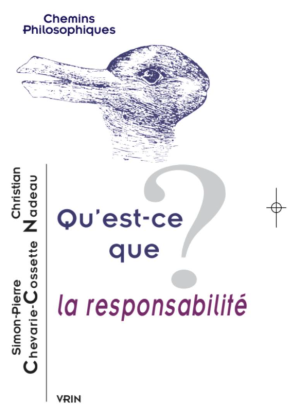
Nous avons le plaisir de vous convier au lancement de l’ouvrage Qu’est-ce que la responsabilité? co-écrit par Christian Nadeau et Simon-Pierre Chevarie-Cossette et paru chez Vrin en novembre 2024. Le lancement se tiendra le 14 février de 18h30 à 20h30 à la librairie Le Port de tête (269 avenue Mont-Royal Est). Des rafraîchissements et bouchées véganes seront servis.
Au plaisir de vous y voir!
Résumé du livre :
Être responsable de notre conduite passée, c’est, en un sens, devoir en répondre. Cela signifie d’accepter qu’on en est l’auteur, à titre d’individu ou de membre d’un groupe. Mais cela implique aussi de devoir la défendre, c’est-à-dire de la justifier si possible ou de l’excuser et parfois d’en accepter les conséquences négatives. Bref, si nous sommes responsables, c’est que nous sommes concernés et que nous devons réagir. À la difficulté psychologique de cette prise de responsabilité s’ajoutent des défis intellectuels majeurs. Peut-on être responsables si notre conduite est due à des mouvements d’atomes déterminés ou soumis au hasard? Comment pourrait-il y avoir responsabilité à titre de membre d’un groupe qui échappe à notre contrôle?
-
« Le problème de la foutaise » par Simon-Pierre Chevarie-Cossette @ Salle 309, CRÉ, hybride, 2910 Edouard-Montpetit, Montreal
12 h 00 – 13 h 15

Dans le cadre des midis de l’éthique, Simon-Pierre Chevarie-Cossette donnera une conférence intitulée « Le problème de la foutaise ».
Pour y participer sur Zoom, c’est ici.
Résumé :
Harry Frankfurt a fait entrer la foutaise (ou « baratin ») dans le domaine de l’investigation philosophique avec son opuscule sur le sujet, On Bullshit (1984). Baratiner n’est pas mentir, mais de quoi s’agit-il et pourquoi est-ce répréhensible ? Selon Frankfurt (et selon plusieurs autres dont Carson, Webber, Fallis, Stoke, Moberger), l’essence de la foutaise est l’indifférence à l’égard de la vérité (ou quelque chose de connexe comme la raison, la connaissance ou l’enquête) : le baratineur parle sans se demander si ses paroles s’accordent ou non avec les faits. Un deuxième courant, initié par Gerry Cohen (et bonifié par Wreen et Cova), l’associe à un énoncé défectueux plutôt qu’à un énonciateur mal intentionné. Ainsi l’astrologue qui croit dur comme fer à ses théories baratine tout de même puisque ses propos sont insensés, sans fondements ou triviaux. Dans cet exposé, je donnerai deux arguments qui donnent raison à Cohen contre Frankfurt : d’une part, si Frankfurt avait raison, le baratin serait toujours blâmable, ce qu’il n’est pas ; d’autre part, la théorie de Cohen explique mieux en quoi la foutaise est nuisible que la théorie de Frankfurt.
-
Nous avons le plaisir de vous inviter à la prochaine rencontre du groupe de lecture en philosophie et éthique économique, qui se tiendra en mode hybride le 13 février 2025 à 9h30 (heure de Montréal). La rencontre se déroulera dans la salle 840, 2e étage à HEC, 3000 Chemin Côte Ste-Catherine (à côté de la bibliothèque). Nous aborderons l’article de Daniel Burkett intitulé « A Legacy of Harm? Climate Change and the Carbon Cost of Procreation », publié dans Journal of Applied Philosophy, 2021.
Nous espérons vous voir en grand nombre pour cette rencontre et nous serions ravis que vous partagiez cette invitation avec toute personne qui pourrait être intéressée.
Pour recevoir le texte en discussion et/ou le lien Zoom, veuillez écrire aux organisateurs, Morgane Delorme (morgane.delorme.1@umontreal.ca) ou Gabriel Monette (gabriel.monette@hec.ca).
Organisé par Nicolas Pinsonneault, en collaboration avec le HEC.
-
Pierre-Yves Néron (Université catholique de Lille) @ Salle 309, CRÉ, hybride, 2910 Edouard-Montpetit, Montreal
12 h 00 – 13 h 15
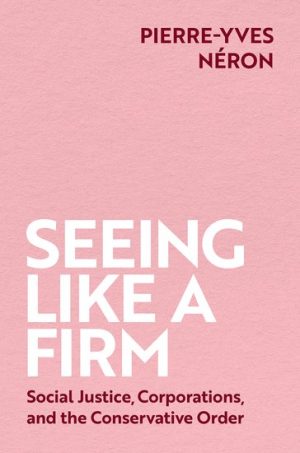
Dans le cadre des Midis de l’éthique, Pierre-Yves Néron (Université catholique de Lille) nous offrira une présentation inspirée de son récent livre Seeing Like a Firm: Social Justice, Corporations, and the Conservative Order (Oxford University Press, 2024).
Pour participer sur Zoom, c’est ici.
Résumé du livre :
Business corporations are political entities and need to be considered as such. Seeing Like a Firm invites readers to do just that by providing a political theory of the business firm and, in doing so, offering new perspectives on the recent history of social justice, neoliberalism, and conservatism.
This book challenges the usual way of thinking about corporations in two ways. Firstly, it argues that firms ‘see’ in a conservative way and embrace a ‘conservatism of commerce’ that requires socioeconomic inequality. In doing so, it challenges our usual interpretation of neoliberalism and its connections with the contemporary business corporation. Secondly, it argues that we need a relational concept of equality and justice to think about corporations. Given that the corporate ‘optic’ is built on dismissing demands for equal standing, Pierre-Yves Néron asserts that relational egalitarians should deconstruct it, argue against it, tackle it.
By offering a new interpretation of conservatism based not on a desire to simply preserve the existing system but on an ‘aesthetics of inequality’, Néron provides an alternative way to think about the main challenges that proponents of equality face.
-
Séminaire des boursier-ères d’études supérieures du CRÉ – 1ère séance @ Salle 309, CRÉ, hybride, 2910 Edouard-Montpetit, Montreal
13 h 00 – 16 h 00
Vous êtes chaleureusement convié.es à la 1ère séance du Séminaire des boursier.es du CRÉ 2024-2025. À tour de rôle, trois des six récipiendaires des bourses du CRÉ nous présenteront leurs travaux. L’objectif du séminaire est d’offrir à nos étudiant.es de maîtrise et de doctorat des commentaires, des critiques constructives et des recommandations qui leur permettront d’améliorer leur projet de recherche.
Nous vous proposons le programme suivant:
13h – 13h50. Présentation de Nicolas Lacroix, Démocratie insurgeante et mouvements sociaux.
13h50 – 14h. Pause
14h – 14h50. Présentation de Clara Dallaire, Curriculum caché en éducation médicale : Recherche-intervention pour le développement d’un outil réflexif participatif.
14h50 – 15h. Pause
15h – 15h50. Présentation de Valérie Lafond, L’impact des injustices structurelles sur la vulnérabilité des personnes face aux conséquences de la crise climatique.
Pour y participer par Zoom, c’est ici.
La seconde séance du séminaire sera tenue au courant du mois de mars 2025.
-
« The Ethics of Publishing in Academic Journals », Arash Abizadeh @ Salle 309, CRÉ, hybride, 2910 Édouard-Montpetit, Montréal
12 h 00 – 13 h 15

Dans le cadre des midis de l’éthique, Arash Abizadeh donnera une conférence intitulée « The Ethics of Publishing in Academic Journals ».
Pour participer sur Zoom, cliquez ici.
-
« The Grounds of Moral Status: Sentience and (a bit) beyond », Will Gildea @ Salle 309, CRÉ, mode hybride
12 h 00 – 13 h 15

Dans le cadre des midis de l’éthique du CRÉ, Will Gildea nous offrira une présentation intitulée « The Grounds of Moral Status: Sentience and (a bit) beyond ».
Pour y participer via Zoom, c’est ici.
-
Nous avons le plaisir de vous inviter à la prochaine rencontre du groupe de lecture en philosophie et éthique économique, qui se tiendra en mode hybride le 30 janvier 2025 à 9h30 (heure de Montréal). La rencontre se déroulera dans la salle 840, 2e étage à HEC, 3000 Chemin Côte Ste-Catherine (à côté de la bibliothèque). Nous aborderons l’article de Samuel Bagg intitulé « Whose Coordination? Which Democray? On Antitrust as a Democratic Demand », publié dans Politics & Society, 2023.
Nous espérons vous voir en grand nombre pour cette rencontre et nous serions ravis que vous partagiez cette invitation avec toute personne qui pourrait être intéressée.
Pour recevoir le texte en discussion et/ou le lien Zoom, veuillez écrire aux organisateurs, Morgane Delorme (morgane.delorme.1@umontreal.ca) ou Gabriel Monette (gabriel.monette@hec.ca).
Organisé par Nicolas Pinsonneault, en collaboration avec le HEC.
-
Pierre André (Université catholique de Louvain) @ En ligne
12 h 00 – 13 h 00
Le mardi 28 janvier 2025, de 12h00 à 13h00, Pierre André (Université catholique de Louvain) donnera une présentation sur son nouveau livre La Justice climatique, co-écrit avec Axel Gosseries (Université catholique de Louvain).
Docteur en philosophie, Pierre André a également une formation en sciences politiques et en gestion. Anciennement chargé de recherches FNRS, il est actuellement chargé de cours invité à la Chaire Hoover d’éthique économique et sociale de l’Université de Louvain ainsi qu’à la Frankfurt School of Finance & Management.
La présentation est organisée par Juliette Roussin (Université Laval) pour le Groupe de recherche interuniversitaire et interdisciplinaire en éthique environnementale et éthique animale (GRÉEA) et le Centre de recherche en éthique (CRÉ).
Pour y participer, c’est ici. Veuillez prendre en note le mot de passe pour la réunion Zoom : 940004.
-
REPORTÉ – « Localizing Knowledge in Sustainability Discourse », Olusegun Samuel @ Salle 309, CRÉ, mode hybride
12 h 00 – 13 h 15

Dans le cadre des midis de l’éthique, Olusegun Samuel nous offrira une présentation de son travail en cours. Sa conférence est intitulée « Localizing Knowledge in Sustainability Discourse ».
Pour y participer via Zoom, c’est ici.
-
« Avoiding Taking Responsibility for Access », Corinne Lajoie @ Salle 309, CRÉ, hybride, 2910 Edouard-Montpetit, Montreal
12 h 00 – 13 h 15

Dans le cadre des Midis de l’éthique, Corinne Lajoie nous offrira une présentation intitulée « Avoiding Taking Responsibility for Access ».
Le séance sera animée par Anne-Marie Gagné-Julien.
Pour participer sur Zoom, c’est ici.
-
« How Beliefs Harm », Abraham Tejiri Tobi @ Salle 309, CRÉ, mode hybride
12 h 00 – 13 h 15

Dans le cadre des midis de l’éthique du CRÉ, Abraham Tejiri Tobi nous offrira une présentation intitulée « How Beliefs Harm ».
Pour y participer par Zoom, c’est ici.
-

Dans le cadre des activités du Réseau de philosophie du travail, Joshua Preiss (University of North Carolina, Chapel Hill) offrira une présentation intitulée : « The Moral and Political Importance of Good Jobs ». Pour participer, c’est ici.
Les activités du Réseau de philosophie du travail sont ouvertes aux chercheur.es et aux étudiant.es diplômé.es ayant des intérêts de recherche dans ce domaine. Elles sont organisées par Denise Celentano (denise.celentano@umontreal.ca) et Pablo Gilabert (pablo.gilabert@concordia.ca).
Abstract: This paper connects the political, business, and policy discourse on good jobs with recent philosophy of work, bringing philosophical analysis to bear on a defining moral and political challenge for our time. My teleological account of good jobs provides a normative lens for understanding the economic transformations of wealthy democratic societies the past half century, the crisis of liberal democracy that has resulted from these transformations, and what, at minimum, needs to be done about it. Good jobs, on this account, enable workers to cross a context-relevant threshold of compensation, status, and power. In addition, I argue that a focus on good jobs does not entail fetishizing paid work or endorsing the proliferation of so-called bullshit jobs (despite the fact that the later often provide significant compensation, status, and power). Even those who envision a future with little to no paid labor can recognize a basic moral and political imperative: restoring the promise that through hard work people can build a better life for themselves, their families, and their communities. Good jobs provide the fuel for democratic norms and institutions and give ordinary workers the power they’ll need to secure a free and inclusively prosperous future with less paid work.