
Évènements passés
Archives du calendrier
-

Cocktail de 5@6
Table ronde organisée dans le cadre du volet « Dialogue Citoyen » du projet AIship : Les nouveaux états d’être / The New States of Being, qui visait à impliquer le public dans une réflexion sur les enjeux éthiques, sociaux et légaux du développement de l’intelligence artificielle en santé.
Ces rencontres s’appuient sur les productions artistiques et scientifiques de 5 duos d’artistes et bioéthiciens (1 œuvre / 1 essai) présentées au sein de l’exposition collective du 27 sept. au 14 décembre 2019 au Centre d’exposition de l’Université de Montréal.
À propos de cette activité :
Sur la base du travail collaboratif de l’artiste Gregory Chatonsky et de la chercheuse Laurence Devillers, ce panel visait à créer un espace de discussion entre experts et grand public autour du thème de la passibilité des robots, soit de leur capacité à éprouver des sensations et les conséquences éthiques de cette passibilité. Croisant les perspectives disciplinaires, les discussions se penchaient plus particulièrement autour de deux aspects relatifs à la passibilité des robots :
1) la nature de cette passibilité et ses impacts émotionnels et relationnels potentiels sur les humains;
2) les préoccupations éthiques qui émergent de cette passibilité et les moyens d’y répondre.

Partenaires : Conseil de recherches en sciences humaines du Canada | Laboratoire d’innovation de l’Université de Montréal | L’Institut de Valorisation des Données | Le Centre d’exposition de l’Université de Montréal | Petrie-Flom Center, Harvard Law School | Le Centre de Recherche en Éthique | Le Ministère des Relations internationales et de la Francophonie
-
« Moral Psychology and Non-cognitivism: Hume against the Humeans” @ Salle 309, Stone Castle
16 h 00 – 17 h 15

Les membres du CRÉ se réjouissent de recevoir Mark T. Nelson, qui offrira une présentation intitulée « Moral Psychology and Non-cognitivism: Hume against the Humeans”.
Abstract:
Humeanism is influential in contemporary metaethics, so it may come as a surprise that a currently popular Humean argument in metaethics should be unacceptable to Hume himself. The argument in question is the argument from motivational Humeanism to the conclusion of moral non-cognitivism. I argue that this argument would be unacceptable to Hume because it requires as a further premise the thesis of motivational internalism. This thesis asserts a universal, necessary connection between an agent’s judging something to be the case morally and that agent’s being motivated to act accordingly, but this runs afoul of a key methodological plank in Hume’s larger project.
-
Frédéric Côté-Boudreau (Queen’s University) @ Salle 309, Stone Castle
14 h 30 – 16 h 25


Frédéric Côté-Boudreau, Queen’s University – Autonomie et paternalisme pour les animaux non humains : pour une conception intégrale de la liberté et de l’interférence permissible
Résumé
Pour que les animaux humains et non humains puissent réellement vivre la vie qu’ils et elles désirent, il ne suffit pas de leur octroyer un droit à la liberté: il faut aussi déterminer dans quels cas une intervention pourrait être nécessaire et justifiée pour garantir leur bien-être (et celui des autres) et quels sont les pouvoirs qui manipulent, limitent ou orientent de manière indue le développement de leurs préférences. En d’autres mots, au-delà du concept de liberté lui-même, il nous faut étudier les concepts d’autonomie, de paternalisme et de préférences adaptatives ainsi qu’explorer comment ceux-ci peuvent s’appliquer jusqu’à des individus n’ayant pas nécessairement la capacité à réfléchir à leurs désirs ni à comprendre les structures de domination.
En plus d’adopter un fondement antispéciste, cette approche (que je nomme « l’autonomie inclusive ») fera appel à la liberté en tant que non-domination, s’intéressera à l’autonomie relationnelle dans une perspective anticapacitiste, et distinguera trois clauses permettant de penser des interférences légitimes dans la vie des individus tout en leur permettant de jouir le mieux possible de leur liberté.
-
Bruce Maxwell (Université du Québec à Trois-Rivières) @ Salle 309, Stone Castle
12 h 00 – 13 h 30

Présentation du midi, de Bruce Maxwell (University of Quebec Trois-Rivières), sur un papier coécrit avec Joanna Peplak (University of Toronto)
Abstract:
This article provides a critical overview of the evidence on the impact of social and emotional learning programs on emotional intelligence. The social and emotional learning movement and research on emotional intelligence are intimately linked. However, exuberance for social and emotional learning in educational circles has contributed to a situation in which program implementation and evaluation has gotten ahead of the impact of social and emotional learning on emotional intelligence as a measureable psychological construct and frequently ignores relevant theoretical issues. Mapping out this terrain, the article shows that despite the extensive research on the impact of social and emotional learning on key indicators of academic success and youth well-being, compelling evidence that SEL affects the development of EI remains scant.
-
La quête du bonheur @ Amphithéâtre Ernest-Cormier (K500) du Pavillon Roger-Gaudry, Université de Montréal
18 h 00 – 20 h 00

Dans le cadre des Conférences de la montagne, sera tenue une table ronde sur le thème « La quête du bonheur », à laquelle participeront Marc Fleurbaey (Princeton U et membre du Comité d’experts scientifiques du CRÉ), Daniel Haybron (Saint Louis U) et Marie-France Raynault (U de Montréal).


Pour prendre connaissance des biographies des conférencier.e.s et des résumés de leurs présentations, c’est ici.
Organisation: Christine Tappolet.

-
Marie-Sol Poirier (Secrétariat sur la conduite responsable de la recherche) @ Salle 309, Stone Castle
12 h 15 – 13 h 30

Dans le cadre des Ateliers de la bioéthique, le CRÉ reçoit Marie-Sol Poirier, Conseillère principale en éthique de la recherche au Secrétariat sur la conduite responsable de la recherche.
Résumé
Récemment, la troisième mise à jour de la seconde édition de l’Énoncé de politique des trois conseils : Éthique de la recherche avec des êtres humains (EPTC 2) a été lancée. Cette dernière version de l’EPTC 2, datée de 2018, remplace la version de 2014 en tant que politique officielle en éthique de la recherche avec des êtres humains des trois organismes fédéraux de financement de la recherche.
Bien que des lignes directrices aient été ajoutées à la nouvelle version, la Politique demeure fidèle à ses trois principes directeurs : le respect des personnes, la préoccupation pour le bien-être et la justice.
La présente conférence vise principalement à clarifier la portée de l’EPTC 2 et à présenter les principales modifications qui y ont été apportées.
-
Charles Mills (City University of New York) @ Salle B-3245, Pavillon Jean-Brillant, Université de Montréal
14 h 00 – 16 h 00

Dans le cadre du cycle des conférences féministes du CRÉ, et en collaboration avec le GRIPP, nous avons le plaisir d’accueillir Charles Mills, qui nous offrira une présentation intitulée « Black Rights White Wrongs: The critique of Racial Liberalism ».
Charles Mills is Distinguished Professor of Philosophy at The Graduate Center, City University of New York. He is a political philosopher, working in the area of oppositional political theory, as centered on race and class. He is the author of numerous articles and six books, among which are The Racial Contract (1997) (winner of the Gustavus Myers Outstanding Book Award), Blackness Visible: Essays on Philosophy and Race (1998) (finalist for the award of the most important North American work in social philosophy of that year), Black Rights/White Wrongs: The Critique of Racial Liberalism (Oxford University Press 2017).
Résumé/abstract:
Liberalism’s promise of equal rights has historically been denied to blacks and other people of color. Black Rights/White Wrongs: The Critique of Racial Liberalism argues that rather than being irrelevant to the workings of self-conceived liberal polities today, this history of denial and its current legacy should be regarded as continuing to shape liberalism in fundamental ways. As feminists have conceptualized the dominant form of liberalism as a patriarchal liberalism, this book suggests seeing it as a racialized liberalism. Accordingly, the chapters look at racial liberalism, past and present: “white ignorance” as a guilty ignoring of reality that facilitates ongoing white racial domination; Immanuel Kant’s role as the most important liberal theorist of both personhood and sub-personhood; the centrality of racial exploitation to the economy of the United States; and the evasion of the realities of white supremacy and the need for corrective racial justice in John Rawls’s hugely influential “ideal theory” framing of the derivation of principles of social justice. Nonetheless, the book argues that a deracialized liberalism is both possible and desirable. But it will be necessary to reconstruct liberalism on a new foundation that self-consciously takes its unacknowledged racial history into account.
Organisation: Ryoa Chung, Naïma Hamrouni et Arash Abizadeh.
-
Hille Paakkunainen (Syracuse University) @ Salle/Room 1220, Henry F. Hall Building, Sir George Williams Campus
15 h 00 – 17 h 00

Dans le cadre des ateliers du GRIN, on reçoit Hille Paakkunainen (Syracuse University), qui offrira une présentation intitulée “Virtue and Practical Inference”.
Résumé/Abstract:
In this talk, Dr. Hille Paakkunainen will argue that virtues of character are dispositions of practical inference, and that neo-Humean belief-desire psychology is inadequate to account for them.
Dr. Hille Paakkunainen is Associate Professor of Philosophy at Syracuse University. She works in metaethics, epistemology, and philosophy of action. Most of her work concerns the nature of various normative phenomena, such as having a good reason for doing something or being justified in believing something, and the relationship between such phenomena and forms of reasoning or agency.
The venue is wheelchair accessible.
-
Les nouveaux états d’être / The New States of Being @ Faculté de l'aménagement, UdeM, salle 0056
17 h 30 – 19 h 00
Le CRÉ est fier de s’associer à cette belle activité Bioéthique & IA.
Raymond Lalande, vice-recteur aux relations avec les diplômés, aux partenariats et à la philanthropie, et le Centre d’exposition de l’Université de Montréal sont heureux de vous inviter au vernissage de l’exposition Les nouveaux états d’être / The New States of Being, 1er volet du projet interdisciplinaire AIship.
Sous le commissariat de Aseman Sabet et la direction scientifique de Jean-Christophe Bélisle-Pipon, Nathalie Voarino et Virginie Manus, cette exposition collective conjugue l’art et la science à travers le dialogue de cinq duos d’artistes et chercheurs en bioéthique, interrogeant librement les dimensions affectives et relationnelles suscitées par le développement et l’application de l’intelligence artificielle (IA) en santé.
Fier participant de la 23e édition des Journées de la culture, le CEUM profite aussi de l’occasion pour multiplier les rencontres et accueillir le lancement du no. 123 de la revue ESPACE art actuel.
Artiste + bioéthicien.ne : les duos
Grégory Chatonsky (Paris) – Laurence Devillers (Paris-Sorbonne)
Mat Chivers (Royaume-Uni) – Cansu Canca (AI Ethics Lab)
Clément de Gaulejac (Montréal) – Pascale Lehoux (Université de Montréal)
Julie Favreau (Berlin) – Effy Vayena (ETH Zürich)
Sandra Volny (Montréal) – Robert Truog (Harvard Medical School)En présence de :
Paul Lewis : vice-recteur associé, vice-rectorat aux relations avec les diplômés, aux partenariats et à la philanthropie | UdeM
Marie-Josée Hébert : vice-rectrice à la recherche, à la création et à l’innovation | UdeM
Anne Marchand ::: vice-rectrice associée, vice-rectorat à la recherche, à la découverte, à la création et à l’innovation | UdeM
Aseman Sabet : commissaire
Jean-Christophe Bélisle-Pipon : directeur scientifique AIship
André-Louis Paré : directeur général et rédacteur en chef ESPACE art actuelUn vin d’honneur sera servi.
-
Colleen Murphy (University of Illinois) @ Arts Council Room (160), Arts Building, McGill
14 h 00 – 16 h 00

Colleen Murphy est reçu au GRIPP. Elle offrira une présentation portant sur la justice transitionnelle.
-
Dr. Michael Titelbaum (Winsconsin-Madison) @ Salle 422, Stone Castle, UdeM
10 h 00 – 12 h 00
Dans le cadre des Ateliers du GRIN, on reçoit Dr. Michael Titelbaum (Winsconsin-Madison), qui offrira une présentation intitulée The Logical Firmament
Résumé/Abstract:
Most work in the epistemology of logic asks how inferential rules are known, and how individual steps in a proof are justified. But what happens when single steps are composed into a complex derivation? A new set of facts—“combinational facts”—come into play, which have been undertheorized despite being at the heart of such phenomena as logical non-omniscience. I will ask how recognition of these facts might alter our epistemology of logic. And I will make a tentative proposal for how combinational facts come to be known.
-
Dr. Victoria McGeer (Princeton University) @ Leacock 927, McGill University
10 h 00 – 12 h 00
Le GRIN reçoit Dr. Victoria McGeer (Princeton University), qui offrira une présentation intitulée « Empathy Internalized: On the scaffolding power of self-directed emotion ».
Résumé/Abstract:
It is commonly accepted that empathy plays a key role in moral agency. More deeply, it is often held to play a critical role in (adult) moral development by generating self-castigating emotions of guilt, shame and remorse when we are brought face to face with the wrongs we do to others. In defense of this commonsense view, I argue the self-castigating emotions can be epistemically valuable so far as they promote insight into our conduct and character that may be necessary for such development. But more problematically, these emotions can also be motivationally counterproductive for such development. To overcome this problem, I examine the conditions under which these self-castigating emotions can be managed, contained or metabolized, thereby supporting rather than defeating our self-development. My claim will be that forging an empathetic connection with our own erring self is an essential part of this developmental process.
-
Philip Pettit lecture on Persons, and Values @ B-2325, Pavillon Jean-Brillant, UdeM
19 Sep – 20 Sep Jour entier

Among the many different accounts of personhood, that which links it with the activity of personation, as Hobbes called it, has a particular claim on our allegiance. It explains why we ascribe certain distinctive capacities to persons. And it enables us to vindicate the ways in which Charles Taylor connects being a person with interacting with others, operating within language and constructing a narrative of the self.
Philip Pettit sera reçu en conférence inaugurale de la série de conférence Charles Taylor, les 19 et 20 septembre. La partie 1 intitulée « What marks off persons from other agents? Society, language, and narration », sera tenue à l’Université de Montréal; la partie 2 intitulée « What ties personhood to having values? Autonomy, respect, and freedom », le sera à McGill, de 16h à 18h dans chaque cas.
Événement organisé par le GRIPP, et parrainé notamment par le CRÉ.
Page facebook de l’événement.

-
Entretien balado avec Philip Pettit (Princeton University) @ Librairie Olivieri
17 h 00 – 19 h 00

Podcast interview with / Entretien balado avec Philip Pettit
on the course of his career / sur le parcours de sa carrièrehttps://soundcloud.com/radio-cr/entretien-avec-philip-pettit-princeton-university
Interviewer: Éliot Litalien
Événement facebook.


-
Raamy Majeed (University of Auckland) @ Salle 422, Stone Castle
10 h 00 – 12 h 00
Le GRIN reçoit Raamy Majeed (University of Auckland), qui offrira une présentation intitulée « Do Recalcitrant Emotions Show that Emotions are Modular? »
Résumé
The occurrence of recalcitrant emotions, i.e. emotional episodes that are in conflict with our considered judgements, are used as unproblematic means of motivating the view that emotions are modular: roughly, that they are cognitive capacities which are explained by mental components functionally dissociable from other parts of the mind. In this paper, I argue that recalcitrant emotions don’t, by themselves, show that emotions are modular in a non-trivial sense.
-
Building the Canadian Green Economy. A Just Transition @ Ballroom, McGill Faculty Club
12 Sep – 13 Sep Jour entier

Le CRÉ est fier de s’associer à la conférence sur les changements climatiques Building the Canadian Green Economy: A Just Transition, qui sera tenue les 12 et 13 septembre 2019 à McGill et qui est organisée par Alexandre Gajevic Sayegh.
Les membres du CRÉ qui ont participé à l’événement sont :
Justin Leroux (Applied Economics, HEC)
Pierre-Olivier Pineau (Chair in Energy Sector Management, HEC)
Gregory Mikkelson (School of Environment, McGill University)
-
Social Justice Theory Workshop @ Room 201, S Annex, Sir George Williams Campus, Concordia University, Philosophy Department
29 Août – 30 Août Jour entier

Social Justice Theory Workshop
Organized by the Social Justice Centre (Concordia University) and the Centre de Recherche en Éthique (CRÉ)
The aim of the Social Justice Theory Workshop is to enable sustained exploration in the theory of social justice. It addresses topics such as the articulation of ideals and principles of economic, political, gender, race, environmental, and cultural justice; the critique of inequality, domination, exploitation, and alienation; and the illumination of political institutions, practices, and processes of transformation that might foster progressive change.
Participation sur invitation seulement (our réserver une place: sjc@concordia.ca)
Affiche (.pdf)
Conférencier.e.s:
- Kristi Olson (Bowdoin College). Commentator: Louis-Philippe Hodgson (York University).
- Martin O’Neill (University of York, UK). Commentator: Dominique Leydet (Universite de Quebec a Montreal).
- Christine Sypnovich (Queen’s University). Commentator: Katharina Nieswandt (Concordia University).
- Nicholas Vrousalis (Leiden University). Commentator: Ben Laurence (University of Chicago).
- Peter Dietsch (Universite de Montreal). Commentator: Francois Claveau (Universite Sherbrooke).
- Pablo Gilabert (Concordia University). Commentator: Samuel Arnold (Texas Christian University).
Programme (.pdf)
-
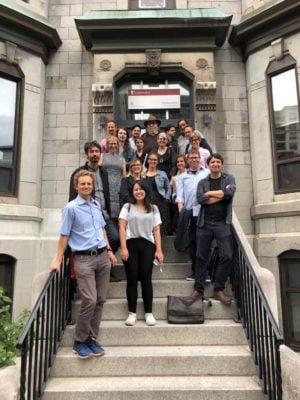
 Les membres du CRÉ auront le plaisir d’entendre Camilo Sarmiento, étudiant en séjour de recherche au CRÉ, nous parler des biais et de la discrimination en intelligence artificielle.RésuméAprès une bref introduction des principes sur lesquels reposent les réseaux de neurones, nous allons plonger dans des exemples permettant de mettre en évidence différentes catégories de biais que l’on peut retrouver dans les techniques d’apprentissage machine. Puis, nous verrons de quelle façon certaines utilisations des algorithmes peuvent nous mener à des comportements discriminatoires, renforçant ainsi les inégalités déjà existantes avec lesquelles nous vivons tous les jours. Finalement, nous allons parcourir l’histoire des ordinateurs, d’internet et de l’IA afin d’essayer de répondre à la question suivante : est-ce réellement surprenant de retrouver des biais ayant tendance à renforcer les inégalités déjà existantes dans ces outils ?
-
Media Ethics. Human Ecology in a Connected World @ St Michael's College, University of Toronto
27 Juin – 30 Juin Jour entier

CRÉ is happy to join the University of St. Michael’s College in the University of Toronto, he Media Ecology Association (MEA), and several units at the University of Toronto to support the International conference « Media Ethics. Human Ecology in a Connected World ». Dominic Martin and Jocelyn Maclure will be among the presenters, participating to a round table on « Algorithmic Accountability » on June 28th, at 9:30 am.
Exploring Media Ethics
MEDIA ETHICS. Human Ecology in a Connected World is the 20th Annual Convention of the Media Ecology Association (MEA), a four day international conference hosted by the University of St. Michael’s College in the University of Toronto.
THE CONFERENCE draws attention to the ways that contemporary communication practices and emerging technologies are marked by ethical issues and decisive political, societal and cultural questions.
WITH THIS AGENDA, conference participants will share research that engages with the nature of contemporary media, communication, and technological struggle, and the potential that communication, media, and digital technologies hold for enacting positive social change.
-
Les enjeux politiques de l’intelligence artificielle : gouverner les algorithmes et gouverner par les algorithmes @ Maison Suger, Paris, France
24 Juin – 28 Juin Jour entier
 École d’été CÉRIUM/MILA/CRÉ « Les enjeux politiques de l’intelligence artificielle : gouverner les algorithmes et gouverner par les algorithmes »
Le séminaire doctoral a pour objet l’étude de la gouvernance algorithmique comme nouvel enjeu politique, social et juridique auquel sont confrontées les démocraties libérales aussi bien à l’intérieur de leurs frontières qu’au niveau international. La gouvernance renvoie à l’idée d’une régulation qui ne s’appuie pas seulement sur les moyens classiques du gouvernement, mais sur un éventail d’instruments et de procédures que mettent en œuvre des acteurs très divers dotés d’une légitimité qui n’est pas uniquement politique. Avec l’avènement de l’intelligence artificielle qui accentue la procéduralisation de la démocratie et la fragmentation des centres de décisions, le mode de gouvernement qui s’impose est celui de la gouvernance. La gouvernance algorithmique renvoie aux procédures qui permettent d’encadrer les décisions prises par un système automatisé. Mais l’expression de « gouvernance algorithmique » ou de « gouvernance des algorithmes » trahit une ambiguïté intéressante, selon que le génitif est objectif ou subjectif : on peut en effet comprendre que la gouvernance algorithmique porte sur la manière de « gouverner l’intelligence artificielle (IA) » ou sur la manière dont « l’IA nous gouverne ».
Liste des invité.e.s/ conférencier.e.s:- Laurence Devillers (Paris-Sorbonne, INRIA- DATAIA)
- Nicolas Miailhe (co-fondateur, directeur, The Future Society)
- Bertrand Pailhès (coordonnateur interministériel de la stratégie IA France)
- Moez Chakchouk (Unesco, Deputy Secretary-General for Communication and Information)
- Yannick Meneceur, Conseiller IA, Conseil de l’EuropeFanny Hidvegi (Access Now’s European Policy Manager, membre du High Level Expert Group on AI de la Commission Européenne).
- Élodie Vialle, Dir. du bureau journalisme et technologie, Reporter sans frontières
- Valérie Peugeot (commissaire à la CNIL, chercheuse Lab Orange)
- Karine Perset (OCDE / OECD, Administrator on Digital Economy and AI Policy; Directorate for Science, Technology and Innovation)
- Saadi Lahlou, dir. de l’Institut des Études Avancées de Paris & professeur à la LSE (Londres)
- Hugues Bersini (Laboratoire IRIDIA, Université Libre de Bruxelles)
Ce séminaire doctoral du Centre d’études et de recherches international (CÉRIUM) se tient à la Maison Suger (Paris) et est organisé en partenariat avec la Maison Suger, la Fondation de la Maison des Sciences de l’Homme (FMSH), le Centre d’Études Sociologiques et Politiques Raymond Aron (EHESS), et l’Observatoire international sur les impacts sociétaux de l’intelligence artificielle et des technologies numériques. Avec le soutien de l’Institut des Études Avancées de Paris, The Future Society, Mila et le Centre de Recherche en Éthique.
Responsable:
Marc-Antoine Dilhac et Luc Foisneau.