
Évènements passés
Archives du calendrier
-
Altered Inheritance: CRISPR and the Ethics of Human Genome Editing @ McGill, Elizabeth Wirth Music Building Room A-823
17 h 30 – 19 h 30
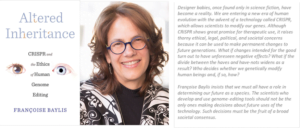

Copies of the book will be available for sale on site and 30 free copies will be distributed to students (with valid student ID) at the event.
Co-organized by Daniel Weinstock, McGill Institute for Health and Social Policy, and Vardit Ravitsky, Centre de recherche en éthique (CRÉ)
-
« Is it Time for Robot Rights? », présentation de Vincent Müller (Eindhoven University of Technology) @ Agora-Café, Mila/Ivado
16 h 00 – 18 h 00

Dans le cadre de la série de Conférences de Montréal en éthique de l’intelligence artificielle, présentation de Vincent Müller (philosophie, Eindhoven University of Technology) intitulée « Is it Time for Robot Rights? ».
Merci de vous inscrire sur Eventbrite à partir du lien sur ce site web: https://sites.google.com/view/dmartin/ai-ethics/speakers#h.p_qo_GXaUOxpqS.
-
Séminaire des boursier.e.s d’études supérieures du CRÉ – 1ère séance @ Salle 307, UdeM
9 h 00 – 12 h 00
 Vous êtes cordialement invité.e.s au premier séminaire des boursier.e.s d’études supérieures du CRÉ 2019-2020.
À tour de rôle, les boursier.e.s présenteront leur projet de recherche (environ 20 minutes) et une période de discussion s’ensuivra (à peu près 30 minutes).
L’horaire proposé pour cette première demi-journée est le suivant :9:00-10:00 Jordan Walters. Maitrise sous la direction de Katharina Nieswandt, en philosophie, Concordia. Son projet s’intitule A Defense of Minimalist Responses to Debunking Arguments.10:00-11:00 Matthew Palynchuk. Maitrise sous la direction de Kristin Voigt et Iwao Hirose, en philosophie, McGill. Son projet s’intitule The Dependency Challenge to Theories of Domination.
11:00-12:00 Morgane Delorme. Doctorante sous la direction de Peter Dietsch et Arnauld Leclerc, en philosophie, UdeM. Son projet s’intitule La Banque Centrale européenne à la lecture du contractualisme. Enjeux normatifs et exigences de justification. -

Annual Montreal Political Theory Manuscript Workshop
The Groupe de recherche en philosophie politique de Montréal (GRIPP) is pleased to announce a one-day workshop dedicated to the 2019 winner of the Annual Montreal Political Theory Manuscript Workshop Award, “Morally and Socially Constructed Norms” by Laura Valentini of the London School of Economics.
Format: To maximize the quality of discussion, participants are expected to have read the manuscript beforehand. The workshop comprises four sessions dedicated to the manuscript. Each session will begin with brief critiques of chapters of the manuscript, followed by a brief response by the author and general discussion
Registration: The workshop is open to all, but attendance is by registration and limited in number. RSVP Arash Abizadeh <arash.abizadeh@mcgill.ca>
Manuscript: Click here for access to manuscript. Access requires a password, which all participants will receive upon registration.
Programme
9:00 Coffee & croissants / Café et croissants
9:30 Welcome / accueil
9:45 – 11:30 Présidente: Dominique Leydet (philosophie, UQAM)
Ch. 1: “What are socially constructed norms?” Daniel Weinstock (law, McGill)
Ch. 2: “Grounding the moral force of socially constructed norms I: Unsuccessful views” Stephanie Leary (philosophy, McGill)
11:30 – 13:00 Lunch / Dîner
13:00 – 14:45 Chair: Catherine Lu (politics, McGill)
Ch. 3: “Grounding the moral force of socially constructed norms II: The agency-respect view” Natalie Stoljar (philosophy, McGill)
Ch. 4: “Grounding moral rights” Pablo Gilabert (philosophy, Concordia)
14:45 – 15:00 Coffee Break / pause café
15:00 – 16:45 Chair: Will Roberts (politics, McGill)
Ch. 5: “Grounding political obligation” Victor Muñiz-Fraticelli (law & politics, McGill)
Ch. 6: “Explaining the wrong of sovereignty violations” Peter Dietsch (philosophie, Université de Montréal)18:30 Dinner / Souper
-
Le GRIPP reçoit Christian List (LSE) qui offrira une présentation intitulée “Group Agency and Artificial Intelligence”. Commentateur: Nicholas Dunn.
Le texte est disponible sur demande (écrire à Valéry Giroux: valery.giroux@umontreal.ca) pour celles et ceux qui assisteront à la rencontre.
-
« Le véganisme comme mouvement social : une approche par l’analyse de réseau » @ Salle 309, Stone Castle
10 h 30 – 12 h 00

Le GRÉEA reçoit Alexia Renard (Université de Montréal), qui nous offre une présentation intitulée « Le véganisme comme mouvement social : une approche par l’analyse de réseau ».
Résumé
La communication présentera les résultats d’une recherche de terrain menée en 2019, au Québec, sur le mouvement végane. Alors que certains qualifient le véganisme de mouvement lifestyle, orienté vers le changement culturel et individuel – tandis que les mouvements « conventionnels » viseraient le changement social (Haenfler, Johnson, et Jones 2012), d’autres s’opposent à une dichotomie jugée artificielle et proposent une définition du véganisme comme engagement politique pour les droits des animaux (Véron 2016). Qu’en est-il au Québec ?
Selon Mario Diani, les mouvements sociaux se caractérisent par des réseaux d’interaction informels entre une pluralité d’individus, de groupes et d’organisations, liées par une identité collective et engagées dans un conflit politique ou culturel (Diani 1992). Partant de cette définition, ma recherche s’est d’abord intéressée à la structure globale des acteurs collectifs québécois (organismes de charité, grassroot groups, etc.). J’ai, dans un second temps, analysé l’identité collective du mouvement, qui repose sur une revendication centrale – plus ou moins frontalement énoncée : l’abolition de l’exploitation animale.
Les résultats montrent que le véganisme constitue un mouvement social, selon la définition proposée par Diani. Sur le plan organisationnel, le mouvement québécois présente une structure éclatée, peu hiérarchisée, qui s’incarne dans des actions diverses dont la cible est autant la culture dominante que l’arène juridique et, moins souvent, la sphère politique. Toutefois, le mouvement est quasiment absent de l’arène politique conventionnelle : la question du conflit politique est donc encore ouverte, nous amenant à nous réinterroger sur la dichotomie entre mouvement culturel et mouvement social.
Biographie
Alexia Renard est candidate au doctorat en science politique à l’Université de Montréal, sous la direction de Pascale Dufour. Elle prépare une thèse sur le mouvement pour les droits des animaux, en perspective comparée France/Québec. Son mémoire de maîtrise, portant sur le mouvement végane au Québec, a obtenu la mention « exceptionnel » et a été jugé comme étant « une contribution majeure ».
-
Shelly Kagan (2019), « How to count animals, more or less » @ Salle 309, Stone Castle
10 h 00 – 12 h 00
À l’hiver 2020, le GRÉEA organise un groupe de lecture autour du livre de Shelly Kagan (2019), How to count animals, more or less, Oxford University Press.
Calendrier des séances
- 14 Janvier: chapitres 1-2
- 28 Janvier: chapitres 3-4
- 11 Février: chapitres 5-6
- 3 Mars: chapitres 7-8
- 17 Mars: chapitres 9-10
- 31 Mars: chapitre 11
Le groupe de lecture est ouvert à tout-es. Une version .pdf du livre est disponible sur demande: sophia.rousseau-mermans@
UMontreal.CA Abstract
Most people agree that animals count morally, but how exactly should we take animals into account? A prominent stance in contemporary ethical discussions is that animals have the same moral status that people do, and so in moral deliberation the similar interests of animals and people should be given the very same consideration. In How to Count Animals, more or less, Shelly Kagan sets out and defends a hierarchical approach in which people count more than animals do and some animals count more than others. For the most part, moral theories have not been developed in such a way as to take account of differences in status. By arguing for a hierarchical account of morality – and exploring what status sensitive principles might look like – Kagan reveals just how much work needs to be done to arrive at an adequate view of our duties toward animals, and of morality more generally.
-
Kate Nolfi (Vermont) @ W-5215 5e étage Pavillon Thérèse-Casgrain (W), UQAM
10 h 00 – 12 h 00

Les membres du GRIN et les chercheur.se.s associé.e.s au thème phare du CRÉ « Éthique féministe » sont heureux.ses de recevoir Kate Nolfi (Vermont), qui offrira une présentation intitulée « An Action-Oriented Approach to Epistemic Theorizing ». Le texte est disponible sur demande: grin.normativity@gmail.com.
-
Elena Casetta (Université de Turin) @ Carrefour des arts et des sciences, salle C-2059 Pavillon Lionel-Groulx, UdeM
10 h 00 – 12 h 00
Le GRÉEA propose d’assister par vidéoconférence à la conférence d’Elena Casetta (Université de Turin), intitulée « Naturalness as independence: a theoretical framework for nature restoration ».

-
« In defense of honour? What justification for moral rights in copyright doctrine? » @ Salle 309, Stone Castle
12 h 00 – 13 h 15

Dans le cadre des Midis de l’éthique du CRÉ, Hannah Carnegy-Arbuthnott nous offrira une présentation intitulée « In defense of honour? What justification for moral rights in copyright doctrine? ».
Résumé
Moral Rights are a subsection of intellectual property rights which are independent of an artist’s economic rights over a piece of work. Article 6bis of the Berne Convention grants authors rights to attribution, including the right to object to false attribution of authorship, as well as allowing an author to object to any distortion, mutilation or derogatory action in relation to the work which would be “prejudicial to his honour or reputation”. Crucially, Moral Rights persist even after transfer of the copyright on a piece of work – they are inalienable.The inalienability of Moral Rights does not fit well with typical legal and philosophical approaches to explaining intellectual property rights. This paper suggests an alternative account of the justificatory basis of Moral Rights in copyright doctrine – one based on the principle of relational equality.
-
« Counter-majoritarian Democracy: Persistent Minorities, Federalism, and the Power of Numbers » @ Salle 309, Stone Castle
12 h 00 – 13 h 15

Dans le cadre des Midis de l’éthique du CRÉ, Arash Abizadeh nous offrira une présentation intitulée « Counter-majoritarian Democracy: Persistent Minorities, Federalism, and the Power of Numbers ».
-
 Avi Goldfarb
Ellison Professor of Marketing, Rotman School Of Management« The Simple Economics Of Artificial Intelligence »Discussant: Peter Dietsch (Département de philosophie, Université de Montréal)
WEDNESDAY, NOVEMBER 27
4-6 PM – UQAMInformation and registration:https://sites.google.com/view/
dmartin/ai-ethics/speakers or send an email to marcoux.aude_marie@ courrier.uqam.ca Enregistrement de l’événement. Pour visionner, c’est ici: https://sites.google.com/view/dmartin/ai-ethics/speakers#h.p_Dix4KOsaxBuT.
Recent excitement in artificial intelligence has been driven by advances in machine learning. In this sense, AI is a prediction technology. It uses data you have to fill in information you don’t have. These advances can be seen as a drop in the cost of prediction. The framing generates some powerful, but easy-to-understand implications. As the cost of something falls, we will do more of it. Cheap prediction means more prediction. Also, as the cost of something falls, it affects the value of other things. As machine prediction gets cheap, human prediction becomes less valuable while data and human judgment become more valuable. Business models that are constrained by uncertainty can be transformed, and organizations with an abundance of data and a good sense of judgment have an advantage.
Avi Goldfarb is the Rotman Chair in Artificial Intelligence and Healthcare, and Professor of Marketing, at the Rotman School of Management, University of Toronto. Avi is also Chief Data Scientist at the Creative Destruction Lab, Senior Editor at Marketing Science, and a Research Associate at the National Bureau of Economic Research. Avi’s research focuses on the opportunities and challenges of the digital economy. Along with Ajay Agrawal and Joshua Gans, Avi is the author of Prediction Machines: The Simple Economics of Artificial Intelligence (www.
predictionmachines.ai) and editor of the NBER book The Economics of Artificial Intelligence: An Agenda. -
Being a believer by David Hunter (Ryerson) @ A-2407, pavillon Maximilien-Caron, UdeM
13 h 00 – 18 h 30
GRIN Symposium On being a believer by David Hunter (Ryerson)Chair/organizer: Charles Côté-Bouchard (UdeM)
13:10-13:30 – Introduction by David Hunter (Ryerson)
13:30-14:10 – Miriam McCormick (Richmond)
14:20-15:00 – Aude Bandini (UdeM)
15:00-15:30 – Coffee break
15:30-16:10 – Stephanie Leary (McGill)
16:20-17:00 – Ulf Hlobil (Concordia)
17:10-18:30 – Charles Côté-Bouchard (UdeM)
-
Marc Fleurbaey (University Center for Human Values, Princeton University) @ C-1017-02, Carrefour des arts et des sciences, Pavillon Lionel-Groulx, UdeM
10 h 00 – 11 h 30

Marc Fleurbaey, Robert E. Kuenne Professor in Economics and Humanistic Studies, Professor of Public Affairs and the University Center for Human Values, donnera la Conférence inaugurale de la série de vidéoconférence de l’axe éthique et économie du CRÉ.
La présentation est intitulée «Économie du bien-être animal, ou comment valoriser la biodiversité sans anthropocentrisme».
Le but de la série de vidéoconférence est de stimuler l’échange des idées sans déplacement physique dans l’intérêt du développement durable.
La deuxième conférence dans la série sera donnée par Miriam Ronzoni (University of Manchester) le 11 mars 2020: «Republicanism and Global Institutions: Three Desiderata in Tension».
-
“Epistemic Duty and Epistemic Tension: a Rossian Account” @ Salle 309, Stone Castle
12 h 00 – 13 h 15

Les membres du CRÉ se réjouissent d’entendre Mark T. Nelson, chercheur invité au CRÉ, donner une présentation intitulée “Epistemic Duty and Epistemic Tension: a Rossian Account”.
Résumé
We are subject to “epistemic tension” when we feel the pull of apparently incompatible ideas P and Q, i.e., when we have what we take to be strong reasons to think that both P and Q are true. Sometimes we relieve this tension by showing that P and Q are not really incompatible or that we do not have strong reason to believe both of them. Sometimes, however, we do not. For example, in his famous discussion of “naked soldiers” Michael Walzer (1992: 138-143) presents a number of historical accounts in which soldiers were in a position to kill an enemy, but declined to do so because the enemy soldier in question was bathing or holding up his pants or drinking coffee or simply enjoying a spring sunrise, i.e., activities in which we “recognize a fellow creature, who is not threatening me, whose activities have the savor of peace and camaraderie, whose person is as valuable as my own.” And yet, after presenting these accounts in loving detail, Walzer returns to the conclusion he has defended over the previous eight chapters: “It is not against the rules of war as we currently understand them to kill soldiers who look funny, who are taking a bath, holding up their pants, reveling in the sun, smoking a cigarette.” Far from seeking to eliminate the epistemic tension between two conflicting moral ideas, here he seems to embrace it. Why would he do this? Maybe his purpose is to show that logic breaks down, hence we must tolerate paradoxes? Or maybe he wants to heighten our sense of the problem to make his later solution all the more dazzling? Or maybe he is just perverse? On the contrary, I suggest that in some such cases epistemic tension can provide us with valuable information: namely, that there is strong prima facie evidence for both P and Q. I will argue further that the existence of such cases fits well with a pluralistic, non-reductive account of epistemic justification modelled on Rossian prima facie rightness. Finally, I argue that the distinctive phenomenology of epistemic tension shows how we may garner such information about justification in the absence of a plausible objective, quantitative account of evidential relations.
-
Aide médicale à mourir: retour sur l’expérience québécoise @ C-3061 Pavillon des arts et sciences Université de Montréal
17 h 00 – 19 h 00

Comité Scientifique :
–Vardit Ravitsky (Professeure titulaire, Programmes de bioéthique)
–Bryn Williams-Jones (Professeur titulaire, Programmes de bioéthique)
-Julie Cousineau (Professeure adjointe de clinique, Faculté de médecine, Université de Montréal)
-Paule Sauvignac (Présidente de l’association d’éthique clinique)
-Elise Smith (Chercheuse, Programmes de bioéthique, Centre de Recherche en Éthique)

Inscription gratuite mais obligatoire
Pour vous inscrire, cliquez sur Eventbrite: http://bit.ly/AideMedicaleAmourir
Contact : info@aqec.ca
Sujet :
En 2009, une commission parlementaire sur la question de mourir dans la dignité a été créée par la députée Véronique Hivon. Le 5 juin 2014, la Loi concernant les soins de fin de vie, incluant un droit à l’aide médicale à mourir (AMM), sous réserve de répondre à des critères précis, a été adoptée à l’unanimité par l’Assemblée nationale du Québec. Suite au jugement de la Cour suprême (Carter c. Canada) en 2015, qui a reconnu l’inconstitutionnalité de certaines dispositions du Code criminel, le Parlement canadien a adopté sa propre loi autorisant l’AMM et le suicide assisté dans des circonstances déterminées. Au Québec, si la Loi concernant les soins de fin de vie est plus restrictive en limitant l’accès à l’AMM uniquement, des dispositions procédurales de la loi fédérale s’appliquent de façon concurrente. En septembre 2019, la Cour supérieure du Québec a quant à elle tranché en faveur de Mme Nicole Gladu et M. Jean Truchon qui contestaient surtout le critère de fin de vie (Québec) et de mort naturelle raisonnablement prévisible (Canada). Des changements s’annoncent donc alors que la Cour a laissé un délai d’un an afin d’ajuster les textes de loi. Le rapport du Groupe d’experts sur l’inaptitude et l’aide médicale à mourir est d’ailleurs attendu.
Cette innovation a été perçue tantôt comme le plus grand mouvement social contemporain, tantôt comme étant à l’origine d’une pente glissante présentant des risques pour les personnes vulnérables. La mise en œuvre de l’aide médicale à mourir ne s’est pas faite sans requérir d’importants changements dans les soins en matière de fin de vie et continue de susciter de nombreux enjeux éthiques pour les professionnels de la santé sur le terrain. Une importante offre de formation a d’ailleurs dû être développée pour tous les acteurs appelés à intervenir dans une demande d’AMM. Les différents milieux ont également dû s’adapter.
La présente conférence vous propose un retour sur l’expérience québécoise en matière d’aide médicale à mourir. Suite à une présentation de Me Véronique Hivon, Ad.E., un panel interdisciplinaire initiera une réflexion sur les enjeux éthiques, légaux, sociaux et médicaux que ce soin suscite. Dre Le Thi Nguyen Gia pourra discuter des défis qu’elle rencontre dans sa pratique alors Mme Any Brouillette contribuera à la réflexion éthique. Me Julie Cousineau agira en tant que modératrice afin de faire le pont entre les différentes dimensions abordées durant les discussions.
Nos invités:
Conférencière principale : Maitre Véronique Hivon, Ad.E. Députée de Joliette
Véronique Hivon est diplômée en droit civil et en common law de l’Université McGill, en plus de détenir une maîtrise en analyse et planification de politiques sociales de la London School of Economics and Political Science de Londres. Elle a œuvré comme chercheuse, conseillère politique et avocate, avant d’être élue députée dans Joliette, en 2008, sous la bannière du Parti Québécois. Au sein du gouvernement de Pauline Marois, elle a occupé le poste de ministre déléguée aux Services sociaux et à la Protection de la jeunesse, où elle a notamment piloté l’important dossier de Mourir dans la dignité.
Panéliste : Dre. Le Thi Nguyen Gia, Chef du service de Soins palliatifs de l’Hôpital Maisonneuve-Rosemont, CIUSSS de l’Est-de-l’île-de-Montréal
Médecin de famille depuis 20 ans. Dre Le Thi est médecin praticienne à temps plein en soins palliatifs depuis 10 ans. Elle participe régulièrement aux conférences sur l’aide médicale à mourir et les soins de fin de vie (Congrès de gériatrie, Congrès de l’Association des neurologues du Québec, Fédération des médecins résidents du Québec). Elle a développé le tout premier cours sur l’aide médicale à mourir à la Faculté de médecine de l’Université de Montréal
Panéliste : Mme Any Brouillette, Conseillère en éthique, CIUSSS du Centre-sud-de-l’île-de-Montréal
Any Brouillette est détentrice d’un Baccalauréat en physiothérapie de l’Université McGill et d’une maîtrise en Bioéthique de l’Université de Montréal. Présidente du comité de soutien à l’éthique du CSSS de Jeanne Mance depuis 2012, elle est maintenant conseillère en éthique au CIUSSS du Centre-sud-de-l’île-de-Montréal. Elle siège sur le Groupe Interdisciplinaire de Soutien (GIS) ainsi que sur le comité aviseur des soins palliatifs et des soins de fin de vie de son établissement. Ses préoccupations premières concernent la démocratisation de l’éthique clinique et l’intégration de la dimension éthique dans toutes les sphères de l’organisation des soins.
Modératrice : Julie Cousineau, Professeure adjointe de clinique, Faculté de médecine, Université de Montréal
Me Julie Cousineau est professeure à la Faculté de médecine de l’Université de Montréal. Elle a complété une maîtrise en droit des biotechnologies, un doctorat en droit civil ainsi qu’un postdoctorat multidisciplinaire au Centre de recherche du CHU Sainte-Justine. Elle est coordonnatrice du Bureau de l’éthique clinique de la Faculté de médecine de l’Université de Montréal depuis 2013. Ses domaines actuels de recherche concernent notamment les enjeux entourant l’acharnement thérapeutique et la proportionnalité de soins.
-
Stéphanie Posthumus (Mc Gill University) @ Wilson Hall, salle 104, McGill
10 h 30 – 12 h 00
Le GRÉEA reçoit Stéphanie Posthumus (Mc Gill University), qui nous offrira une présentation intitulée « L’écocritique, vers une nouvelle analyse du réel, du vivant et du non-humain ».
Résumé
Que peut la littérature face à la crise environnementale? Parue dans le domaine des études littéraires au début des années quatre-vingt-dix, l’écocritique s’est donnée comme objectif principal de répondre à cette question en posant les jalons d’une nouvelle analyse de la nature et de l’environnement dans le texte littéraire. Depuis son émergence, l’écocritique a connu des moments fondateurs ainsi que des moments de crise par rapport à ces deux concepts de nature et d’environnement; certains soulignent l’échelle globale de l’imagination environnementale (Buell) alors que d’autres cherchent à comprendre les différentes traditions littéraires et culturelles des imaginations environnementales au pluriel (Heise). En me situant dans ce deuxième camp, je me propose d’illustrer ce que la littérature française contemporaine contribue à la discussion des enjeux littéraires, écologiques et culturels de l’écocritique. -
Knowledge in a Digital World: Epistemic Injustice, Bias, and other Challenges in the Age of Artificial Intelligence @ Concordia University, Thursday: JMSB-09 1450 Guy St, Montreal. Friday: LB-362, Webster Library, Concordia University, Pavillion J.W. McConnell Bldg, 1400 Maisonneuve Blvd W, Montreal.
14 Nov – 15 Nov Jour entier

Colloque: Knowledge in a Digital World: Epistemic Injustice, Bias, and other Challenges in the Age of Artificial Intelligence.
Conférenciers: Karen Frost-Arnold (Hobart and William Smith Colleges) et J. Adam Carter (University of Glasgow)
The digital age poses new challenges for epistemology. Digital technologies have become central to how we form, revise, and maintain our beliefs. How should we approach this recent development as epistemologists? What is the epistemological significance of our increasing reliance on, e.g., anonymous online sources, social media, personalized news feeds and search engines? What does the widespread use of AI and opaque algorithms mean for our lives as knowers, testifiers, and reasoners? Do new epistemic responsibilities arise in the digital world? How can we, as epistemologists, contribute to making sense of these developments?
One thing we can do is help identify the epistemic risks associated with these technological trends. As some have already noted, technologies using AI and opaque algorithms might very well, e.g., perpetuate and accentuate biases against marginalized groups, promote epistemic bubbles and echo chambers, help the spread of toxic misinformation (propaganda, hoaxes, conspiracy theories, “fake” news, “deepfakes”), and produce outputs that lack justification. Some of these risks constitute obstacles to acquiring knowledge or justified beliefs about important matters. Others may constitute or perpetuate various forms of epistemic injustice. Epistemic injustices may, e.g., be present in labeled data sets that are used to train artificial neural networks. These are some of the questions we’d like to discuss at this year’s annual meeting of the Canadian Epistemological Society.
The languages of the symposium are English and French.
-
« If You’re a Classical Liberal, How Come You’re Also an Egalitarian?: A Theory of Rule Egalitarianism » @ Salle 309, Stone Castle
12 h 15 – 13 h 30

Vous êtes invité.e.s à entendre Åsbjørn Melkevik nous présenter le livre qu’il prépare et qu’il s’intitulera « If You’re a Classical Liberal, How Come You’re Also an Egalitarian?: A Theory of Rule Egalitarianism » (pour Palgrave McMillan, Palgrave Studies in Classical Liberalism).
Résumé
Classical liberalism has wrongly been regarded as an ideology that rejects the welfare state. This book endeavours to correct this far too common reading of the classical liberal tradition. Not only is this tradition compatible with social justice, but it can also help us understand why some egalitarian endeavours are an essential feature of a market society. If a necessary link exists between the classical liberal tradition and the moral and institutional dimensions of the rule of law, then this tradition is bound to uphold a substantial form of social justice. Coherence requires that classical liberals adopt an authentic egalitarian program. That is, if the set of beliefs classical liberals like Friedrich Hayek and Milton Friedman have favoured is justified, then it follows that we should have social justice in market societies. Some neoclassical liberals have argued that social justice requires market capitalism. The argument of this book, conversely, is that market capitalism requires social justice, or, to be more precise, classical liberals cannot argue for market capitalism without also arguing for social justice, because of their prior commitment to the rule of law. They must ameliorate poverty and limit extreme inequality of wealth. There is indeed a need to provide a principled grounding for egalitarian policies within classical liberalism, while at the same time showing how only some such policies are compatible with the main tenets of the classical liberal tradition. This grounding has two dimensions – showing what is compatible and showing what is required. This book provides us with such grounding from a classical liberal standpoint.
-
Rodrigo Diaz (Université de Berne) @ Salle 309, Stone Castle
13 h 30 – 14 h 45

Présentation intitulée « What are the emotions? Physiological vs. Conceptual approaches ».
Résumé
In order to elucidate the nature of emotions, researchers rely on two main methodological approaches. Physiological approaches focus on the empirical data regarding emotions’ physiology. Conceptual approaches focus on our understanding of emotion, or folk emotion concepts. Because the extension of folk emotion concepts is too heterogenous to make generalizations regarding physiology, some authors in the Physiological approach have advocated for the elimination of folk emotion concepts from our research toolkit. Conversely, because our understanding of emotion cannot be fully explained in terms of physiology, some researchers in the Conceptual approach have disregarded data on emotions’ physiology. The overall result is a stark divide: physiological approaches ignore folk emotion concepts, and conceptual approaches ignore emotions’ physiology. In this paper, I will argue that this outcome is not warranted. That the extension of folk emotion concepts is physiologically heterogenous does not warrant ignoring conceptual investigations, as physiological investigations depend on folk emotion concepts in order to operationalize emotion. Similarly, rejecting physiological reductionism does not warrant ignoring physiological data, as we still acknowledge that the mind and the body are in relation to each other. Thus, when trying to elucidate the nature of emotion, we must carry physiological and conceptual investigations hand in hand. I will conclude by proposing experimental-philosophical research as a way of bridging the two methodological agendas.