General information about the Lecture Series: The concept of invisible work describes the forms of work that fall outside the traditional model of waged employment and are not recognized, in a monetary and/or symbolic sense, to the point that even their nature as “work” is often disputed. Invisible work takes place behind the scenes of more recognized and valued work. Given its liminal nature with respect to long-established categories, it serves as a prism for exploring a number of issues, from recognition to social segregation to the critical questioning of the normative assumptions behind what is supposed to count as “work.” The notion of invisible work promises to shed light, as it were, on the mechanisms of valorization that operate behind social cooperation. This series of lectures, open to the public, explores the subject from both a philosophical and interdisciplinary perspective.
Past events
Calendar archives
-
Tyler DesRoches (Arizona State University) @ Room 309, CRÉ, hybrid
12 h 00 – 13 h 30
The members of the CRÉ’s Ethics and Economics Axis are pleased to welcome Tyler DesRoches (Arizona State University), who will present a paper co-authored with his colleagues Paul Bartha, Kian Mintz-Woo, Angela Rodriguez, and Daniel Steel, entitled “Climate Nudging, Climate Catastrophe and Cost-Benefit Analysis.”
To join via Zoom, please click here (Meeting ID: 815 3210 8882; Passcode: 9Me2EW).
Chair: François Claveau (University of Sherbrooke)
Abstract
Green nudges (GNs) are increasingly popular behavioral interventions aimed at mitigating environmentally mediated harm, particularly in the context of climate change. Examples include default enrollment in renewable energy programs and real-time feedback on energy consumption, designed to promote sustainable behaviors by leveraging behavioral insights and social norms (Thaler and Sunstein 2008; Allcott 2011).
The justification of GNs traditionally relies on cost-benefit analysis (CBA), which quantifies the total costs and benefits, factoring in probabilities to maximize expected utility (Sunstein and Reisch 2013; DesRoches et al. 2023). However, the application of CBA faces significant challenges when GNs involve potential catastrophic outcomes associated with climate change and climate nudging. These include violating basic human rights, potential civilization collapse, and ethical concerns over autonomy and paternalism (Caney 2010; Steel et al. 2022; Berlin 1969).
This article argues that the qualitative distinction between catastrophic and non-catastrophic outcomes poses a challenge for traditional CBA. While CBA is adept at assessing ordinary costs and benefits, it struggles to accommodate the putative catastrophic outcomes linked to climate change and climate nudging. To address this challenge, this article considers the lexical precautionary principle (LPP) as a viable decision-making framework for climate nudging. Unlike CBA’s decision rule, maximize expected utility, LPP maximizes lexical utility, thereby prioritizing the avoidance of catastrophic outcomes (Bartha and DesRoches 2021; Steel and Bartha 2022).
This article makes two original contributions to two different literatures, one negative and one positive: the first is to the literature on the ethical permissibility of green nudging. Our claim is that the received view on justifying GNs should be amended for the special case of climate nudging when catastrophic outcomes are at stake. If climate nudging involves the prospect of catastrophic outcomes and CBA cannot handle the distinction between non-catastrophic and catastrophic outcomes, then a decision-making framework that can accommodate such outcomes should be given careful consideration. Second, our article shows how the LPP can apply to climate nudging, which is a contribution to the theoretical literature on the precautionary principle. We argue that LPP offers a notable advantage over CBA by accommodating the qualitative distinction between catastrophic and non-catastrophic outcomes, even when policymakers disagree or foresee multiple catastrophes.
References
Allcott, H. 2011. Social norms and energy conservation. Journal of Public Economics, 95(9-10), 1082-1095.
Bartha, Paul and C. Tyler DesRoches. 2021. “Modeling the Precautionary Principle with Lexical Utilities.”Synthese 199, 8701–8740.
Berlin, Isaiah. 1969. “Two Concepts of Liberty.” In Four Essays on Liberty, 118–172. Oxford: Oxford University Press.
Caney, Simon. 2010. “Climate Change, Human Rights, and Moral Thresholds,” Climate Ethics: Essential Readings. New York: Oxford Academic.
DesRoches, C. Tyler, Daniel Fischer, Julia Silver, Philip Arthur, Rebecca Livernois, Timara Crichlow, Gil Hersch, Michiru Nagatsu and Joshua K. Abbott. 2023. “When is Green Nudging Ethically Permissible?”Current Opinion in Environmental Sustainability 60C.101236.
Steel, Daniel, C. Tyler DesRoches and Kian Mintz-Woo. 2022. “Climate Change and the Threat to Civilization.” Proceedings of the National Academy of the Sciences of the United States of America 119 (42) e2210525119.
Steel, Daniel, and Paul Bartha. 2022. “Trade-offs and the Precautionary Principle: A Lexicographic Utility Approach.” Risk Analysis. 43 (2): 260-268.
Sunstein, Cass R. and Lucia A. Reisch. “Green by Default.” Kyklos 66 (3): 398-402.
Thaler, R. H., and Sunstein, C. R. 2008. Nudge: Improving Decisions about Health, Wealth, and Happiness. Yale University Press.
-

Kory P. Schaff (California State University, Los Angeles) will give a presentation entitled “Free from Work? Dependence, Independence, and Automation” as part of the activities of the Philosophy of Work Network.
The activities of the Philosophy of Work Network are open to researchers and graduate students with research interests in this area. Please write to the organizers, Denise Celentano (denise.celentano@umontreal.ca) and Pablo Gilabert (pablo.gilabert@concordia.ca), to receive the Zoom link.
Abstract
The automation of tasks accelerating in the labor market threatens a sizeable portion of workers with unemployment through no fault of their own. While technological unemployment in general is thought to be temporary, many economists are worried that the scope and depth of automation now taking place will leave many permanently unemployed. This threat raises the obvious question: what will they do for their own welfare including the satisfaction of needs and pursuit of life plans? Underlying this question is a conception of freedom that includes some form of self-sufficiency: that is, individuals are independent insofar as they can satisfy their own welfare. In this paper, I explore the arguments in support of this conception and evaluate whether they serve as the basis for a critique of automation. The philosophical question pursued here is, can one be “free” without work?
-
Economic Philosophy Reading Group – Special Edition @ Room 2.880 (space z), 2nd floor, HEC
10 h 00 – 11 h 00

You are cordially invited to a special session of the Philosophy of Economics Reading Group, which will be held in hybrid format (Zoom) on Thursday, April 30, 2026, from 10:00 a.m. to 11:00 a.m. (Montreal time). The meeting will take place in room 2.880 (space z), 2nd floor at HEC, 3000 Côte Ste-Catherine (in the premises of the Alphonse-et-Dorimène-Desjardins International Institute of Cooperatives at the end of the hallway next to the library).
This session will focus on a chapter from the book by Tyler DesRoches (Arizona State University) titled A New Theory of Consumer Well-Being. Tyler will lead the session in person, but it will also be possible to attend remotely via Zoom using the following link.
Please note that Tyler will also present another article titled “Climate Nudging, Climate Catastrophe, and Cost-Benefit Analysis” from 12:00 p.m. to 1:30 p.m. in room 309 of the CRÉ.
Pour receive the text, please write to the organizers: Morgane Delorme (morgane.delorme1@umontreal.ca); Gabriel Monette (gabriel.monette@hec.ca); and Nicolas Pinsonneault (nicolas.pinsonneault@hec.ca).
-
Conference on the theme of “Trust” @ Salle C-2059, Carrefour des arts et des sciences, Pavillon Lionel-Groulx, Université de Montréal, mode hybride
All day

The Centre de recherche en éthique (CRÉ) is pleased to announce a workshop devoted to the theme of Trust, which will mark the launch of its new flagship research theme.
Few would dispute the importance of this notion, which cuts across multiple research axes and contexts of analysis: institutional trust and distrust, the role of mistrust in vaccine hesitancy, trust in the patient–physician relationship, among others. This workshop aims to bring together CRÉ researchers working on these issues in order to present their work in progress, share avenues for reflection, and foster discussion and collaboration.
Designed as an open and stimulating space for exchange, the event will place a strong emphasis on discussion, in a deliberately informal format conducive to the exploration of new ideas.
Schedule:
- 9:15 a.m. – 9:30 a.m.: Welcome & launch of thème phare – Kristin Voigt (McGill)
- 9:30 a.m. – 10:20 a.m.: Natalie Stoljar (McGill) and David Oh (McGill): “What is Institutional Distrust?”
- 10:30 a.m. – 11:20 a.m.: Daniel Weinstock (McGill): “Why (and when) to distrust”
- 11:30 a.m. – 12:20 p.m.: Alexis Morin-Martel (McGill): “Vicarious Distrust”
- 12:30 p.m. – 1:30 p.m.: Lunch
- 1:30 p.m. – 2:20 p.m.: Abraham Tobi (UdeM): “Relational Trust-Building”
- 2:30 p.m. – 3:20 p.m.: Aude Bandini (UdeM): “Would you trust a stranger? The role of authenticity and relatability in online peer-support groups” (via Zoom)
- 3:30 p.m. – 4:20 p.m.: Ian Gold (McGill): “Institutional Trust, Vaccine Hesitancy, and Conspiracy Thinking During the COVID-19 Pandemic”
- 4:30 p.m. – 5:20 p.m.: Kristin Voigt (McGill): “Equality, distrust and public health policy: how (not) to ban menthol cigarettes”
- 5:20 p.m. – 5:45 p.m.: Closing remarks – David Oh (McGill), Natalie Stoljar (McGill), Kristin Voigt (McGill)
Everyone is welcome. Please register before April 26, 2026, via the following link.
We very much hope you will be able to join us.
To participate via Zoom, please click here (Meeting ID: 827 5605 4721; Passcode: 392745).
-
Charles Côté-Bouchard (Collège Montmorency) @ Room 309, CRÉ, hybrid
12 h 30 – 14 h 00

The CRÉ is pleased to welcome Charles Côté-Bouchard (Collège Montmorency), who will give a talk entitled “Le brain rot et son importance: un examen sceptique.”
Abstract
The aim of this presentation is to shed philosophical light on the concept and phenomenon of brain rot. Translatable as digital stupefaction or mental dulling, the term has recently entered common usage and has quickly become ubiquitous in discussions about our use of the web. It was also named Word of the Year 2024 by the editors of the Oxford English Dictionary, who define it roughly as follows:
The supposed deterioration of a person’s mental or intellectual state as a result of overconsumption of content (especially online) that is trivial or not intellectually stimulating.
But what exactly is brain rot? What kind of mental or intellectual deterioration is at issue? Is brain rot necessarily or conceptually bad? Are we right to fear this phenomenon? Does it really designate something new and distinctive? After distinguishing several of the main uses of the expression, I defend a generally skeptical stance regarding both the significance of brain rot and the theoretical usefulness of the concept.
To participate via Zoom, click here (Meeting ID: 883 6649 5097; Password: 478352.)
Please note that the presentation will be in English.
-
(Décom)poser les limites : dialogues et enjeux actuels @ Room 223, University of Montréal, hybrid mode
8 h 45 – 17 h 00

Join us for the 2025–2026 CRÉ Annual Graduate Fellows Conference! This year, the conference will feature three sessions and roundtables: the first session will focus on social limits and normativity; the second will address the nature of political, economic, and ecological limits; and the third will explore limits and mortality. See below for abstracts for each presentation and session.
To participate via Zoom, click here (Meeting ID: 704 532 7051; Secret code: 9Me2EW)
Schedule:
- 8:45 a.m. – 9:00 a.m.: Coffee and welcome snacks
- 9:00 a.m. – 9:15 a.m.: Opening remarks, Ryoa Chung (UdeM), co-director of the CRÉ
First session – focus on social norms – chaired by Alex Stankovich (UdeS), “Les limites à la reconnaissance des savoirs expérientiels : une discussion croisée entre les milieux académique et pratique”
- 9:15 a.m. – 11:00 a.m.: Presentations by Reem Alameddine (Mauve Clinic, UdeM, UQÀM), “Habiter l’entre-deux : produire du savoir depuis une position située”; Aude Bandini (UdeM), “Savoirs expérientiels et extractivisme épistémique”; Amandine Catala (UQÀM), “Savoirs expérientiels et justice épistémique dans le contexte de la neurodiversité”; and Fernanda Pérez-Gay Juárez (McGill; Neurophilosophy Lab), “Des vécus pluriels aux savoirs reconnus : patient·es, clinicien·nes et chercheur·es en circulation”
- 11:00 a.m. – 11:15 a.m.: Break
Second session – focus on the nature of political, economic, and ecological constraints – chaired by Olivier Boucher (UdeM) and Nohémie Bokuma (Concordia), “Les limites économiques et politiques : réflexions sur la gestion collective des limites”
- 11:15 a.m. – 12:30 p.m.: Presentations by Denise Celentano (UdeM), “Les limites du travail”; and Michaël Lemelin (UdeM), “L’argument démocratique en faveur du limitarisme à l’épreuve de la stagnation économique”
- 12:30 p.m. – 1:30 p.m.: Lunch
Third session – focus on limits and mortality – chaired by Olivier Boucher (UdeM), “Les limites et la mortalité : trois voies/voix de réflexion sur l’expérience de la finitude”
- 1:30 p.m. – 3:00 p.m.: Presentations by Louise La Fontaine (AQSP, UdeS); France Lacharité (UdeS); and Vincent Rochelle (ULaval)
- 3:00 p.m. – 3:15 p.m.: Break
- 3:15 p.m. – 4:45 p.m.: Plenary session – chaired by Alex Stankovich (UdeS) ; Sophie Djigo (Laboratoire STL, Lille ; Institut Convergences Migrations), “Frontières et limites : Déjouer le blanchiment / résister en solidarité”
- 4:45 p.m. – 5:00 p.m.: Closing remarks
First session: “Les limites à la reconnaissance des savoirs expérientiels : une discussion croisée entre le milieu académique et les milieux de pratique”
Participants: Reem Alameddine (Clinique Mauve, Université de Montréal, Université du Québec à Montréal), Aude Bandini (Université de Montréal), Amandine Catala (Université du Québec à Montréal) and Fernanda Pérez Gay Juárez (PGY-2, psychiatrie, McGill University; Neurophilosophy Lab).
Description of the roundtable
L’université comme institution, avec sa vocation pédagogique non-négligeable, entretient un rôle sociétal fort. Ayant centralement des buts épistémiques (ex. : création/conservation/révision des savoirs), elle a une implication, à degré variable, sur ce que nous considérons comme un savoir dit « valide » ‒ qui possède (ou non) une expertise, quoi devrait être étudié ‒ et assure la transmission de ces connaissances au public. Ce pouvoir lui génère donc aussi des responsabilités épistémiques.
Sachant que toutes les voix ne sont pas audibles et que toutes les expériences ne sont pas visibles, pour l’axe Normativités sociales du colloque annuel des boursier·ère·s du CRÉ, nous avons décidé de saisir l’occasion de mettre en dialogue des intervenant·e·s des milieux universitaires, pratiques et aussi ceux·celles qui se trouvent entre les deux. Bien que notre table ronde n’ait pas la prétention d’entamer un changement systémique ou institutionnel, nous croyons qu’une réflexion fertile pourrait éclore sur la pertinence des savoirs situés et de la (ou des) (in)justice(s) épistémique(s), afin de repenser les pratiques hégémoniques de production des connaissances.
Reem Alameddine (Clinique Mauve, Université de Montréal, Université du Québec à Montréal)
“Habiter l’entre-deux : produire du savoir depuis une position située”
Abstract
Cette présentation propose une réflexion située sur les limites à la reconnaissance des savoirs expérientiels, à partir d’un double ancrage en recherche doctorale et en pratique clinique à la Clinique Mauve. En mobilisant une posture d’ethnographie féministe, elle met en lumière les tensions liées à la position de chercheuse à la fois « insider » et « outsider », ainsi que les enjeux éthiques et épistémiques associés à la production, à la traduction et à la représentation des savoirs issus des personnes musulmanes LGBTQI+.
À partir d’exemples concrets, notamment en contexte de pratiques transaffirmatives et intersectionnelles, la présentation interroge les conditions de légitimité des savoirs expérientiels dans les milieux académiques et institutionnels, et souligne les dynamiques de pouvoir qui continuent de structurer leur reconnaissance. Elle propose enfin des pistes de réflexion visant à repenser les rapports entre savoirs académiques, communautaires et expérientiels, dans une perspective de justice épistémique et de transformation des pratiques.
Aude Bandini (Université de Montréal)
“Savoirs expérientiels et extractivisme épistémique”
Abstract
À première vue, la notion de “savoir expérientiel” constitue un outil prometteur que l’on gagnerait à intégrer à l’appareillage théorique de l’épistémologie sociale. Dans cette présentation, je défendrais cependant la thèse selon laquelle après réflexion, ce concept n’a pas la robustesse nécessaire pour ce faire, en raison des tensions internes qui en rendent la définition nécessairement confuse, et le rendent particulièrement susceptible de faire l’objet de diverses instrumentalisations et de pratiques extractivistes dommageables pour les personnes concernées.
Amandine Catala (Université du Québec à Montréal)
“Savoirs expérientiels et justice épistémique dans le contexte de la neurodiversité”
Abstract
Cette présentation souligne l’importance des savoirs expérientiels et des perspectives à la première personne des personnes autistes pour cultiver une plus grande justice épistémique. Je commence par un bref survol de ma théorie pluraliste de l’agentivité et de l’injustice épistémiques, qui inclut non seulement les savoirs propositionnels mais aussi pratiques, tacites, incarnés et affectifs. Je montre ensuite en quoi cette théorie pluraliste peut s’appliquer dans le contexte de la neurodiversité et de l’autisme.
Fernanda Pérez Gay Juárez (PGY-2, psychiatrie, McGill University; Neurophilosophy Lab)
“Des vécus pluriels aux savoirs reconnus : patient·es, clinicien·nes et chercheur·es en circulation”
Abstract
Cette intervention examine comment les savoirs expérientiels en santé mentale, ancrés dans le vécu des patient·es et la pratique des clinicien·nes, s’articulent avec les savoirs produits en recherche. Elle met en lumière les tensions éthiques liées aux hiérarchies entre formes d’expérience et à leur reconnaissance académique.
Second session: “Les limites économiques et politiques : réflexions sur la gestion collective des limites”
Participants: Olivier Boucher (Université de Montréal), Denise Celentano (Université de Montréal) and Michaël Lemelin (Université de Montréal).
Description of the roundtable
Alors que les inégalités ne font que s’aggraver à travers le monde, en 2026, nous constatons qu’il a fallu moins de 9 heures pour que les 100 patrons d’entreprises les mieux payées au Canada « empochent l’équivalent du salaire annuel moyen des travailleurs ». Ainsi, de ce même constat où les élites, une minorité, accumulent une richesse écrasante et sans fin au détriment des plus pauvres, Professeure Ingrid Robeyns introduit le concept du limitarisme. En soulignant que l’extrême richesse affaiblit la démocratie, est incompatible avec le bien-être de tous et a des impacts considérables sur notre environnement, Robeyns met de l’avant une question importante pour nos invités, celle de la nécessité des limites par rapport à l’économie et la politique. Ainsi, cette discussion cherche à introduire des réflexions critiques sur le capitalisme et la précarité qu’il entraîne à tous les niveaux, en plus de la manière dont les limites peuvent servir d’outils afin de réimaginer le monde d’aujourd’hui.
Third session: “Limites et mortalités : trois voies/voix de réflexion sur l’expérience de la finitude”
Participants: France Lacharité (Université de Sherbrooke), Louise La Fontaine (AQSP, Université de Sherbrooke) and Vincent Rochelle (Université Laval).
Description of the roundtable
Alors que nos sociétés sont de plus en plus confrontées aux frontières de la vie humaine, les limites de nos existences et de notre rapport à la mort sont ici mises en question. Dans ce contexte, la Dre Louise La Fontaine, Ph. D., (médecin à la retraite, spécialisé en soins palliatifs et présidente de l’Association québécoise de soins palliatifs, professeure associée au Centre d’études du religieux contemporain de l’Université de Sherbrooke), entamera une discussion avec France Lacharité (doctorante en études du religieux contemporain à l’Université de Sherbrooke et proche aidante) et Vincent Rochelle (doctorant en philosophie à l’Université Laval). En croisant des savoirs issus de la pratique clinique, de l’expérience vécue et de la réflexion philosophique, cette rencontre des différentes voies/voix permettra d’interroger les manières dont la finitude humaine est comprise, habitée et accompagnée. Elle ouvrira également un espace de réflexion sur les expériences subjectives et les horizons de sens qui émergent à l’approche de la mort. Les échanges mettront ainsi en dialogue les aspects pratique des expériences de la finitude vécues lors de l’accompagnement de personnes malades et de leurs proches en soins palliatifs, en lien avec des dimensions théoriques et conceptuelles.
— Keynote speaker —
Sophie Djigo (Laboratoire STL [Savoirs, Textes, Langage], Lille; Institut Convergences Migrations)
“Frontières et limites : Déjouer le blanchiment / résister en solidarité”
Sophie Djigo est une philosophe engagée, professeure de philosophie en khâgne et directrice de recherche au Collège International de Philosophie, également chercheure affiliée au laboratoire STL (Savoirs, Textes, Langage) à Lille ainsi qu’à l’Institut Convergences Migrations. Spécialiste des questions migratoires, elle s’impose comme une philosophe de terrain en menant des enquêtes approfondies auprès des personnes en exil à Calais, Londres, Paris-La Chapelle, et Bruxelles. Ses recherches explorent la condition migrante, les politiques migratoires françaises et européennes, ainsi que les différentes formes de solidarité. Défenseure des droits, elle a fondé en 2018 le collectif citoyen Migraction59, dédié à l’accueil et au soutien des personnes migrantes. Plus récemment, ses travaux se sont concentrés sur les liens entre les questions migratoires et la politisation des quartiers populaires, soulignant l’urgence d’une réflexion critique sur les dynamiques sociales et politiques à l’œuvre dans ces contextes. Elle a notamment publié Les migrants de Calais (2016), Aux frontières de la démocratie (2019), Des philosophes sur le terrain (2022) et il y a quelques semaines: La solidarité n’est pas un crime (Textuel).
Abstract
La notion de limite se trouve au cœur de l’élaboration du régime de frontière. Or, le régime de frontière, en fabriquant des limites, en particulier ethno-nationales, ouvre la possibilité d’un régime d’action « sans limites » du point de vue pratique et moral, qui court-circuite toutes les règles de l’action et les lois. Ce régime déploie un processus de frontiérisation de la solidarité, qui l’enferme dans des limites ethno-nationales, au-delà desquelles « tout est permis ». Il fonctionne par un double geste d’affirmation-abolition: affirmation des lois et du droit à l’intérieur de l’espace national et au profit des citoyens/ abolition des droits à l’extérieur, notamment dans les espaces coloniaux ou marqués par la colonialité. Cela est rendu possible par un épaississement et une démultiplication de la frontière, y compris à l’intérieur de l’espace national, en fabriquant des catégories hors-la-loi et privées de droit. Historiquement, l’impérialisme colonial repose sur l’accumulation primitive des richesses, qui constitue justement l’objet d’un effacement, ou plutôt, d’un processus de blanchiment: les violences de la spoliation coloniale sont légalisées, normalisées, invisibilisées par les États de droit qui peuvent ensuite assurer le règne de la stabilité et d’une relative abondance au sein de leur territoire, tout en niant son coût à l’extérieur. Pire, pour perpétuer l’accumulation, les États de droit occidentaux continuent à piller dans d’autres territoires, en toute impunité. Ce qui est obtenu illégalement d’un côté de la limite est transformé en propriété légitime de l’autre. C’est le blanchiment — avec toute la connotation raciale qu’il implique aussi. Ce processus de blanchiment contraste avec la criminalisation de ceux que l’on appelle les “passeurs”. Il y a alors deux formes de transgression des limites, l’une, qui est blanchie et légitimée malgré sa violence, l’autre, qui est criminalisée et condamnée alors qu’elle repose sur le droit fondamental de libre circulation et la quête d’asile. Un double processus opère d’une part, à travers la légitimation de pratiques transgressives et immorales et d’autre part, avec la disqualification des acteurs qui tentent de contourner, transgresser, subvertir le régime de frontières et de revenir à une limite commune — celle des mêmes droits pour tous. Dans un monde où la solidarité se retrouve frontiérisée par des clôtures (sociales, nationales, ethno-nationales), transgresser les frontières de la solidarité permet de remettre une limite à l’exercice de la violence coloniale.
*Please note that this event will take place in French.
Organized by Olivier Boucher (Université de Montréal), Nohémie Bokuma (Concordia University), Melissa Hernández-Parra (Université de Montréal), France Lacharité (Université de Sherbrooke), Vincent Rochelle (Université Laval) and Alex Stankovich (Université de Sherbrooke).
Poster design: Déborah Léa Girard Iduma.
-
Study Day on Radicalization @ Laval University
10 h 00 – 17 h 00
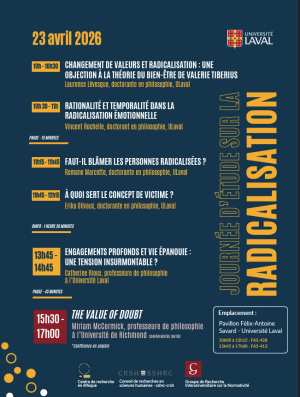
Join us for a study day on radicalization, scheduled for April 23, 2026, from 10:00 a.m. to 5:00 p.m., at the Félix-Antoine Savard Pavilion at Laval University, 2325 rue des Bibliothèques, in Quebec City. This event will feature a presentation by guest speaker Miriam Schleifer McCormick, professor of philosophy at the University of Richmond, titled “The Value of Doubt.”
Schedule:
Morning (room FAS-428)
- 10:00 a.m. – 10:30 a.m.: Laurence Lévesque (PhD student in philosophy, ULaval), “Changement de valeurs et radicalisation : une objection à la théorie du bien-être de Valerie Tiberius”
- 10:30 a.m. – 11:00 a.m.: Vincent Rochelle (PhD student in philosophy, ULaval), “Rationalité et temporalité dans la radicalisation émotionelle”
- 11:00 a.m. – 11:15 a.m.: Break
- 11:15 a.m. – 11:45 a.m.: Romane Marcotte (PhD student in philosophy, ULaval), “Faut-il blâmer les personnes radicalisées ?”
- 11:45 a.m. – 12:15 p.m.: Erika Olivaux (PhD student in philosophy, ULaval), “À quoi sert le concept de victime ?”
Lunch, from 12:15 p.m. to 1:45 p.m.
Afternoon (room FAS-413)
- 1:45 p.m. – 2:45 p.m.: Catherine Rioux (Professor of Philosophy, ULaval), “Engagements profonds et vie épanouie : une tension insurmontable ?”
- 2:45 p.m. – 3:30 p.m.: Break
- 3:30 p.m. – 5:00 p.m.: Miriam Schleifer McCormick (Professor of Philosophy, University of Richmond), “The value of doubt”
*Please note that all presentations will be given in French, with the exception of the keynote speaker’s lecture.
This event is organized by the Centre de recherche en éthique (CRÉ), the Social Sciences and Humanities Research Council (CRSH – SSHRC) and the Groupe de recherche interuniversitaire sur la normativité (GRIN).
-
“Casal on interspecies justice without over-demandingness” @ Room 309 at the CRÉ, hybrid mode
12 h 00 – 13 h 15

As part of the Midis de l’éthique du CRÉ lecture series, Will Gildea will present on “Casal on interspecies justice without over-demandingness.” The presentation will be given in English, but the ensuing discussion can be held in French and/or English.
To participate on Zoom, click here.
Credit : Harmut Kiewert, “Evolution in Revolution“.
-
Philosophy and Ethics of Economics Reading Group @ HEC
12 h 00 – 13 h 30
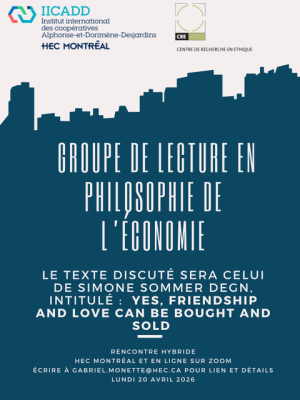
You are cordially invited to the next Philosophy and Ethics of Economics Reading Group, which will be held in hybrid format (Zoom) on Monday, April 20, 2026, from 12:00 p.m. to 1:30 p.m. (Montreal time). The meeting will take place in room 2.880 (space z), 2nd floor at HEC, 3000 Côte Ste-Catherine (in the premises of the Alphonse-et-Dorimène-Desjardins International Institute of Cooperatives at the end of the hallway next to the library).
This session will focus on an article by Simone Sommer Degn entitled “Yes, Friendship and Love Can Be Bought and Sold” (Journal of Applied Philosophy, 2026). To participate via Zoom, click here.
To receive the text, please write to the organizers: Morgane Delorme (morgane.delorme1@umontreal.ca) ; Gabriel Monette (gabriel.monette@hec.ca) ; and Nicolas Pinsonneault (nicolas.pinsonneault@hec.ca).
-
Advising policymakers. Choice and responsibility @ Room C-3061 Carrefour des arts et des sciences, Pavillon Lionel-Groulx, Université de Montréal
16 Apr – 17 Apr All day
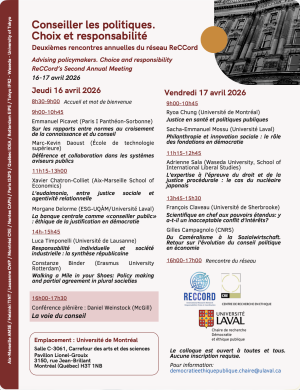
RéCCord’s Second Annual Meeting
Thursday, April 16, 2026
- 8:30 a.m. – 9:00 a.m.: Welcome and opening remarks
- 9:00 a.m. – 10:45 a.m.: Emmanuel Picavet (Paris I Panthéon-Sorbonne), “Sur les rapports entre norms au croisement de la connaissance et du conseil”; Marc-Kevin Daoust (École de technologies supérieur), “Déférence et collaboration dans les systèmes à viseurs publics”
- 11:15 a.m. – 1:00 p.m.: Xavier Chatron-Colliet (Aix-Marseille School of Economics), “L’eudaimonia, entre justice sociale et agentivité relationnelle”; Morgane Delorme (ESG-UQÀM, ULaval), “La banque centrale comme « conseiller public » : éthique de la justification en démocratie”
- 2:00 p.m. – 3:45 p.m.: Luca Timponelli (U. of Lausanne), “Responsabilité individuelle et société industrielle : la synthèse républicaine”; Constanze Binder (Erasmus U. Rotterdam), “Walking a Mile in Your Shoes: Policy-Making and Partial Agreement in Plural Societies”
- 4:00 p.m. – 5:30 p.m.: Keynote speaker, Daniel Weinstock (McGill), “La voie du conseil”
Friday, April 17, 2026
- 9:00 a.m. – 10:45 a.m.: Ryoa Chung (UdeM), “Justice en santé et politiques publiques”; Sacha-Emmanuel Mossu (ULaval), “Philanthropie et innovation sociale : le rôle des fondations en démocratie”
- 11:15 a.m. – 12:45 p.m.: Adrienne Sala (Waseda U., School of International Liberal Studies), “L’expertise à l’épreuve du droit et de la justice procédurale : le cas du nucléaire japonais”
- 1:45 p.m. – 3:30 p.m.: François Claveau (U. of Sherbrooke), “Scientifique en chef aux pouvoirs étendus : y a-t-il un inacceptable conflit d’intérêts?”; Gilles Campagnolo (CNRS), “Du Caméralisme à la Sozialwirtschaft. Retour sur l’évolution du conseil politique en économie”
- 4:00 p.m. – 5:00 p.m.: Network meeting
Open to all. No registration required. To participate via Zoom, click here.
For more information, please send an e-mail to the following address: democratieehiqepublique.chaire@ulaval.ca.
-
Eszter Kollar (KU Leuven) @ University of Montreal
12 h 30 – 14 h 15
 You are cordially invited to the second conference in the Invisible Labour lecture series organized by the Ésope Chair, in collaboration with the Centre de recherche en éthique. For this second event, we are pleased to welcome Eszter Kollar (KU Leuven), who will give a talk entitled “On the Normative Significance of Colonial Legacies for Justice in Labour Migration.” The conference will be held in English.
The event will take place on April 14, 2026, from 12:30 p.m. to 2:15 p.m., in room 422 of the University of Montreal’s Department of Philosophy (2910 Édouard-Montpetit Boulevard, Montreal, QC). Please register via the following link.
Abstract
Colonial systems of labour organization, structured through racial hierarchies and differentiated migration schemes, re-emerge in contemporary labour immigration regimes that differentiate migrants by skills and rights. How this resurfacing should be properly accounted for in normative theorizing, and what its normative implications are, remains insufficiently understood in contemporary political philosophy. This paper aims to address that gap. First, I argue that a historically informed mapping of the structural processes of colonialism and capitalism enables theories of migration justice to capture a previously overlooked dimension of injustice in today’s differentiated labour immigration regimes: namely, that racialization as skill devaluation is a key form of labour control that is reinforced through contemporary border control regimes and their stratified migration systems. Second, I argue that a historically grounded understanding of injustice and labour deepens our normative grasp of what is unjust about contemporary labour migration and border control. It paves the way for rearticulating the normative problem of differentiated skills and rights through borders as a seemingly race-neutral, meritocratic organization of labour that, in fact, perpetuates a global racialized hierarchy. The injustice of differentiated labour migration regimes thus lies not merely in the restriction of migrant workers’ rights that conflict with liberal-democratic principles of social and political equality. Contemporary borders are a crucial site of global structural injustice, whereby present-day labour migration regimes systematically constrain the rights, mobility, and opportunities of racialized workers from the Global South, devalue their labour through border control, and expose them to persistent conditions of exploitation and marginalization.The Lecture Series on Invisible Work is an initiative by Denise Celentano (University of Montreal), holder of the Aesop Chair, in collaboration with the Centre de recherche en éthique.
For more information, please contact Denise Celentano at the following address: denise.celentano@umontreal.ca.
-
CANCELED! Valerio de Stefano (York University) @ University of Montreal
16 h 30 – 18 h 30
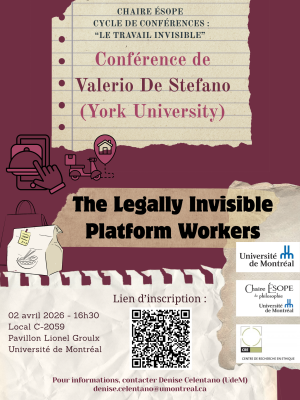
Please, note that this event is canceled.
You are cordially invited to the second conference of the lecture series on invisible labor organized by the Aesop Chair in collaboration with the Centre de recherche en éthique. For this conference, we are pleased to welcome Valerio de Stefano (York University), author of the book Your Boss Is an Algorithm (Bloomsbury Publishing, 2022), with a presentation entitled “The Legally Invisible Platform Workers.”
The event will take place on April 2, 2026, at 4:30 p.m., in room C-2059 of the Lionel Groulx building at the University of Montreal (3150 Jean-Brillant Street, Montreal, QC H3T 1N8). Please register via the following link.
Abstract
Platform workers are increasingly visible in our communities, and their work attracts growing public attention. Yet the law has not fully recognised platform work. Even recent legislation specifically targeting platform work often fails to make it visible and legally salient across the full spectrum of protections. In some cases, it operates as a barrier, placing platform work behind a façade that risks concealing from workers fundamental rights and protections that should belong to all workers. This presentation analyses the legal mechanisms that produce this invisibility and discusses potential solutions to lift the cloak of legal invisibility now affecting platform workers.
The Lecture Series on Invisible Work is an initiative by Denise Celentano (University of Montreal), holder of the Aesop Chair, in collaboration with the Centre de recherche en éthique.
For more information, please contact Denise Celentano at the following address: denise.celentano@umontreal.ca.
General information about the Lecture Series: The concept of invisible work describes the forms of work that fall outside the traditional model of waged employment and are not recognized, in a monetary and/or symbolic sense, to the point that even their nature as “work” is often disputed. Invisible work takes place behind the scenes of more recognized and valued work. Given its liminal nature with respect to long-established categories, it serves as a prism for exploring a number of issues, from recognition to social segregation to the critical questioning of the normative assumptions behind what is supposed to count as “work.” The notion of invisible work promises to shed light, as it were, on the mechanisms of valorization that operate behind social cooperation. This series of lectures, open to the public, explores the subject from both a philosophical and interdisciplinary perspective.
-
Philosophy and Ethics of Economics Reading Group @ HEC
12 h 00 – 13 h 30
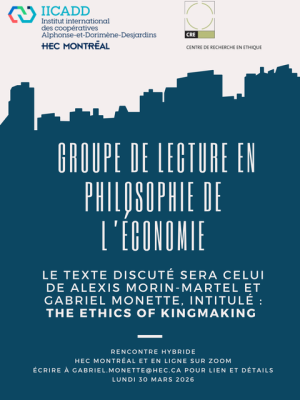
You are cordially invited to the next Philosophy and Ethics of Economics Reading Group, which will be held in hybrid format (Zoom) on Monday, March 30, 2026, from 12:00 p.m. to 1:30 p.m. (Montreal time). The meeting will take place in room 2.880 (space z), 2nd floor at HEC, 3000 Côte Ste-Catherine (in the premises of the Alphonse-et-Dorimène-Desjardins International Institute of Cooperatives at the end of the hallway next to the library).
This session will focus on an article by Gabriel Monette (HEC) and Alexis Morin-Martel (McGill University) entitled “The Ethics of Kingmaking” (Ethical Theory and Moral Practice, 2026). Gabriel and Alexis will present their recently published article and participate in the discussion.
To receive the text, please write to the organizers: Morgane Delorme (morgane.delorme.1@umontreal.ca), Gabriel Monette (gabriel.monette@hec.ca) and Nicolas Pinsonneault (nicolas.pinsonneault@hec.ca).
To participate via Zoom, click here.
-
The Faces of Responsibility @ Law Faculty, Maximilien-Caron Building and Carrefour des arts et des sciences, Université de Montréal
25 Mar 12 h 00 – 27 Mar 16 h 10
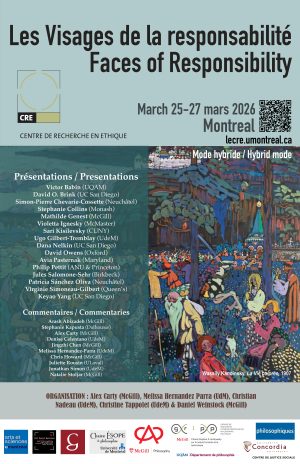
The conference The Faces of Responsibility aims to explore the plurality of forms that responsibility takes in our individual, social, and institutional practices. From an interdisciplinary perspective, bringing together scholars in moral and political philosophy, political science, and legal theory, the objective is to examine the concepts of moral responsibility, political responsibility, and legal responsibility.
The conference will be held in a hybrid format. David Owen’s and Philip Pettit’s presentations will be delivered via Zoom. To attend the conference yourselves by Zoom, you are invited to register here. You will then receive the connection link.
The program (PDF) is available here, and the presentation abstracts are available here.
Organization: Alex Carty (McGill), Melissa Hernandez-Parra (UdeM), Christian Nadeau (UdeM), Christine Tappolet (UdeM) & Daniel Weinstock (McGill).
-
Second Session – CRÉ Graduate Fellows’ Seminar @ Room 309, CRE, hybrid
15 h 00 – 16 h 30

You are invited to the second session of the 2025–2026 edition of the CRÉ Graduate Fellows’ Seminar.
On this occasion, Alexandra Stankovich (UdeS) and Olivier Boucher (UdeM) will present their work. Each presentation will last approximately 20 minutes and will be immediately followed by a discussion of about 25 minutes.
The aim of the Seminar is to provide our graduate fellows with constructive feedback and critical discussion in order to help them strengthen their research projects. It also offers them the opportunity to practise delivering an academic presentation in a format comparable to that of scholarly conferences. We very much hope that many of you will join us for this activity, which we intend to be especially formative.
Both presentations will be in French, but questions may be asked either in French or English.
Program
1) 3:00–3:45 p.m. – Presentation by Olivier Boucher, master degree student in philosophie, working under the supervision of Denise Celentano (UdeM).
Limitarisme et limites planétaires
In my presentation, I would like to develop the central problem that will structure my thesis project, which will examine the relevance of limitarian theory in distributive justice for thinking about ecological issues—and, conversely, the relevance of ecological issues for limitarianism.
Limitarianism is a theory of distributive justice which holds that “in the world as it is, no one should have more than a certain amount of certain goods, such as income or wealth” (Robeyns, 2022; my translation). Two main arguments have been advanced in support of this view. The Democratic Argument (DA) claims that any wealth beyond a certain threshold constitutes a threat to political equality and to the stability of democratic regimes (Robeyns, 2022: 184). The Unmet Urgent Needs Argument (UUNA) maintains that any form of wealth beyond a certain threshold should be taxed in order to meet the urgent needs of a significant portion of humanity (Robeyns, 2022: 184).
Environmental concerns are already incorporated into limitarian arguments, but most often only in a secondary way. Yet it seems to me that the treatment of environmental issues within limitarian theory deserves closer examination, for at least three reasons.
First, recent research in environmental science argues that there are absolute “planetary boundaries” that should not be crossed in the exploitation of natural resources if humanity is to remain within a “safe operating space” (Steffen et al., 2023). Recent work has attempted to show the relevance of limitarian arguments for debates in environmental ethics concerning these planetary boundaries (Green, 2023; Bohnenberger, 2025). It thus seems that research on planetary boundaries could strengthen the UUNA, but also the DA, since the integrity of the biosphere is plausibly a condition of possibility not only for meeting human needs, but also for political equality and democracy (Steffen et al., 2023).
Second, it seems plausible that the establishment of limitarian thresholds is more strictly constrained by ecological considerations than by political or economic ones. Indeed, a limitarian threshold that failed to keep humanity within the biosphere’s “safe operating space” would likely also fail to achieve the aims of either the UUNA or the DA. For the ecosystemic conditions that make current economic and political institutions possible would be undermined (Steffen et al., 2023), thereby compromising the conditions under which urgent needs can be met and political equality preserved—both of which depend on the existence of these basic institutions. Moreover, this consideration could lead to a re-examination of what distinguishes limitarianism from other partial theories of justice, such as sufficientarianism, egalitarianism, and prioritarianism (Timmer, 2021). It may turn out that a limitarian threshold compatible with the ecological constraints of the biosphere would be so low that the distinction between these theories would collapse at the level of operationalization; alternatively, limitarianism might come to subsume the others logically (Hickey, 2019).
Third, and in light of the preceding points, limitarian theory might be reconsidered as a component of an ideal theory of justice, rather than as a component of a non-ideal theory of justice (Robeyns, 2022: 179). As Hickey (2019) suggests, it is plausible that there exists a “pre-institutional” limit to the appropriation of natural resources—that is, an absolute theoretical limit to the exploitation of natural resources that any theory of justice must respect. If so, the relevance of limitarian theses would not only be increased, but limitarian principles should be regarded as relevant not merely in “the world as it is and the closest possible worlds” (Robeyns, 2022: 199; my translation), but also in any world governed by the laws of thermodynamics—that is, in all physically possible worlds (Lee, 1989). Limitarian principles could therefore be integrated into an ideal theory of justice, for instance Rawls’s, as Christian Neuhäuser proposes (2018; 2023).
2) 3:45–4:30 p.m. – Presentation by Alexandra Stankovich, PhD candidate in practical philosophy at the Université de Sherbrooke,, under the supervision of Allison Marchildon (UdeS) and the co-supervision of Jessica Roda (Georgetown).
Expansion des frontières identitaires : dynamiser les orthodoxies juives par la voix de ceux·celles·celleux s’identifiant comme queer d’expérience hassidique
While the presuppositions connecting queerness and Jewish Orthodoxy are often conceived as antithetical, the panorama of embodiment of these identities is both vast and complex (Kabakov, 2010; Stankovich, 2025a). Without framing the discussion in binary terms — inside and outside orthodoxy —, but rather placing it on a spectrum, ranging from traditionally observant circles to the margins, the experience of queer and religious identities does not unfold in the same way in every context. While some use identity tactics to maintain their place in the Orthodox Jewish communities where they grew up, negotiating the terms of self-disclosure in order to fit into a halakhic framework, for others, living a double life becomes too emotionally, morally, and/or practically challenging; when this limit is reached, some make the more radical choice to distance themselves from it (Fader, 2020). However, those who leave these communities do not necessarily reject faith (or religion) but rather construct an alternative that explicitly unites their queerness and their Hasidic heritage (Stankovich, 2025a, 2025b).
Using a field philosophy framework (Briggle, 2015; Frodeman and Briggle, 2016; Vollaire 2016) – combining social science and practical philosophy approaches –, I will explore the intermarginality of queer public figures of Hasidic experience. They embody a specific position between two groups: the liberal, secular New York society and their Hasidic communities (Stankovich, 2025a, 2025b, 2020). I argue that, through their status, these public figures actualize their intermarginality by queering — to different degrees — the norms within the circles they inhabit, since they make them visible and question them (Ahmed, 2008).
More specifically, for this talk, I will focus on how exiters reclaim the term “Hassidic experience” informs us about the fluidity of Orthodox labels. This new form of self-definition contributes to the discursive process through which Jewish identities are experienced (Avishai, 2023) as well as constructed (Gaddi, 2023). By challenging boundaries, these marginal positionalities indicate a desire to reclaim Hasidic practices and beliefs beyond strict and hegemonic institutional definitions in order to (re)define their observance (Fader, 2020; Newfield, 2020a; Roda, 2024, 2022; Stankovich 2025a, 2025b, 2020).
Chair: Ryoa Chung (UdeM).
To attend via Zoom, click here (Meeting ID: 818 6254 4190; Passecode: 9Me2EW).