
Past events
Calendar archives
-
Nuit de la justice, 6th edition: “Ethics and law: a winning combination for justice” @ Cégep du Vieux-Montréal
18 h 00 – 21 h 00

The Centre de recherche en droit public (CRDP) invites you to the 6th edition of La Nuit de la justice, which will focus on “Ethics and law, a winning combination for justice”. The event is organized in collaboration with the Centre de recherche en éthique, the Institut d’éthique appliquée of Université Laval (IDÉA), and the Cégep du Vieux-Montréal.
Two members of the CRÉ will participate in next year’s event: Emmanuelle Marceau, a researcher affiliated with the CRÉ’s flagship theme on the ethics of AI, and Valentina de Maak, a student of the CRÉ working under the supervision of our co-researcher Charles Dupras (Université de Montréal).
The event will take place on March 12, 2026, from 6:00 p.m. to 9:00 p.m., in room A4.82a at the Cégep du Vieux-Montréal, 255 Ontario Street E., Montreal, Quebec. The conference will be followed by a student speech contest (with prizes).
For more information and to register for the event, click here.
-
Study day – “Penser les violences sexuelles comme injustice structurelle” @ Pavillon Lionel-Groulx
9 h 00 – 18 h 00

How can we conceptualize sexual violence in all its diversity and complexity? Moreover, how can we think about it from a philosophical perspective when the concepts available to the discipline struggle to account for the specificity and prevalence of such violence in contemporary societies? While there is a wealth of research and work on sexual violence in various disciplines within the humanities and social sciences (anthropology, sociology, social work, psychotraumatology, sexology, etc.), and although feminist philosophy has been striving since the 1960s to make it a legitimate subject of philosophical inquiry and reflection, it must be acknowledged that philosophy still tends today to ignore what is specific to these forms of violence, when it does not simply evade their existence.
To mark the occasion of the recent publication of Penser les violences sexuelles (La Découverte, 2025) by philosopher and documentary filmmaker Marie Chartron, this study day aims to fill this gap by reflecting on the issue of sexual violence, what it is, and how to combat it. Bringing together researchers from various disciplines in the humanities and social sciences (philosophy, political science, sociology, social work, nursing) and community workers, this study day aims to highlight the plurality and complexity of sexual violence as a social and political phenomenon, and to determine the ethical and political responses that can be brought to bear on it. It also aims to contribute to philosophical reflection on these issues from other disciplines and practices.
The study day will be held on Thursday, March 12, 2026, from 9:00 a.m. to 6:00 p.m., at the Lionel-Groulx Pavilion of the University of Montreal. Registration is required via the following link.
The study day will be followed by a public discussion at the bookstore n’était-ce pas l’été on Friday, March 13, 2026. For more information about the public discussion, click here.
Schedule:
- 8:30 a.m. – 9:00 a.m.: Welcoming participants
- 9:00 a.m. – 10:00 a.m.: Opening lecture by Marie Chartron
- 10:15 a.m. – 12:30 p.m.: Discussion about Penser les violences sexuelles, with Pascale Devette (University of Montréal), Erika Olivaux Marmignon (Laval University) and Mickaëlle Provost (UC Louvain Saint-Louis Bruxelles)
- 12:30 p.m. – 1:30 p.m.: Lunch
- 1:30 p.m. – 3:30 p.m.: (Re)conceptualizing sexual violence, with presentations by Sandrine Ricci (UQAM) – “La culture du viol pour penser la violence sexuelle comme fait social”; Marie-Hélène Desmeules (University of Sherbrooke) – “La définition juridique de l’agression sexuelle comme injustice structurelle”; Audrey Rochon (University of Montréal) – “Mémoires émotionnelles et généalogies du corps-témoin”; and Julie Quynh Nhi Tran (University of Montréal) – “Au croisement des dominations systémiques : reconfigurer le regard sur les violences sexuelles vécues par les communautés racisées”
- 3:45 p.m. – 5:45 p.m.: Ethical and political responses to sexual violence, with presentations by Éléonore Paré (University of Ottawa and University of Amiens) – “Gestes et langages infrapolitiques à partir de l’expérience de la violence sexuelle traumatique”; Mona Gérardin-Laverge (Université de Lausanne)– ““Mon corps c’est mon corps” : de l’éducation à la vie affective, relationnelle et sexuelle en milieu scolaire aux ateliers d’autodéfense pour les mineur·e·s, penser la lutte contre les violences sexuelles à l’intersection du genre et de l’âge”; Tania Turnbull (Université de Montréal) – “Repenser le soin : une perspective infirmière sur les violences sexuelles”; and Noah Benoît, Noä Anckaert, GG (Collectif consenti) – “Regards pratiques sur l’intersectionnalité et son application terrain dans un CALACS”
This discussion is organized in partnership with the Centre de recherche en éthique (CRÉ) and is funded thanks to the generous contributions of the Department of Philosophy of the Université de Montréal, the Société québécoise de philosophie (SPQ), the Groupe de recherche interdisciplinaire en philosophie politique (GRIPP), the Réseau québécois en études féministes (RéQEF), the Centre for Interdisciplinary Research on Citizenship and Minorities (CIRCEM) and the Réseau perspectives féministes (RPF).
*N.B. Mediators will be present on site for the duration of the event. Please note that the event will take place in French.
-
Contemporary Feminist Movements Across Geographies: An International Workshop by Bermal Küçük @ SHIFT Centre, Concordia University
9 h 45 – 17 h 00
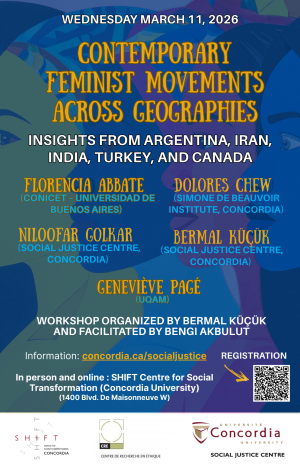
Contemporary Feminist Movements Across Geographies – Insights From Argentina, Iran, India, Turkey, and Canada
This workshop brings together feminist scholars and activists from Argentina, Iran, India, Turkey, and Québec to explore the contemporary landscapes of feminist politics and the resonances that emerge across distinct geopolitical contexts. Through comparative dialogue, the workshop aims to illuminate how feminist movements articulate their agenda, demands, and navigate political constraints in contemporary times.
Speakers:
- Florencia Abbate (Feminist movements in Argentina, CONICET – Universidad de Buenos Aires)
- Dolores Chew (Feminist movements in India, Simone de Beauvoir Institute, Concordia University; History and Humanities, Marianopolis College)
- Geneviève Pagé (Feminist movements in Québec, UQAM)
- Niloofar Golkar (Feminist movements in Iran, Postdoctoral Fellow, Social Justice, Concordia University)
- Bermal Küçük (Feminist movements in Turkey, Postdoctoral Fellow, Social Justice, Concordia University)
The talks will be followed by a commentary by Bengi Akbulut (Associate Professor, Geography, Planning and Environment, Concordia University and Director of the Social Justice Centre).
Organized by Bermal Küçük, Postdoctoral Researcher, Social Justice Center, Concordia University.
This event will be offered in a hybrid format on Zoom. Registration is free and accessible via the following link. Please indicate on the registration form whether you plan to attend the event in person or online.
For those joining in person, there will be snacks and a vegan lunch provided. Please let us know if you have dietary restrictions.
Pour more information, click here.
Organized by Concordia University’s SHIFT Centre for Social Transformation, with the financial support of the Centre de recherche en éthique, the SHIFT Centre and the Simone de Beauvoir Institute.
-

Mattéo Stienlet, a doctoral student in a cotutelle program between Université Laval and Paris 1, will give a presentation entitled “Égalité devant le suffrage, pouvoir électoral et envie”.
Chair: Juliette Roussin.
Abstract
Equality of suffrage is generally invoked to oppose two practices deemed anti-democratic: plural voting, which consists in weighting citizens’ votes differently, and inequalities of representation resulting from the use of electoral districts of very unequal sizes. By contrast, it is more difficult to provide a positive definition capable of identifying precisely the resource that must be distributed equally in order for equality of suffrage to be realized.
In a recent article entitled “One Person, One Vote” (2025), Daniel Wodak has shown that the solutions proposed by egalitarian philosophers fail insofar as they do not succeed in normatively grounding the rejection of all forms of plural voting and of significant representational inequalities, particularly when these practices occur randomly.
This presentation proposes to conceive of equality of suffrage as a norm of fair distribution of power, which requires that electoral districting and vote weighting be such that no voter envies the resources that democratic institutions allocate to others. After presenting this conception in detail, I argue that it can be justified on egalitarian premises and that it helps explain both why plural voting is unconditionally anti-democratic and under what conditions certain inequalities of representation may be permissible.
Biographical Note
Mattéo is a PhD candidate in political philosophy, completing a joint doctorate between Université Laval and Université Paris 1 Panthéon-Sorbonne under the supervision of Juliette Roussin and Magali Bessonne. His dissertation examines the relationship between political equality and representation in contemporary democracies, focusing on the normative issues raised by the delineation of electoral districts.
He holds a Master’s degree in political philosophy from Université Paris 1 Panthéon-Sorbonne and has previously worked on epistemic justifications of democracy. His main research interests include contemporary theories of political egalitarianism and democracy, as well as the relationship between political philosophy and the social sciences. matteo.stienlet.1@ulaval.ca
Hybrid format
To participate via Zoom, click here (Meeting ID: 851 2545 8884; Passcode: 9Me2EW).
-
Philosophy and Ethics of Economics Reading Group @ HEC
12 h 00 – 13 h 30

We are pleased to invite you to the philosophy and ethics of economics reading group, which will be held in a hybrid format (Zoom) on Monday, March 2, 2026, from 12:00 p.m. to 1:30 p.m. (Montreal time). The meeting will take place in room 2.880 (space z), 2nd floor at HEC, 3000 Côte Ste-Catherine (in the premises of the Alphonse-et-Dorimène-Desjardins International Institute of Cooperatives at the end of the hallway next to the library).
This session will focus on Anna Bartsch‘s text entitled “Where Is My Cut? Justifying Resale Rights”, published in 2025 in the Journal of Applied Philosophy. You can access the article via the following link.
To participate via Zoom, click here.
Organized by Morgane Delorme, Gabriel Monette and Nicolas Pinsonneault.
-
Mirjam Mueller (University of Glasgow) @ University of Montreal
16 h 30 – 16 h 45

You are cordially invited to the first conference of the lecture series on invisible labor organized by the Aesop Chair in collaboration with the Research Centre on Ethics. For this first conference, we are pleased to welcome Mirjam Müller (University of Glasgow) with a presentation entitled “(Un)free Care: A Normative Account of the Care Crisis.”
The event will take place on February 26 at 4:30 p.m. in room C-2059 of the Lionel Groulx building at the University of Montreal (3150 Jean-Brillant Street, Montreal, QC H3T 1N8). Please register via the following link.
The Lecture Series on Invisible Work is an initiative by Denise Celentano (University of Montreal), holder of the Aesop Chair, in collaboration with the Research Centre on Ethics.
For more information, please contact Denise Celentano at the following address: denise.celentano@umontreal.ca.
General information about the Lecture Series: The concept of invisible work describes the forms of work that fall outside the traditional model of waged employment and are not recognized, in a monetary and/or symbolic sense, to the point that even their nature as “work” is often disputed. Invisible work takes place behind the scenes of more recognized and valued work. Given its liminal nature with respect to long-established categories, it serves as a prism for exploring a number of issues, from recognition to social segregation to the critical questioning of the normative assumptions behind what is supposed to count as “work.” The notion of invisible work promises to shed light, as it were, on the mechanisms of valorization that operate behind social cooperation. This series of lectures, open to the public, explores the subject from both a philosophical and interdisciplinary perspective.
-

Science outreach activity in collaboration with BistroBrain
Three students from the CRÉ will engage in science outreach and communication exercise and present their current work at the Île Noire pub on February 25, 2026, as part of a collaboration between the CRÉ and BistroBrain. The theme of the evening will be “Between Justice and Prejudice.”
Below is a summary of the ethical issue and public appeal of each presentation.
Mathilde Genest: “Les survivantes d’agression sexuelle à la barre”

Les survivantes d’agressions sexuelles subissent diverses injustices lors d’un procès pour agression sexuelle. Les mythes sur le viol et les stéréotypes associés aux victimes génèrent de fausses attentes concernant leur comportement et produisent des injustices épistémiques. La crédibilité du témoignage des survivantes dépend notamment de leur conformité aux comportements attendus (McKimmie et al., 2020 ; Nitschke et al., 2019). Par ailleurs, le système judiciaire ne protège pas suffisamment les survivantes et peut leur nuire en limitant leur autonomie et en permettant la revictimisation. Les avocats de la défense ont tendance à se concentrer sur la survivante, son comportement et son identité, particulièrement lors du contre-interrogatoire, afin de transférer la responsabilité de l’accusé sur elle (Craig, 2018 ; McGlynn, 2017). De nombreuses injustices vécues par les survivantes sont liées à leurs réactions au traumatisme pendant et après l’agression sexuelle. Les neurosciences offrent une compréhension approfondie du traumatisme et permettent d’expliquer des comportements souvent mal compris, tels que la réaction de paralysie ou des souvenirs fragmentaires (Haskell & Randall, 2019). Ces connaissances peuvent donc être mobilisées lors des procès pour soutenir les survivantes, notamment par la sensibilisation des jurés et l’adoption de pratiques tenant compte du traumatisme. Je soutiens que les connaissances neuroscientifiques sur le traumatisme devraient être intégrées aux procédures judiciaires afin de remédier aux injustices subies par les survivantes. En parallèle, j’ai développé un cadre bioéthique féministe et centré sur les victimes, qui met l’accent sur leur santé et leur bien-être sans compromettre l’équité du système judiciaire.
Les agressions sexuelles constituent un problème social important, mis en lumière par des mouvements comme #MeToo, auquel le système judiciaire peine encore à répondre adéquatement. Au Canada, une femme sur trois est victime d’agression sexuelle, et pourtant, seules 5 à 6 % des agressions sont signalées à la police (Canadian Women’s Foundation, 2022 ; Lachapelle, 2024). Parmi celles-ci, une infime minorité mène à un verdict de culpabilité, et seuls deux ou trois agresseurs sont incarcérés sur 1 000 agressions. Ces chiffres soulèvent une question fondamentale : pourquoi le système échoue-t-il si souvent à rendre justice aux survivantes? Ma présentation intéressera le public parce qu’elle propose des outils pour mieux comprendre cet échec, en reliant des données empiriques à une analyse philosophique accessible. J’explique comment les mythes sur le viol, les stéréotypes de genre et une méconnaissance du traumatisme influencent la manière dont les survivantes sont perçues et traitées en cour, affectant directement leur crédibilité. En mobilisant les neurosciences du traumatisme, je montre comment certaines réactions des survivantes, souvent mal interprétées, peuvent être mieux comprises et prises en compte. Bien que cette recherche soit principalement menée et publiée en anglais, il est particulièrement pertinent de la vulgariser en français afin de la rendre accessible au public québécois, directement concerné par ces enjeux sociaux et institutionnels. Cette présentation vise ainsi à traduire des réflexions philosophiques complexes dans un langage clair et ancré dans le contexte local, tout en contribuant à une meilleure compréhension et mobilisation citoyenne sur ces enjeux.
Alexis Boivin: “Protester contre les enfantillages des adultes”

Considéré comme la plus grande manifestation de rue de l’histoire des mouvements sociaux chez les jeunes, Fridays for Future a mobilisé plus de 1,5 million de personnes à travers le monde. En enfreignant la loi de la présence obligatoire en classe chez les élèves, ce mouvement a lancé une avenue de recherche intéressante en philosophie politique : la désobéissance civile chez les enfants. Cependant, peu de littérature aborde cette question, malgré l’importance des jeunes dans des mouvements sociaux de grande envergure. Cet angle mort peut s’expliquer par la négligence ou même le refus de l’agentivité politique des enfants : ces derniers sont exclus du droit de vote et sont relégués dans l’espace privé, incapables d’agir politiquement ou de participer à l’exercice commun du pouvoir politique. En effet, peut-on reconnaître des actes de désobéissance civile chez une population qui n’est pas considérée comme ayant une agentivité politique? Si oui, est-ce que ces actes peuvent être justifiés? Je défendrai la thèse suivante: non seulement les enfants devraient être reconnus comme des agents politiques, mais aussi qu’ils peuvent recourir à la désobéissance civile de manière justifiée. J’aborderai le refus de leur agentivité politique au travers du cas d’Elizabeth Eckford, une élève de 15 ans lors du mouvement des droits civiques aux États-Unis. Ensuite, je ferai un parallèle entre les caractéristiques du mouvement Fridays for Future et celles de la désobéissance civile, et j’établirai une justification de la désobéissance civile avec l’aide de l’argument de l’exclusion de Mattheis (2022).
Le blocage du pont Jacques-Cartier en 2024 et du terminal pétrolier à Montréal-Est en 2022 (ce dernier ayant mené à la condamnation des activistes écologistes impliquées) sont deux exemples parmi d’autres de désobéissance civile qui ont occupé l’actualité québécoise ces dernières années. Ainsi, le terme « désobéissance civile » n’est pas étranger au public et ne le laisse pas indifférent, mais peut parfois être mécompris. Concernant la désobéissance civile spécifiquement menée par des enfants, cela demeure un sujet assez peu discuté, bien que Emmanuelle Dufour et Francis Dupuis-Déri (2025) aient récemment fait paraître une bande dessinée sur les révoltes menées par des élèves du monde entier. La présentation se situe en continuité de cet ouvrage et pourrait donc rejoindre ce lectorat. Au-delà de cette nouvelle parution, la désobéissance civile chez les enfants reste un sujet soit intriguant (pour les personnes adultes qui veulent en connaître davantage), nostalgique (pour les personnes ayant manifesté avant d’avoir le droit de vote), ou confrontant (chez celles qui doutent de l’agentivité politique des enfants). Enfin, les enfants demeurent très souvent un angle mort à tout sujet discuté. Pour reprendre une image de soupers de famille, il y a la table des adultes et celle des enfants, sans toutefois que les deux puissent se communiquer pleinement. Cette présentation offrira donc l’occasion d’accorder une place à ces derniers, même si nous nous trouvons dans un bar!
Georges Lupwana Ngamasana: “Punir les victimes ? Repenser la justice sociale”
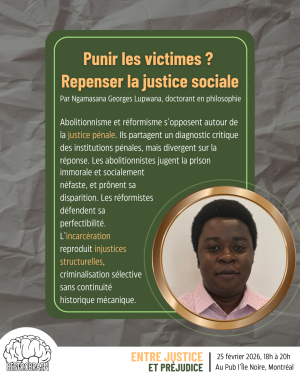
La justice pénale, fondée sur l’idée du mérite de la peine, constitue le cadre de débats théoriques structurés principalement autour de deux orientations opposées : l’abolitionnisme et le réformisme. Ces deux perspectives partagent un diagnostic critique des institutions pénales, mais divergent profondément quant aux réponses normatives à envisager. Les abolitionnistes font de la prison une cible centrale de leur position. Ils la considèrent comme immorale et socialement néfaste parce qu’elle inflige des préjudices graves et durables aux individus sous couvert de prévenir, contrôler et punir la criminalité. Ils appellent de ce fait à la rendre obsolète (Davis 2014). À l’inverse, tout en prenant au sérieux les arguments abolitionnistes, souvent étayés par des données empiriques solides (Shelby 2022), les réformistes défendent la thèse de la perfectibilité des institutions pénales. Ils soutiennent que des réformes profondes peuvent corriger leurs dérives sans nécessité leur suppression. Cette option est toutefois rejetée par les abolitionnistes. Selon eux, on ne peut maintenir des institutions dont les réformes même les plus ambitieuses échouent à produire des transformations substantielles. Je fais valoir l’idée qu’en essentialisant la peine carcérale comme réponse au crime, la justice est particulièrement vulnérable aux injustices structurelles, notamment à travers une criminalisation sélective et une distribution inégale des sanctions. Elle les reproduit par des mécanismes de tri social, les biais et stéréotypes sociaux ancrés dans le fonctionnement de ses institutions. Il ne s’agit toutefois ni d’une simple répétition mécanique du passé dans le présent, ni d’une stricte continuité entre des institutions appartenant à des époques différentes.
Le regain d’intérêt que connaît l’abolitionnisme carcéral invite à repenser la justice non comme une simple réponse au crime, mais comme un processus social visant à réparer les causes structurelles des préjudices. Cette réflexion révèle un paradoxe : des institutions supposées rendre justice engendrent des préjudices structurels supplémentaires, souvent inégalement distribués. Elle invite à comprendre que les injustices structurelles reproduites par les prisons actuelles ne relèvent pas de défaillances contingentes, mais d’un mode de fonctionnement enraciné dans l’histoire. Il ne s’agit ni d’une simple répétition mécanique du passé esclavagiste ou colonial, ni d’une continuité institutionnelle directe, mais d’une transformation des logiques de domination, de stigmatisation et de contrôle social dans des contextes nouveaux. L’injustice peut être intentionnelle en ce sens que, par le complexe industriel carcéral (Davis 2014), certains ont intérêt à ce que ces formes de gestion des populations vulnérables perdurent. Mais l’injustice devient autonome – structurelle – lorsqu’elle ne dépend plus des efforts des agents facilement identifiables pour se maintenir. Ainsi, les fonctions et services revendiqués par la prison – et avec elle la police – ne compensent pas les torts qu’elles causent (Charbit et Gwenola 2024). Je considère que l’abolitionnisme ne peut être une simple entreprise négative d’abolition immédiate et inconditionnelle des institutions pénales. Je suggère de l’appréhender comme un processus de transformation orienté vers une justice véritablement réparatrice et émancipatrice. Son succès mérite d’être accompagné d’une mission constructive (Fryer, 2023) visant à proposer des institutions alternatives. Cette double dimension — critique et constructive — est décisive pour sa cohérence.
Everyone is welcome!
*Please note that the event will take place in French.
-
Citoyenneté et maladie – Une investigation conceptuelle, normative et empirique @ Room M5389, Université de Genève
14 h 15 – 18 h 00
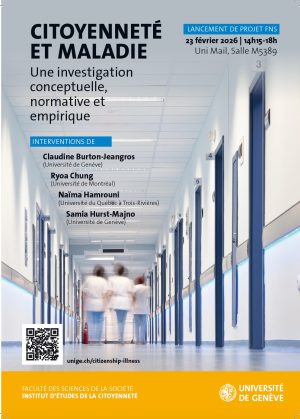
Naïma Hamrouni (UQTR), Sami Hurst-Majno (University of Geneva), and Ryoa Chung (Université de Montréal) are taking part in a roundtable organized by Yoann Della Croce at the University of Geneva.
-
Workshop of the axis Environmental & animal Ethics @ Room 223, 2nd floor
13 h 00 – 17 h 00

Members of the Environmental and animal ethics axis as well as other members of the CRÉ interested in questions around environmental and/or animal ethics are warmly invited to attend this first annual workshop. The purpose of the meeting is for members to update each on other on their current and future research plans, to identify and discuss opportunities for collaboration.
Schedule:
1-2:30 pm: Introductions – Each participant is invited to give a brief overview of their current research projects as well as future research plans and interests (5 mins per participants)
2:30-3:15 pm: Brainstorming session 1 – Discussion about possible collaborations in two large groups (group 1: environmental ethics, group 2: animal ethics)
15 min break
3:30-4 pm: Brainstorming session 2 – 30 mins discussion in smaller groups
4-4:30 pm: Brainstorming session 3 – 30 mins discussion in smaller groups
4:30–5 pm: Wrapping up and consolidating plans
5 pm: Close – informal drinks nearby for those interested
-
“A Consideration of Life Transitions: the Case of Alienation from Hegemonic Cultural Tools” @ Room 309, CRE - hybrid mode
12 h 00 – 13 h 15

As part of CRÉ’s Midis de l’éthique series, guest researcher Stephanie Kapusta (Dalhousie University) will present a paper titled “A Consideration of Life Transitions: the Case of Alienation from Hegemonic Cultural Tools”.
More details to follow.
To participate via Zoom, click here.
-
Philosophy and Ethics of Economics Reading Group @ HEC
12 h 00 – 13 h 30

We are pleased to invite you to the philosophy and ethics of economics reading group, which will be held in a hybrid format (Zoom) on Monday, February 16, 2026, from 12:00 p.m. to 1:30 p.m. (Montreal time). The meeting will take place in room 2.880 (space z), 2nd floor at HEC, 3000 Côte Ste-Catherine (in the premises of the Alphonse-et-Dorimène-Desjardins International Institute of Cooperatives at the end of the hallway next to the library).
This session will focus on Kirun Sankaran‘s article entitled “Cash rules everything around me: in defence of housing markets”, published in 2025 in the journal Economics and Philosophy. You can find the article via the following link.
To participate via Zoom, click here.
Organized by Morgane Delorme, Gabriel Monette and Nicolas Pinsonneault.
-
GRIN Lecture – Emanuela Carta (Graz University of Technology, KU Leuven) @ Université de Montréal
10 h 00 – 12 h 00

As part of the GRIN workshops, you are invited to attend a lecture by Emanuela Carta (Graz University of Technology, KU Leuven) entitled “Rethinking Consent as Affective Approval”. The lecture will take place on February 13, 2026, from 10:00 a.m. to 12:00 p.m., in room 422 of Department of Philosophy at the Université de Montréal, located at 2910 Édouard-Montpetit Boulevard, Montreal, Quebec.
The conference will also be broadcast on Zoom via the following link (meeting ID: 266 439 5811; passcode: 454185).
Summary
-

2025–2026 edition of the Annual Meeting of the CRÉ’s Fundamental Ethics axis, directed by Natalie Stoljar (McGill) and Mauro Rossi (UQAM).
This first edition of the annual workshop will take place at McGill. The program will feature six presentations by co-researchers affiliated with the axis!
The axial meetings are organized with the aim of enabling members of each of the Centre’s five main research axes to become better acquainted with their colleagues’ work, to foster a sense of belonging to the Centre, and to encourage collaboration. While these meetings are primarily intended to bring together the co-researchers of a given axis, collaborators, affiliated researchers, and student or postdoctoral members of the axis are also welcome. Participation by members of other axes is likewise encouraged, particularly where their research interests overlap with those of members of the Fundamental Ethics axis.
Program
Note that the morning and afternoon sessions will be held in different rooms.
Morning session: School of Population and Global Health, 2001 McGill College, Room
1140
9.30am-10.20am: Stephanie Leary (McGill) – “What should we be doing when we’re doing metaethics?”
10.30am-11.20am: Arturs Logins (ULaval) – “The expected fittingness maximization theory of emotional rationality”
Lunch break
Afternoon session: Philosophy Department Seminar Room, Leacock Building, Room 927
1.00pm-1.50pm: Catherine Rioux (ULaval) – “Engaging Ethically With Fundamental Despair”
2.00pm-2.50pm: Iwao Hirose (McGill) – “Minimally good life and time”
Break
3.10pm-4.00pm: Chris Howard (McGill) – “Decentralizing the Digital Public Sphere”
4.10pm-5.00pm: Christine Tappolet (UdeM) – “Embracing Affective Ambivalence”
-
La démocratie et l’état de droit. À l’épreuve du projet de constitution du Québec @ UQÀM
9 h 00 – 17 h 30

A Day of Reflection: “La démocratie et l’état de droit. À l’épreuve du projet de constitution du Québec”*
In light of the proliferation of legislative and political initiatives that undermine rights and freedoms, both in Quebec and internationally, this event offers a day of reflection and discussion on contemporary transformations of the rule of law and democracy. Drawing on the CAQ government’s draft constitution and other recent initiatives in Quebec, the event aims to provide a better understanding of the scope and effects of the reforms underway and to open up discussion on the democratic conditions necessary for defining how we live together.
The day will take the form of a structured exchange divided into three main thematic sessions.
1. The devitalization of the rule of law: contrasting perspectives on a global phenomenon
This first session will place Quebec debates in an international context marked by a widespread weakening of mechanisms for protecting rights and limiting political power. Presentations will focus on transformations in the rule of law, the normalization of violations of fundamental rights, and strategies for circumventing institutional checks and balances. The goal is to better understand what is changing, how these changes are taking place, and what their consequences are for contemporary democratic regimes.
2. Rights and freedoms under pressure: Bill 1 and recent legislative initiatives
This session will focus on the Quebec context. It will analyze Quebec’s draft constitution (Bill 1) in light of a broader set of laws and public policies adopted in recent years that are helping to redefine the balance of powers and the system for protecting rights and freedoms in Quebec. For example, it will address laws affecting union rights, secularism, language, gender equality, and the normalization of the use of the notwithstanding clause.
3. Revaluing democracy and the rule of law: participation, inclusion, and recognition
The final session will broaden the discussion to democratic issues raised by political transformations currently underway. It will focus on the conditions for an inclusive constitutional process with strong democratic legitimacy, the concept of political community and “we” in recent government initiatives, and the importance of co-construction with Indigenous peoples in defining how we live together in Quebec.
This event is organized by the Centre de recherche sur la diversité et la démocratie au Québec in collaboration with the Centre de recherche en éthique, Amnistie internationale, the Barreau du Québec, Conseil de la Nation Atikamekw, the Fédération des femmes du Québec, the Ligue des droits et libertés, and the Observatoire pour la justice migrante.
Organized by Karine Millaire (UdeM), Martin Papillon and Christian Nadeau (UdeM). With the participation of Louis-Philippe Lampron, Daniel Weinstock (McGill), Dominique Leydet (UQÀM), Dia Dabby and Lucie Lamarche.
*Please note that the event will take place in French.

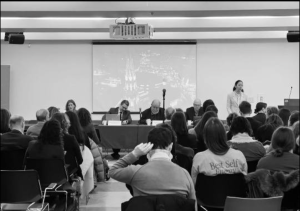
Photos by Ryoa Chung (UdeM) and Ximena Samson.
-
Montreal PhD and Early Career Workshop in Normative Political Philosophy @ Centre de recherche en éthique
9 h 00 – 17 h 30

Join us for the Montreal PhD and early career workshop in normative political philosophy, which will be held February 5, 2026, from 9:00 a.m. to 5:30 p.m., in room 309 of the Centre de recherche en éthique, located at 2910 Édouard-Montpetit Boulevard, Montréal, Québec.
This workshop will provide an opportunity for early career researchers to share their research in a friendly and informal setting, expand their research network, and get feedback on ongoing projects. The workshop will be pre-read and is scheduled to take place in person.
Schedule:
- 9:30 a.m. – 9:45 a.m.: Opening remarks
- 9:45 a.m. – 10:30 a.m.: Kyuree Kim (McGill, CRE), Theorizing the dynamics of structural processes in structural injustice and domination
- 10:30 a.m. – 11:15 a.m.: Alexis Bibeau-Gagnon (McGill), Clashing with the State: Violent Protests, Police, and Self-defense
- 11:45 a.m. – 12:30 p.m.: Grégoire René (McGill), The Metaphysics of Gender Archetypes
- 12:30 p.m. – 1:15 p.m.: Sabrina Bungash (McGill), On the Porn Debate: Reconsidering the Question of Rights
- 1:15 p.m. – 2:00 p.m.: Lunch
- 2:00 p.m. – 2:45 p.m.: Anna Milioni (CRE, UdeM), The right to emigrate and the duty to support just institutions
- 2:45 p.m. – 3:30 p.m.: Alexandre Petitclerc (UdeM, CRE), Theories of Justice and Social Rights: A Normative Dead End
- 3:30 p.m. – 4:00 p.m.: Coffee break
- 4:00 p.m. – 4:45 p.m.: Will Gildea (CRE, McGill), Justice, Animals, and the Earth We Inhabit: Casal’s Theory of Interspecies Justice
- 4:45 p.m. – 5:30 p.m.: Ellena Thibaud-Latour (UdeM), A social understanding of indifference
To register, please contact the organizers, Anna Milioni and Alexandre Petitclerc.
-
First Session – CRÉ Graduate Fellows’ Seminar @ Room 309, CRÉ, hybrid
15 h 00 – 16 h 30

You are invited to the first session of the 2025–2026 edition of the CRÉ Graduate Fellows’ Seminar.
On this occasion, Melissa Hernandez-Parra and Vincent Rochelle will present their work. Each presentation will last approximately 20 minutes and will be immediately followed by a discussion of about 25 minutes.
The aim of the Seminar is to provide our graduate fellows with constructive feedback and critical discussion in order to help them strengthen their research projects. It also offers them the opportunity to practise delivering an academic presentation in a format comparable to that of scholarly conferences. We very much hope that many of you will join us for this activity, which we intend to be especially formative.
Both presentations will be in French, but questions may be asked either in French or English.
Program
1) 3:00–3:45 p.m. – Presentation by Melissa Hernandez-Parra, PhD candidate in Philosophy at the Université de Montréal, under the supervision of Christine Tappolet.
En défense du relativisme modéré des attributions de responsabilité
This presentation is part of a research project devoted to the variability of moral and legal responsibility attributions and their normative implications. Starting from the observation that our responsibility-attribution practices vary significantly across social, cultural, and institutional contexts, the project questions the idea that there are unique and universal criteria for determining, independently of practice, who is responsible and under what conditions.
In the first part, I present the relativist argument from genuine disagreement. According to this argument, the persistence of deep and rationally intractable disagreements about the conditions of responsibility provides reason to doubt a strict normative objectivism regarding responsibility. I then examine several classic objections to this position, including the risk of scepticism and the difficulty of accounting for moral critique and moral progress.
In the second part, I defend a pluralist response to these objections. I argue that responsibility attributions can be objectively justified within plural normative frameworks structured by distinct values and aims. This pluralism makes it possible to acknowledge genuine disagreement while preserving a form of normative objectivity tied to the function of moral responsibility, as well as the possibility of critique across frameworks. The goal is thus to propose an account of responsibility attributions that is sensitive to the diversity of practices without abandoning the idea of a shared criterion of responsibility attribution across different social groups.
2) 3:45–4:30 p.m. – Presentation by Vincent Rochelle, PhD candidate in Philosophy at Université Laval, under the supervision of Catherine Rioux. Vincent will present via Zoom (link below).
Penser une théorie cohérente des sentiments existentiels
Theories appealing to existential feelings have flourished since Matthew Ratcliffe (2008) introduced this class of mental states, described as pre-intentional feelings of the subject’s relation to the world (Ratcliffe 2009, 2012, 2018). These states make it possible to name everyday affective experiences that lack specific objects and that the philosophy of emotions typically relegates to mere figures of speech (feeling disconnected, overwhelmed, in harmony with the world, alive, etc.), while also allowing for a more accurate description of the phenomenology of psychopathological states (such as loss of motivation in depression or feelings of unreality in schizophrenia). They also provide a way of theorizing affective states more fundamental than standard emotions, such as basal hope (Calhoun 2018; Milona and Stockdale 2018), which may function as a condition of possibility for particular hopes. One can also anticipate potential implications for other affective states—such as deep boredom or certain forms of anxiety—that the philosophy of emotions has so far struggled to adequately capture (Elpidorou and Freeman 2019).
These new applications of existential feelings regularly criticize theoretical shortcomings in Ratcliffe’s original account (Saarinen 2018; Fitzpatrick 2023), in particular his appeal to the category of the pre-intentional. These divergences have prevented the development of a coherent and unified theory of existential feelings that would genuinely articulate the various intuitions put forward by different authors.
I propose an alternative conception of existential feelings, departing from Ratcliffe’s account, whose aim is to establish coherent definitional criteria and to unify these theories. The central claim is that existential feelings are indeed intentional, but that they possess objects that differ markedly from those of emotions. I argue that the objects of existential feelings are the states of possibility faced by an agent, and that these feelings are individuated by the modal—rather than evaluative—properties they represent. On this view, existential feelings provide a necessary (though not sufficient) cognitive basis for emotions of uncertainty and for their motivational character. Finally, I describe four existential feelings that appear to account for the phenomena discussed by the various authors.
Chair: Ryoa Chung (UdeM)
To attend via Zoom, click here (Meeting ID: 818 6254 4190; Passcode: 9Me2EW).
-
We are pleased to invite you to the philosophy and ethics of economics reading group, which will be held in a hybrid format (Zoom) on Monday, February 2, 2026, from 12:00 p.m. to 1:30 p.m. (Montreal time). The meeting will take place in room 2.880 (space z), 2nd floor at HEC, 3000 Côte Ste-Catherine (in the premises of the Alphonse-et-Dorimène-Desjardins International Institute of Cooperatives at the end of the hallway next to the library).
This session will focus on Kristoffer Berg‘s article entitled “Why Taxes Need Not Treat Equals Equally”, published in 2024 in the Erasmus Journal for Philosophy and Economics. You can find the article via the following link.
To participate via Zoom, click here.
Organized by Morgane Delorme, Gabriel Monette and Nicolas Pinsonneault.
-
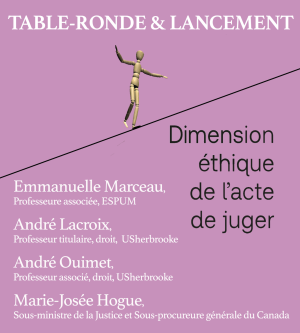
As part of the launch of the book Dimension éthique de l’acte de juger (Éditions Yvon Blais, 2026), co-authored by Emmanuelle Marceau (University of Montreal) and André Lacroix, the Centre de recherche en droit public (CRDP), in collaboration with the Centre de recherche en éthique (CRÉ) and the Institut d’éthique appliquée de l’Université Laval (IDÉA), is organizing a round table discussion on the values that drive judges’ decisions.
Moderated by Nicolas Vermeys, this roundtable discussion will bring together the authors of the book, as well as André Ouimet, associate professor at the Faculty of Law of the University of Sherbrooke, and Marie-Josée Hogue, Deputy Minister of Justice and Deputy Attorney General of Canada.
The event will take place on January 28, 2026, at 4:30 p.m., in room A-3421 of the Maximilien-Caron building at the University of Montreal, in Montreal, Quebec.
A wine reception will follow the roundtable discussion. Copies of the book will be available for purchase.
To register, click here.
-

As part of the CRÉ Lunch Talks, our guest researcher Bob Fischer (Texas State University) will give a presentation entitled “Pricing Suffering.”
To join via Zoom, click here.
-
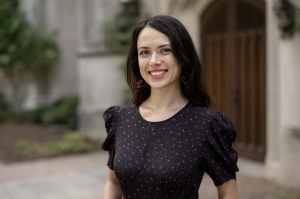
Elvira Basevich (University of California, Davis) will give a presentation entitled “W.E.B. Du Bois on Worker Domination: On Black Chattel Slavery, Wage Slavery, and Second Slavery” as part of the activities of the Philosophy of Work Network.
The activities of the Philosophy of Work Network are open to researchers and graduate students with research interests in this area. Please write to the organizers, Denise Celentano (denise.celentano@umontreal.ca) and Pablo Gilabert (pablo.gilabert@concordia.ca), to receive the zoom link.
Abstract
This talk defends the neglected concept of “second slavery” in W.E.B. Du Bois’s critique of Reconstruction and capitalist political economies in the late 19th- and 20th-century. It proceeds in four steps. First, it distinguishes the concept of black chattel slavery from wage slavery and, second, presents the normative core of Du Bois’s account of black chattel slavery. Next, it illuminates the afterlife of slavery by systematizing Du Bois’s remarks about a “second slavery” that persisted after legal abolition. It defends the following key features of second slavery, which disproportionately target nonwhite laborers alone: the loss of equal public standing as rights-bearers, resulting in insecure labor rights, and the racial division of labor. Lastly, it concludes by considering the implications of the abolition of second slavery today for building an interracial labor movement.