Évènements passés

Archives du calendrier

  • Annual Transatlantic Workshop in Practical Philosophy @ Mode hybride. Carrefour des arts et des sciences, Pavillon Lionel-Grouls, salle C-2059

    28 Avr – 29 Avr Jour entier

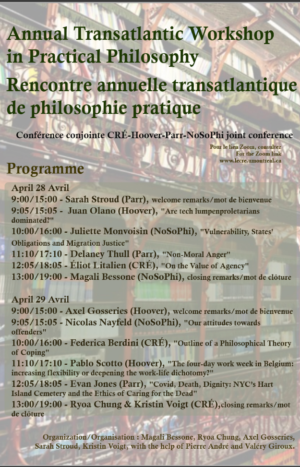
    Annual Transatlantic Workshop in Practical Philosophy

    Rencontre transatlantique annuelle de philosophie pratique

    CRÉ-Hoover-Parr-NoSoPhi joint conference

    April 28-29, 2022

    Pour y participer par Zoom, c’est ici.

    Day 1: April 28 
    Time (EST)  Time (CET)  Program 
    9:00 15:00 Welcome remarks – Sarah Stroud (Parr)
    9:05  15:05  Juan Olano (Chaire Hoover), « Are tech lumpenproletarians dominated? »
    9:30 15:30 Discussion
    10:00  16:00  Juliette Monvoisin (NoSoPhi), « Vulnerability, States’ Obligations and Migration Justice »
    10:25 16:25 Discussion
    10:55 16:55 Break
    11:10  17:10  Delaney Thull (Parr), “Non-Moral Anger”
    11:35 17:35 Discussion
    12:05  18:05  Éliot Litalien (CRÉ), “On the Value of Agency”
    12:30 18:30 Discussion
    13:00 19:00 Closing remarks – Magali Bessone (NoSoPhi)
    Day 2: April 29 
    Time (EST) Time (CET) Program
    9:00 15:00 Welcome remarks – Axel Gosseries (Chaire Hoover)
    9:05 15:05 Nicolas Nayfeld (NoSoPhi), « Our attitudes towards offenders »
    9:30 15:30 Discussion
    10:00 16:00  Federica Berdini (CRÉ), « Outline of a Philosophical Theory of Coping ».
    10:25 16:25 Discussion
    10:55 16:55 Break
    11:10 17:10 Pablo Scotto (Chaire Hoover), »The four-day work week in Belgium: increasing flexibility or deepening the work/life dichotomy? »
    11:35 17:35 Discussion
    12:05  18:05 Evan Jones (Parr), “Covid, Death, Dignity: NYC’s Hart Island Cemetery and the Ethics of Caring for the Dead”
    12:30 18:30 Discussion
    13:00 19:00 Closing remarks – Ryoa Chung & Kristin Voigt (CRÉ)


    Organization : Magali Bessone, Ryoa Chung, Axel Gosseries, Sarah Stroud, Kristin Voigt, with the help of Pierre André and Valéry Giroux.

    Lire la suite

  • The theoretical and practical relevance of feminist perspectives in international relations studies @ Mode hybride. Salle C-1017-02 Carrefour des arts et des sciences et Zoom.

    10 h 30 – 12 h 00

    Échange sur les perspectives féministes en relations internationales entre Toni Haastrup (U. of Stirling) and Maïka Sondarjee (U. Ottawa), co-organisé par le CÉRIUM et le CRÉ.

    Mode hybride: Salle C-1017-02 du Carrefour des arts et des sciences et par Zoom.

    Co-organisé par le CRÉ, le CÉRIUM, le Réseau Perspectives Féministes et le Centre Jean Monnet.

    Biographies

    Maïka Sondarjee is an assistant professor at the School of International Development and Global Studies, at the University of Ottawa. She was previously a Banting Postdoctoral Fellow in political science at the University of Montreal. Her first book, Perdre le Sud. Décoloniser la solidarité internationale (2020), addresses systemic sexism, colonialism, and inequalities in North-South relations. She is a regular contributor for the newspaper Le Devoir, as well as a Board member of the NGO Alternatives and the Canadian Task Force on Anti-racism in the international cooperation sector.

    Toni Haastrup joined the University of Stirling in July 2019 as Senior Lecturer in International Politics. Her research broadly explores the nature of global power hierarchies (between the Global North and South) in knowledge and practice. Dr. Haastrup published her monograph, Charting Transformation through Security: Contemporary-EU Africa Relations (Palgrave, 2013) and published in several leading international journals including Journal of European Integration, Journal of Common Market Studies, Foreign Policy Analysis, International Feminist Journal of Politics, International Negotiation, among many others. She is an occasional media commentator on topics including the African Union, EU relations with Africa; feminists foreign policy; Brexit, and the women, peace and security agenda.

    Lire la suite

  • Organisation | Organization : Francois Jaquet, Université de Strasbourg

    Speakers | Invité-es

    • Kristin Andrews, York University
    • Frédéric Côté-Boudreau, Queen’s University
    • Angie Pepper, Roehampton University
    • Cédric Sueur, Université de Strasbourg

    More information to come  | Plus d’information à venir

    Lire la suite

  • La précarisation générale du vivant à travers les crises écologiques et sanitaires nous amène inévitablement à considérer la question de l’invivable. Qu’est-ce qui constitue le vivable et l’invivable dans notre contexte moderne ? Pour répondre à cette question, nous devons considérer la précarité comme une condition politiquement induite dans laquelle certains groupes sont différentiellement exposés aux blessures, à la violence et à la mort. Comment les systèmes de précarité et d’invivabilité sont-ils liés, notamment dans le cas de l’exploitation intensive de la nature, des femmes, des personnes racisées et des êtres vivants non humains ? Compte tenu des conditions sociales et politiques imposées à certains individus en fonction de leur race, de leur sexe, de leur classe et de leurs capacités, comment faire en sorte que la vivabilité des un·e·s ne soit pas liée à la destruction des conditions de vie des autres ou de la vie dans son ensemble ?

    Le Centre de Recherche en Éthique (CRÉ) a le plaisir de vous inviter à réfléchir à ces questions grâce à deux conférences d’honneur offertes par Frédéric Worms (École Normale Supérieure) et Katharine Jenkins (Université de Glasgow).

    Conférences d’honneur 

    Frédéric Worms 9h30 à 10h30

    Dans Le vivable et l’invivable (2021), Judith Butler et Frédéric Worms soutiennent que la condition d’invivabilité fait référence à la vie des personnes qui ont subi des traumatismes si grand qu’elles perdent le contact avec leur propre subjectivité. Les violences sociales, politiques et physiques produisent des ruptures et peuvent engendrer la fin de la reconnaissance de soi comme sujet agissant dans le monde. Dans cette conférence, nous explorerons les outils éthiques et philosophiques permettant non seulement de penser cette invivabilité, mais aussi de mieux comprendre ce qui est nécessaire en termes de structures de soutien politique et social pour garantir que toutes les vies soient vivables et ainsi espérer tendre vers la non-violence.

    Katharine Jenkins 11h à 12h

    Pour leur part, les recherches de Katharine Jenkins portent sur la précarité produite par les catégories sociales, leur ontologie, ainsi que sur les moyens par lesquels les mouvements sociaux peuvent s’émanciper de ces catégories. Dans leur livre à paraître, Ontology and Oppression : Race, Gender, and Social Construction, Jenkins identifie une forme distincte d’injustice dans laquelle un individu est lésé par le fait d’être socialement construit comme membre d’un certain type social. Leurs récents travaux sur le handicap s’intéressent à la relation entre les capacités corporelles d’une personne et son contexte social.

    Pause dîner 12h à 13h

    13h00 à 14h30

    13h à 13h30 : « Pas juste une autre femme autochtone » : redéfinition de la vulnérabilité dans les témoignages à l’ENFFADA – Miriam Hatabi

    13h30 à 14h00 : Writing Ungrievable Lives in Car-Dependent Cities: Erín Moure’s Sitting Shiva on Minto Avenue, by Toots – William Brubacher

    14h00 à 14h30 : Nandita Sharma : au-delà de la dichotomie entre nationaux et migrant⋅es –  Alexia Leclerc

    14h45 à 16h15

    14h45 à 15h15 : Addiction as a response to unlivable conditions – Zoey Lavallee

    15h15 à 15h45 : « Doctor, I’m going to die »: Psychic Trauma, Racial Wounds, and Colonial History –  Sujaya Dhanvantari

    15h45 à 16h15 : Technology and Unliveability – David Collins

    ____________________________
    The precarity of living through ecological and health crises inevitably leads us to consider the question of the unlivable. What constitutes liveability and unliveability in our modern context? In order to answer this question, we must consider precarity as a politically induced condition under which certain groups are differentially exposed to injury, violence, and death. How are systems of precarity and unliveability connected, especially in the case of the intensive exploitation of nature, women, racialized people, and non-human living beings? What does it mean to contribute to the livability of certain people to the detriment of others? Given the social and political constraints imposed on certain individuals along lines of race, gender, class, and ability, how can we ensure that the livability of some is not tied to the destruction of the living conditions of others or of life as a whole?

    The Center for Research in Ethics (CRE) is honored to invite you all to think about these questions with two distinguished keynote addresses: Frédéric Worms (École Normale Supérieure) and Katharine Jenkins (University of Glasgow).

    Keynote adresses 

    Frederic Worms 9h30 to 10h30

    In Le vivable et l’invivable (2021) Judith Butler and Frédéric Worms argue that the condition of unliveability refers to the lives of people who have suffered such huge trauma that they lose touch with their own subjectivity. Social, political and physical violence produce ruptures and can engender the end of the recognition of oneself as an acting subject in the world. In this conference, we will explore the ethical and philosophical tools to not only think about this unliveability, but also to better understand what is needed in terms of political and social support structures to ensure that all lives are livable and thus hope to move towards non-violence.

    Katharine Jenkins 11h to 12h

    Katharine Jenkins’ research considers the precarity of ontological categories themselves, as well as the ways in which emancipatory social movements can best respond to these categories. In their forthcoming book, Ontology and Oppression: Race, Gender, and Social Construction, Jenkins identifies a distinctive form of injustice in which an individual is wronged by the fact of being socially constructed as a member of a certain social kind. Their recent work on disability is concerned with the relationship between a person’s bodily capacities and their social world.

    Lunch break 12h to 13h

    Conference presentations

    13h00 à 14h30

    13h à 13h30 : « Pas juste une autre femme autochtone » : redéfinition de la vulnérabilité dans les témoignages à l’ENFFADA – Miriam Hatabi

    13h30 à 14h00 : Writing Ungrievable Lives in Car-Dependent Cities: Erín Moure’s Sitting Shiva on Minto Avenue, by Toots – William Brubacher

    14h00 à 14h30 : Droits des migrant.es et nationalismes autochtones : au-delà des catégories politiques coloniales –  Alexia Leclerc

    14h45 à 16h15

    14h45 à 15h15 : Addiction as a response to unlivable conditions – Zoey Lavallee

    15h45 à 15h45 : « Doctor, I’m going to die »: Psychic Trauma, Racial Wounds, and Colonial History –  Sujaya Dhanvantari

    15h45 à 16h15 : Technology and Unliveability – David Collins

    Organization: Celia Edell, Laurie Gagnon-Bouchard, Annie Liv, Guillaume Soucy et Em Walsh.

    Lire la suite

  • The Konrad Lorenz Institute (KLI) and the GRÉEA are pleased to announce a jointly virtual colloquium:

    Mika Tosca, School of the Art Institute of Chicago, « Imaging a post-climate-crisis future »

    As the world burns and the climate crisis worsens, we must combine scientific expertise with art and design to both understand our present and imagine our future.

    Registration | Inscription : https://us02web.zoom.us/meeting/register/tZIsduusrTsvEtwrOSxAhu-VWU0nj6kzg1s2

    Abstract | Résumé

    As the climate crisis intensifies amidst ongoing public skepticism, much of the science remains abstruse, cumbersomely documented, and opaquely presented, making engagement with it by “nonscientists” difficult. Perhaps this is the reason why a segment of the population continues to assert that human beings are not responsible for the observed 21st century climate change.

    There exists, therefore, an exciting and necessary opportunity for scientists to collaborate with artists to not only improve the communication of climate science, but also to bolster the production of scientific knowledge. In this presentation I present the results of a collaborative project—inspired by that work—that combines the scientific method with the design process. This project elucidated the very real potential for art and design to dramatically improve the way climate research is conducted and communicated.

    I also introduce work from three collaborative projects by undergraduate artists, which explore ways that art and design can help us to collectively imagine (and build) future worlds in the aftermath of the climate crisis.

    —
    Mika Tosca’s official website | Site officiel de Mika Tosca : http://micktosca.com/


    Lire la suite

  • Pierre-Étienne Vandamme (Université libre de Bruxelles, Belgique) @ En mode hybride. Carrefour des arts et des sciences, salle C-2059

    12 h 30 – 13 h 45

    Les chercheur.ses du CRÉ sont ravi.es d’accueillir Pierre-Étienne Vandamme (Université libre de Bruxelles, Belgique) qui nous offrira une présentation intitulée « The Moral Duties of Voters ».

    Pour y participer par Zoom, c’est ici.

    Résumé

    The unconditional character of the right to vote, in a democracy, and the right to voting secrecy do not imply that voters are relieved of all moral responsibility for their votes. I argue that the fundamental moral duty of voters is a duty of decentration, from which a series of subsidiary duties follow: the duty to be sufficiently informed and to consider opposing ideas; the duty to give priority to questions of justice; the duty to vote when one option seems preferable to others from the point of view of justice. These duties should ideally guide citizens in their decisions to vote or abstain, and in determining their electoral choices.

    __________________________

    L’inconditionnalité du droit de vote, en démocratie, et le droit au secret du vote n’impliquent pas que les électeurs soient déliés de toute responsabilité morale par rapport à leurs votes. Je défends l’idée selon laquelle le devoir moral fondamental des électeurs est un devoir de décentrement, dont découle une série de devoirs subsidiaires : devoir de s’informer suffisamment et de prendre au sérieux les idées adverses ; devoir de donner priorité aux questions de justice ; devoir de voter quand une option paraît préférable aux autres du point de vue de la justice. La prise en compte de ces devoirs devrait idéalement guider les citoyens dans leurs décisions de voter ou de s’abstenir ainsi que dans la détermination de leurs choix électoraux.

    Biographie :

    Pierre-Étienne Vandamme est chercheur postdoctoral FNRS en philosophie politique à l’Université libre de Bruxelles (Belgique). Ses recherches portent sur la justification de la démocratie, les innovations démocratiques, l’éthique du vote et les théories de la justice. Il a récemment publié l’ouvrage Démocratie et justice sociale (Vrin, 2021).

    Lire la suite

  • Tereza Hendl (University of Augsburg) @ Par zoom.

    10 h 30 – 12 h 00

    First public seminar IRG-GHJ & CRE: Conference from Dr. Tereza Hendl « Health, intergenerational trauma and Russian imperialism ».


    Résumé

    In this seminar, Dr Tereza Hendl (Postdoctoral Researcher at the University of Augsburg, Research Associate at the Ludwig Maximilian University of Munich and founder of the Central and Eastern European Feminist Research Network) will discuss the health implications of the ongoing Russian invasion of Ukraine. She will investigate this military aggression within the broader context and legacy of Russian imperial and colonial violence, and highlight the under-explored mental health dimensions, particularly concerns of intergenerational trauma experienced across affected populations and diasporas, to which she belongs. She will also explore the impact of racial oppression within Russian imperialism, the role of othering of Ukrainians and fellow populations subjected to Russian genocidal violence as well as the racialization of Ukrainians within the racial structures and hierarchies of Europe.

    Lire la suite

  • Séminaire des boursier.es d’études supérieures du CRÉ – 2e séance @ En mode hybride. Carrefour des arts et des sciences, salle C-1017-02

    13 h 00 – 16 h 00

    Lors de cette seconde séance du Séminaire des boursier.es d’études supérieures du CRÉ 2021-2022, nous aurons la chance d’écouter les présentations de Laurie Gagnon-Bouchard, Annie Liv et Em Walsh.

    La séance aura lieu en mode hybride. Salle C-1017-02 du Carrefour des arts et des sciences (UdeM). Pour y participer par Zoom, c’est ici.

    Laurie offrira la première présentation, à 13h, sur son projet de recherche intitulé Penser les coalitions écoféministes et décoloniales: conditions, pratiques et propositions. À 14h, Annie enchaînera avec sa présentation intitulée Enjeux éthiques issus de la pratique soignante en contexte d’urgence auprès. des personnes Migrantes Sans Assurance Maladie (MSAM) au Québec. À 15h, Em donnera la présentation de clôture du séminaire, présentation portant sur son projet de recherche intitulé The Relational and Personal Hams of Being « Stuck in Time ».

    Les présentations seront d’environ 25 minutes et la période de discussion qui suivra chacune d’elle d’environ 35 minutes.

    Lire la suite

  • Les enjeux de la guerre en Ukraine @ Par Zoom

    10 h 00 – 13 h 00

    Le Centre de recherche en éthique organise un séminaire ouvert au public qui sera divisé en deux tables rondes interdisciplinaires réunissant des expert.es pour discuter des enjeux de la guerre en Ukraine.

    Pour y participer par zoom, il faut s’inscrire ici. L’événement sera enregistré.

    10:00-10:15 Accueil et mot de bienvenue: Kristin Voigt (McGill) et Ryoa Chung (UdeM)

    10:15-11:30 Panel 1: « Le conflit en Ukraine »
    Animation: Ryoa Chung
    Panélistes: Peter Dietsch (University of Victoria, philosophie et économie); Dominic Martin (entreprises et sanctions); Christian Nadeau (philosophie, UdeM); et Marie-Joëlle Zahar (directrice du RROP, CERIUM, UdeM).

    11:30-11:45 Pause

    11:45-13:00 Panel 2: « Avant et après le conflit? » (L’ordre économique et géo-politique international)
    Animation: Dominic Martin
    Panélistes: Magdalena Dembiska (CCÉAE, CERIUM, CEPSI, science politique UdeM); Clément Fontan (École interfacultaire en études européennes, UCLouvain); Jean-Baptiste Jeangène Vilmer (directeur de l’IRSEM, Paris); et Frédéric Mérand (directeur du CERIUM, UdeM).

    Organisé par Dominic Martin (directeur de l’axe éthique et économie du CRE, UQAM) et Ryoa Chung (co-directrice du CRE, UdeM)


    Lire la suite

  • « How to do things without words? Relational ethics in linguistic rupture” @ ATTENTION! L'activité sera finalement tenue en mode virtuel seulement.

    12 h 30 – 14 h 00

    Présentation de Yael Peled à l’occasion des midis de l’éthique du CRÉ.

    Pour y participer par Zoom, c’est ici.


    Lire la suite

  • « Rawlsian Contractualism and Future Generations: The Case of Winding Up » @ Mode hybride - Carrefour des arts et des science, C-2017-02

    12 h 30 – 13 h 45

    Dans le cadre des midis de l’éthique du CRÉ, Emil Andersson nous offrira une présentation intitulée « Rawlsian Contractualism and Future Generations: The Case of Winding Up ».

    Pour y participer via Zoom, c’est ici.

    Résumé

    Rawlsian contractualism is based upon a conception of society as a fair system of intergenerational cooperation. This conception, as formulated by Rawls, appears to imply that “winding up” – the act of intentionally bringing a just society to an end – would be unjust. However, the original position appears to result in principles that allow winding up. In this paper I discuss this problem, and consider the prospects of revising Rawlsian contractualism so that it better coheres with its underlying conception of fair intergenerational cooperation. The most plausible solution, I suggest, is to slightly revise the account of the reasoning of the parties in the original position. This is a revision based on the ideal of free and equal persons, and thus motivated by elements already present in Rawlsian contractualism.

    Lire la suite

  • Nous sommes heureux de vous inviter à la présentation de Susan Landau (Tufts University) intitulée « Securing Us: How the Issue Isn’t Really Security versus Privacy After All ». L’événement est tenu dans le cadre de la série de Conférences de Montréal en éthique de l’intelligence artificielle. Commentateurs / Discussants: Dominique Payette (Privacy and AI Lawyer, National Bank of Canada) and Benoit Dupont (Professor of Criminology, Université de Montréal) .

    Affiche.

    Pour plus d’information : https://sites.google.com/view/dmartin/ai-ethics/speakers?authuser=0#h.u6rptzwv0jdm

    Merci de vous inscrire à partir du lien sur notre site Web. Un lien vers une rencontre Zoom sera envoyé aux participants inscrits.

    Lire la suite

  • « Outline of a Philosophical Theory of Coping » @ Mode hybride. Carrefour des arts et des sciences, salle C-1017-02

    12 h 30 – 14 h 00

    À l’occasion des midis de l’éthique du CRÉ, Federica Berdini nous offrira une présentation intitulée « Outline of a Philosophical Theory of Coping ». Présidente de séance: Anne Iavarone-Turcotte.

    Pour y participer via zoom, c’est ici.

    Résumé

    Psychological resilience is commonly understood as the ability agents exhibit in stressful, uncertain, or challenging situations, when they ‘bounce back,’ adapt, and thrive despite adversity. It is, arguably, the buzz term of our times, pervading common talk in our everyday lives as well as strategic plans in the private, corporate, and public spheres, and is often characterized as a very desirable and sought-after state, quality, or virtue. Philosophy has also demonstrated a novel interest in both the epistemic dimension of resilience and its ethical aspects. Unlike resilience, which remains an elusive construct, coping – construed as a process with the potential to produce resilience – has a longer and better-established history in psychology, and yet remains unexplored in philosophy. This paper begins outlining a philosophical theory of coping by addressing two sets of questions pertaining to its nature and normative assessment.

    Lire la suite

  • Jack Kwong (Appalachian State University) @ Mode hybride - Local C-1017-02, Carrefour des arts et des sciences, Université de Montréal, Pavillon Lionel-Groulx (3150, rue Jean-Brillant, Montréal, QC, H3T 1N8)

    13 h 30 – 15 h 30

    Dans le cadre des conférences du GRIN, Jack Kwong(Appalachian State University) offrira une présentation dont le titre sera annoncé ultérieurement.
    La conférence sera transmise en direct sur Zoom pour ceux et celles qui ne pourront pas se déplacer.

    Abstract:

    It has recently been proposed that hope is polysemous in that it sometimes refers to hoping and other times, to being hopeful. That it has these two distinct senses is reflected in the fact that a person can hope for an outcome without necessarily being hopeful that it will occur. In this talk, I offer a new argument for this distinction. My strategy is to show that accepting it yields a rich account of two distinct ways in which hope can be lost or absent. Roughly, I argue that these two ways map onto the two senses of hope: A person can lose hope either by ceasing to hope for an outcome (hopelessness) or by ceasing to be hopeful that it will obtain (despair). Thinking about these negative attitudes in these two ways, I contend, is explanatorily rich, and fruitfully reveals how they differ in phenomenology, behavioral differences, and the ways in which a person can escape them.

    Lire la suite

  • « The Value of Agency » @ Mode hybride - Carrefour des arts et des sciences

    12 h 30 – 14 h 00

    Dans le cadre des midis de l’éthique, Éliot Litalien offrira une présentation intitulée « The Value of Agency ».

    Pour y participer par zoom, c’est ici.

    Abstract

    In this paper, I argue that agency is not only a capacity but also a value that we should promote. Human individuals—along, possibly, with other entities—qualify as agents because they have this capacity that we call agency. But an individual might have more or less agency. I argue that, other things being equal, more agency is better and that, as such, we should promote everyone’s agency. To see why, I first propose a conception of agency as a two-pronged capacity. Broadly speaking, agency is a capacity for intentional action. But this capacity is composed of two (analytically separable) capacities: (1) a capacity for forming intentions (and other intentional states) and (2) a capacity to carry out those intentions, to have an effect in the world. Each of those two capacities can be more or less extensive. I then argue that agency is a primary good—that is, a good that one should desire whatever else one also desires. That agency is a primary good means that it is desirable for me to have more of it: it is desirable for me to be able to exercise the two component capacities of agency to a larger degree. The same is true of every agent. Finally, I argue that this means that we always have a pro tanto reason to promote individuals’ agency, and we should seek to remove any impediment on an individual’s agency unless those impediments are otherwise justified. That is to say that the value of agency grounds certain basic pro tanto obligations: an obligation not to interfere with another agent and an obligation to support other agents’ agency.

    Résumé (la présentation sera donnée en anglais)

    Dans cette présentation, je soutiens que l’agentivité individuelle n’est pas seulement une capacité, mais également une valeur que nous devrions promouvoir. Les individus humains—en compagnie, possiblement, d’autres entités—se qualifient en tant qu’agents parce qu’ils ont cette capacité que nous appelons l’agentivité. Mais un individu peut avoir plus ou moins d’agentivité. Je soutiens que, toutes choses étant égales par ailleurs, plus d’agentivité est (moralement) meilleur et que, pour cette raison, nous devrions promouvoir l’agentivité de tous. Pour voir pourquoi, je propose d’abord une conception de l’agentivité comme une capacité à deux volets. L’agentivité est une capacité à agir intentionnellement, mais cette capacité est composée de deux autres capacités (analytiquement séparables) : une capacité à former des intentions (et d’autres états intentionnels) et une capacité à réaliser ces intentions. Chacune de ces deux capacités peut être plus ou moins étendue. Je soutiens ensuite que l’agentivité est un bien premier—c’est-à-dire, un bien que l’on devrait désirer peu importe ce qu’on désire par ailleurs. Que l’agentivité soit un bien premier signifie qu’il est désirable pour moi d’en avoir plus : il est désirable pour moi d’être capable d’exercer les deux capacités composant l’agentivité à un degré plus élevé. La même chose est vraie pour tous les agents. Finalement, j’argue que cela signifie que nous avons toujours une raison pro tanto de promouvoir l’agentivité des individus et que nous devrions chercher à éliminer tout obstacle à l’agentivité individuelle, à moins que ces obstacles soient autrement justifiés. Ainsi, la valeur de l’agentivité fonde certains obligations (pro tanto) de base : une obligation de ne pas interférer avec un autre agent et une obligation de supporter l’agentivité des autres.

    Lire la suite

  • David Thorstad (Oxford) @ Mode hybride. Local C-1017-02, Carrefour des arts et des sciences, Université de Montréal, Pavillon Lionel-Groulx (3150, rue Jean-Brillant, Montréal, QC, H3T 1N8)

    10 h 00 – 12 h 00

    Dans le cadre des conférences du GRIN, David Thorstad (Oxford) offrira une présentation intitulée « The zetetic turn and the procedural turn ».

    Pour y participer par Zoom, c’est ici.

    Résumé

    Epistemology finds itself in the midst of a zetetic turn from the study of rational belief towards the study of rational inquiry. Herbert Simon called for a broader procedural turn in the study of bounded rationality away from attitudes and towards the processes of inquiry that produced them. In this paper, I ask what philosophers can learn about the zetetic turn in epistemology in light of its relationship to the procedural turn in bounded rationality. I discuss four concrete lessons: a distinction between two interpretations of the zetetic turn; a novel motivation for taking the zetetic turn; a dilemma for intellectualist accounts of the aim of inquiry; and the need for a second zetetic turn within practical philosophy.

    Lire la suite

  • Atelier tenu dans le cadre des activités du thème phare Antiracisme et Décolonisation, dirigé par Yann Allard-Tremblay, autour d’un article de Jules Salomone-Sehr intitulé « Complicity: A Minimalist Account for Our Maximally Messy Social World ».

    L’événement sera tenu en mode virtuel. Pour y participer par Zoom, c’est ici.

    L’article sera pré-circulé (au moins une semaine avant l’événement). Les intéressé.es peuvent en demander une copie directement à Jules (jsalomone@gradcenter.cuny.edu).

    Résumé

    This paper develops a minimalist account of complicity, one on which complicity is, roughly, a matter of participating, along with others, in the enactment of a wrongful plan of action. This minimalist account combines three features. First, my account is non-psychologistic insofar as it does not require that the accomplice’s mental states register the fact of their participation in wrongdoing. Non-psychologism is encouraged by the law of complicity, in particular the doctrine of command responsibility that countenances negligent complicity and, thus, the possibility of unintentional and unwitting complicity. Non-psychologism is also called for by the complex entanglements typical of human sociality and, specifically, our often unintentional and unwitting participation in social oppression and structural injustice. Second, my account is non-moralistic insofar as it leaves open the possibility of blameless complicity—a possibility that often materializes in our social world as when one’s participation in wrongdoing is excusably ignorant. Third, my account is non-causalist insofar as, in my view, causally contributing to φ is not a precondition for complicity in φ. The resulting minimalist account enables our concept of complicity to do its job, namely: to clarify our thinking about our deeply entangled responsibilities in our messy social world.

    Lire la suite

  • Présentation d’Agnes Tam, à l’occasion des midis de l’éthique du CRÉ.

    Pour le lien zoom, c’est ici.

    Lire la suite

  • Présentation de Sylvie Delacroix (Law and Ethics, Uni. of Birmingham) intitulée « Algorithmic Habits and Precluded Transformations », dans le cadre de la série de Conférences de Montréal en éthique de l’intelligence artificielle.

    Pour plus d’information, c’est ici. Merci de vous inscrire à partir du lien sur notre site Web. Un lien vers une rencontre Zoom sera envoyé aux participants inscrits.

    De plus, les enregistrements de nos dernières conférences sont accessibles en ligne:

    Cynthia Rudin: https://youtu.be/axh1_ExNjQQ

    Karen Levy: https://www.youtube.com/watch?v=yKnUUR2r1iI

    Lê Nguyên Hoang : https://youtu.be/kcvL30zdg5M

    Susan Schneider : https://youtu.be/4KZPERshhKY

    Carissa Véliz : https://youtu.be/8yU8fb3e5dE

    John Danaher: https://youtu.be/ohcyl-FM_Cc

    Martin Gilbert: https://youtu.be/fg65vHbLTAw

    Lire la suite

  • Le GRÉEA reçoit Frauke Albersmeier (Heinrich-Heine Universität Düsseldorf), pour une présentation intitulée « The ambivalence of speciesism ».

    Résumé

    Speciesism is a type of discrimination, viz., a necessarily unjustified way of treating or considering disadvantageously individuals who are classified as belonging to a certain species. Definitions such as this one have been difficult to accept for some defenders of the actual views and practices that have been criticized as being speciesist – such as the practice of animal experimentation or the view that humans may prioritize other humans due to a relation of solidarity. Based on the evaluation of such views and practices as possibly justifiable – and thus not necessarily discriminatory – the equation of speciesism with a kind of discrimination has often been rejected in favor of neutral accounts that just define speciesism as a legitimate position or a view (rather than an unjustified view). This move from a perceived misapplication of a concept to its redefinition in more neutral terms is relatively peculiar in the case of speciesism. Only few of those who think that some practice X is wrongly suspected of being racist, for instance, go so far as to redefine racism as a neutral concept that may, after all, apply to the practice in question but not condemn it as unjustified anymore. In this talk, I show how ambivalence towards certain applications of it has led to ambiguity in the very term “speciesism.” I defend a normative account that characterizes speciesism as necessarily unjustified and discuss how controversy over this definition and the practices it may apply to has hindered understanding of the real ambivalence that attaches to speciesism: like other types of discrimination, we should expect speciesism to be expressed in benign as well as hostile ways and seek to better understand and counteract both.


    Lire la suite