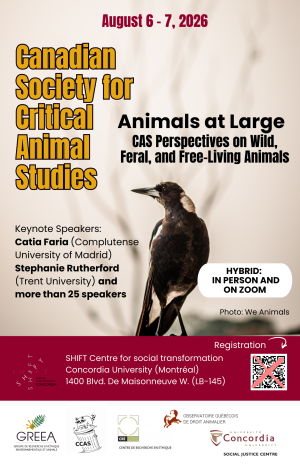
Animals at Large: Critical Animal Studies Perspectives on Wild, Feral, and Free-Living Animals
Ajouter au calendrier
- Quand :
- 5 août 2026 – 7 août 2026 Jour entier
- Où :
-
SHIFT Centre for Social Transformation, Pavillon J.W. McConnell, Concordia University
1400 De Mainsonneuve Ouest, Montréal
Animals at Large: CAS Perspectives on Wild, Feral, and Free-Living Animals est coorganisé par la Canadian Society for Critical Animal Studies, le Centre interuniversitaire de recherche en éthique (CRÉ) le Social Justice Centre à la Concordia University, le Groupe de recherche en éthique animale et environnementale (GRÉEA) et l’Observatoire québécois en droit animalier (OQDA), basé à l’Université de Sherbrooke.
Cet événement est coparrainé par le Groupe de recherche en éthique animale et environnementale (GREEA), l’Observatoire québécois en droit animalier (OQDA) de l’Université de Sherbrooke, le Fonds de recherche Killam, le Kule Institute for Advanced Studies de l’Université de l’Alberta, ainsi que la Faculté des lettres et le Département de criminologie de l’Université métropolitaine de Toronto.
Le colloque se tiendra en mode hybride. Inscrivez-vous ici (gratuit et ouvert à tous.tes).
Programmation :
Mercredi, 5 août
14h30 – 15h45 – Mot de bienvenue et discours d’ouverture : Stephanie Rutherford (Université de Trent), « Canids and Canada: Wolves, Coyotes and Regimes of Violence and Belonging »
16h00 – 17h15 – Séance plénière « Artistes-militants » : Shannon Johnstone (Meredith College), « Photography, Animals, and Activism: Centering Animals Through an Ethics of Sight » ; modératrice : Deborah Hardt (Université de Wollongong à Dubaï)
17h15 – 18h30 – Exposition photographique de Shannon Johnstone et réception
Jeudi, 6 août
9h00 – 10h30 – Attaques d’animaux sauvages
- Emelia Quinn (Université d’Ottawa), « When Animals Attack: The Comedy and Camp of Wild Animal Revenge »
- Susmita Roy (Université de l’Alberta), « Who Produces the ‘Tiger Widow’? Ecology, Patriarchy, and Systemic Marginalization »
- Ian Hanesworth (Université de l’Utah), « Wolf Mothers & Man Things: Agency, Emotionality, and Personhood in Ursula LeGuin’s ‘The Wife’s Story’ »
10h30 – 10h45 – Pause
10h45 – 12h15 – Intimités sauvages : soins et contrôle dans les relations interespèces
- Misha Solomon (Université Concordia), « Goon at Love Park »
- Ishaan Selby (Université Concordia), « ‘Big, Furry, Asymmetrical Balls’: Wildness, Feral Sex, and Ownership in Marian Engel’s Bear »
- Jesse Arsenault (Université Concordia), « The Wildness of Interspecies Desire in South African Literature and Law »
12h15 – 13h15 – Dîner
13h15 – 15h15 – Politique sauvage
- Pablo Castello (Université de Denver), « The Territorial Rights of Wild Animals: Justification »
- Esther Palm (Université de Montréal), « Travail Animal et critique du sauvage en théorie politique »
- Christiane Bailey (Université Concordia), « Renouncing violence and doing politics with wild and liminal animals in Donaldson and Kymlicka’s Animals and the Right to Politics »
- Agata Kowaleska (Université Jagellonne), « Feralizing: Reimagining Future Liberations in Europe »
15h15 – 15h30 – Pause
15h30 – 17h00 –
Vendredi, 7 août
9h00 – 10h15 – Conférence plénière : Catia Faria (Université Complutense de Madrid), « Compassion by Design: Aligning AI with the Welfare of Wild Animals »
10h15 – 10h30 – Pause
10h30 – 12h00 – Analyses des médias
- Mathieu Chaput (Université TÉLUQ) et Jacinthe Dupuis (Université de Montréal), « The Communicative Constitution of Liminal Animals in the ‘Deer Saga’ »
- Briana Magnuson (Université Western) et Tony Weis (Université Western), « HPAI in the Wild: A Critical Analysis of Media Coverage of the Panzootic Crisis »
- Branislava Vičar (Université de Maribor), « The Conservation Discourse of Native Animal Species as Nationalist Narrative: The Case of the Marble Trout »
12h00 – 13h00 – Dîner
13h00 – 14h30 – Chevaux sauvages
- Sabine Sassner (Université du Texas à Dallas), « Movement vs. Behaviour: Visibility and Agency of Equines »
- Lucy Horswill (Université de Falmouth), « From ‘Semi-Wild’ to Surplus: Language and Disposal at British Drift Sales »
- Kelly Struthers Montford (Université métropolitaine de Toronto) et Chloë Taylor (Université de l’Alberta), « Wild Mustang Prison Programs in the American Southwest »
14h30 – 14h45 – Pause
14h45 – 16h15 – À la croisée de l’écologie comportementale et des études critiques sur les animaux : coûts et avantages éthiques de la recherche sur les primates dans des contextes sauvages, en liberté et de réhabilitation
Animatrice : Mikaela Gerwing (Université Concordia)
Intervenant.es : Nève Djevalikian-Couture, Italo Ferreira Perreira, Maya Moghrabi, Viviane Aurora Oliviera et Brogan M. Stewart (tous issus de l’Université Concordia)
16h15 – 16h30 – Pause
16h30 – 18h00 – Refuge et salut
- Sal Renshaw (Université de Nipissing) « Saving By Any Other Name: Sanctuaries, Arks, and the Governance of Animal Lives in the Anthropocene »
- Stephanie Eccles (Université métropolitaine de Toronto), « Farmed Animals in Extreme Weather Events: Disaster Response Pathways and Foreclosures of Wildness »
- Darren Chang (Université de Sydney), « Contesting Wildness: The Farmed Animal Sanctuary as Liminal Contact Zone »