
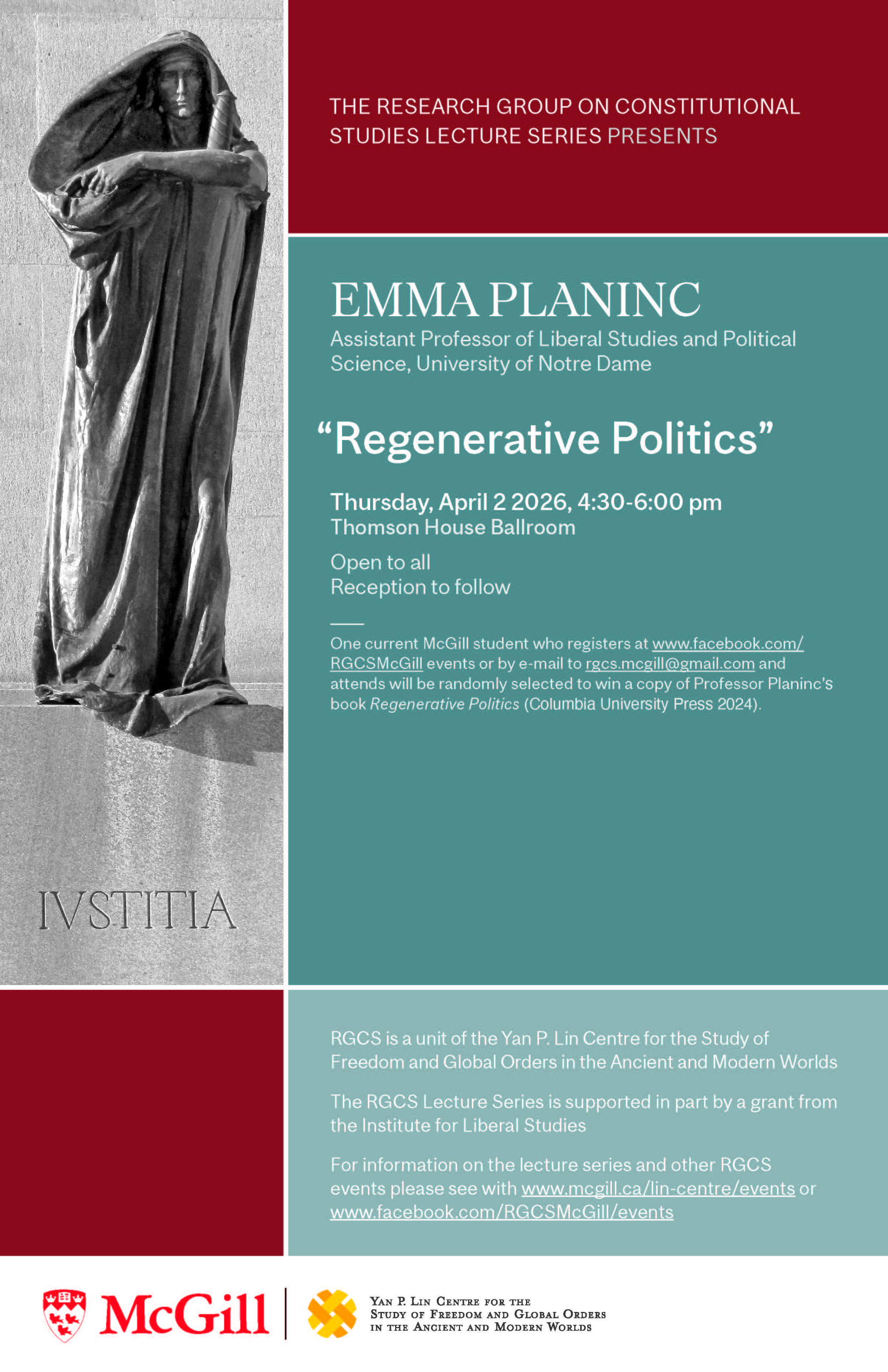
« Regenerative Politics »
Conférence d’Emma Planinc (Maître de conférences en lettres et sciences humaines et en sciences politiques, Université de Notre Dame)
Le jeudi 2 avril 2026, de 16h30 à 18h00, salle de bal Thomson House. Ouvert à tous.tes; une réception suivra.
L’inscription est appréciée, par courriel à l’adresse suivante : rgcs.mcgill@gmail.com ou via Facebook. Un·e étudiant·e de l’Université McGill, tiré·e au sort parmi celles·eux qui se seront inscrit·es et qui assisteront à l’événement, recevra un exemplaire du livre de Planinc, Regenerative Politics (Columbia University Press, 2024).
Organisé par le Groupe de recherche sur les études constitutionnelles (RGCS), une unité du Centre Yan P. Lin pour l’étude de la liberté et des ordres mondiaux dans les mondes ancien et moderne. Le cycle de conférences du RGCS bénéficie en partie d’une subvention de l’Institut d’études libérales.
Résumé de Regenerative Ethics
Critics of liberal democracy from both the left and right view rights not as protectors of freedom but as impediments to self-determination and call for radically regenerative political alternatives. Liberals respond to these challenges by reasserting that universal rights are self-evident, intentionally foreclosing the possibility of remaking the political order. Regenerative Politics makes a bold intervention into this fraught landscape, arguing that the survival of rights depends on abandoning their claims to self-evidence.
Emma Planinc argues that liberal democracies must open themselves up to a regenerative politics that accepts all claims against political convention as self-determinative—including those that desire the rejection of rights or the overturning of liberal democracies themselves. Bringing together scholarship on race, democracy, liberalism, fascism, and the far right with an intellectual history of the Enlightenment and the French Revolution and a novel account of human nature, Regenerative Politics offers a new political theory for the revitalization of politics. Planinc shows that liberal democracies can arm themselves against extreme challenges by remaining perpetually open to the reconstitution of rights, restoring the capacity for human beings to determine themselves in the world.