
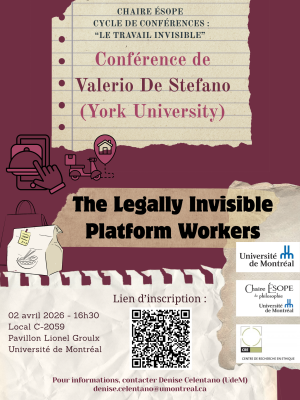
CANCELED! Valerio de Stefano (York University)
Add to calendar
- When:
- 2 April 2026 16 h 30 – 18 h 30
- Where:
-
University of Montreal
Room C-2059, Carrefour des arts et des sciences, 3150 Jean-Brillant Street, Montréal QC
Please, note that this event is canceled.
You are cordially invited to the second conference of the lecture series on invisible labor organized by the Aesop Chair in collaboration with the Centre de recherche en éthique. For this conference, we are pleased to welcome Valerio de Stefano (York University), author of the book Your Boss Is an Algorithm (Bloomsbury Publishing, 2022), with a presentation entitled “The Legally Invisible Platform Workers.”
The event will take place on April 2, 2026, at 4:30 p.m., in room C-2059 of the Lionel Groulx building at the University of Montreal (3150 Jean-Brillant Street, Montreal, QC H3T 1N8). Please register via the following link.
Abstract
Platform workers are increasingly visible in our communities, and their work attracts growing public attention. Yet the law has not fully recognised platform work. Even recent legislation specifically targeting platform work often fails to make it visible and legally salient across the full spectrum of protections. In some cases, it operates as a barrier, placing platform work behind a façade that risks concealing from workers fundamental rights and protections that should belong to all workers. This presentation analyses the legal mechanisms that produce this invisibility and discusses potential solutions to lift the cloak of legal invisibility now affecting platform workers.
The Lecture Series on Invisible Work is an initiative by Denise Celentano (University of Montreal), holder of the Aesop Chair, in collaboration with the Centre de recherche en éthique.
For more information, please contact Denise Celentano at the following address: denise.celentano@umontreal.ca.
General information about the Lecture Series: The concept of invisible work describes the forms of work that fall outside the traditional model of waged employment and are not recognized, in a monetary and/or symbolic sense, to the point that even their nature as “work” is often disputed. Invisible work takes place behind the scenes of more recognized and valued work. Given its liminal nature with respect to long-established categories, it serves as a prism for exploring a number of issues, from recognition to social segregation to the critical questioning of the normative assumptions behind what is supposed to count as “work.” The notion of invisible work promises to shed light, as it were, on the mechanisms of valorization that operate behind social cooperation. This series of lectures, open to the public, explores the subject from both a philosophical and interdisciplinary perspective.